
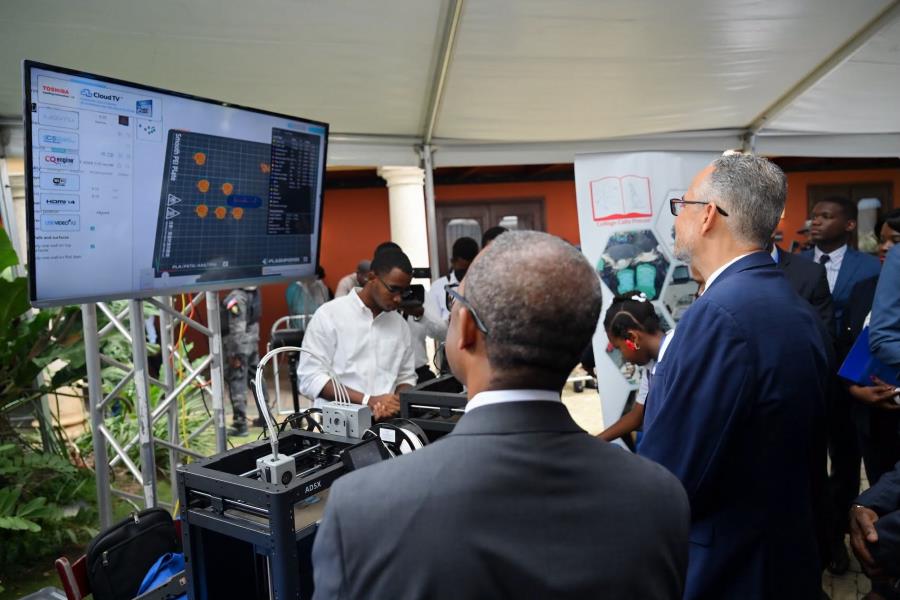
Organized this year around the theme: ‘Research in the service of development: optimizing scientific production and use,’ the second edition of the scientific days, which took place on July 23 and 24 at the Karibe Convention Center, organized by FRD-BRH (BRH Fund for Research and Development), brought together many people from the scientific and academic communities, as well as entrepreneurs from various sectors.
Organized this year around the theme: ‘Research in the service of development: optimizing scientific production and use,’ the second edition of the scientific days, which took place on July 23 and 24 at the Karibe Convention Center, organized by FRD-BRH (BRH Fund for Research and Development), brought together many people from the scientific and academic communities, as well as entrepreneurs from various sectors. This event, created with the goal of utilizing and promoting locally conducted scientific research, paves the way for in-depth reflection on integrating scientific research at the heart of national economic recovery policies.During these scientific days, the participants discovered projects funded by the FRD-BRH that are meant to contribute to development and innovation in the fields of agriculture, health, education, environment, technology, climate change, and mobile payments. The projects were presented through short videos shown on screens set up at the Karibe, where the event took place. Among them are: “Production of a biopesticide to fight coconut pests and aflatoxins in southern Haiti,” with agronomist Junior Aristil; “Nostalgia for traditional knowledge in times of natural disasters in Haiti,” with professor and sociology PhD Jerry Michel; “Application of artificial intelligence to transform Haitian agriculture (AIPAGRI),” with agronomist-engineer Jacky Duvil;”Mapping of the physical and natural resources of the North,” with Widgenia Ulysse, are some of the projects receiving funding from the FRD.Regarding key figures, the BRH Fund for Research and Development has financed, to date, 19 projects and granted an amount of 264 million gourdes to support research in Haiti. 58% of the projects funded by the FRD are carried out by legal entities and 42% by individuals. As of December 31, 2025, four of the projects are already completed. Since its creation, the BRH Fund for Research and Development has received 124 research projects that would require, in terms of cost, a funding envelope of 8.2 billion gourdes. “Each completed project brings new knowledge and paves the way for other innovations,” emphasizes the FRD.In his speech for the occasion, the governor of the Bank of the Republic of Haiti (BRH), Ronald Gabriel, called for the establishment of an ecosystem related to scientific research. “We need to work on promoting a true national ecosystem dedicated to research. We need to create an environment where everyone contributes to scientific thinking activities and where multiple partners pool their resources, expertise, and vision to enhance and encourage this qualitative leap toward development,” said Ronald Gabriel, emphasizing that scientific research is a common good and that, as such, its funding and promotion should gradually become a political responsibility.Speaking at the second edition of the FRD/BRH scientific days, the Rector of the State University of Haiti (UEH), Dieuseul Prédélus, outlined the major challenges regarding research. “The first challenge is research funding. Our public and private universities, including the State University of Haiti, operate with extremely limited research budgets. The second challenge concerns infrastructure and technical capacity, for example: under-equipped laboratories, limited access to scientific databases, and still fragile digital connectivity. The third challenge relates to the absence of a national research policy clearly coordinated between the state, universities, the private sector, and technical and financial partners. Too often, everyone acts in a scattered way without a common framework or defined priorities.”The fourth challenge concerns the effective use of the knowledge produced,” regretted the rector of the UEH, Dieuseul Prédélus.