
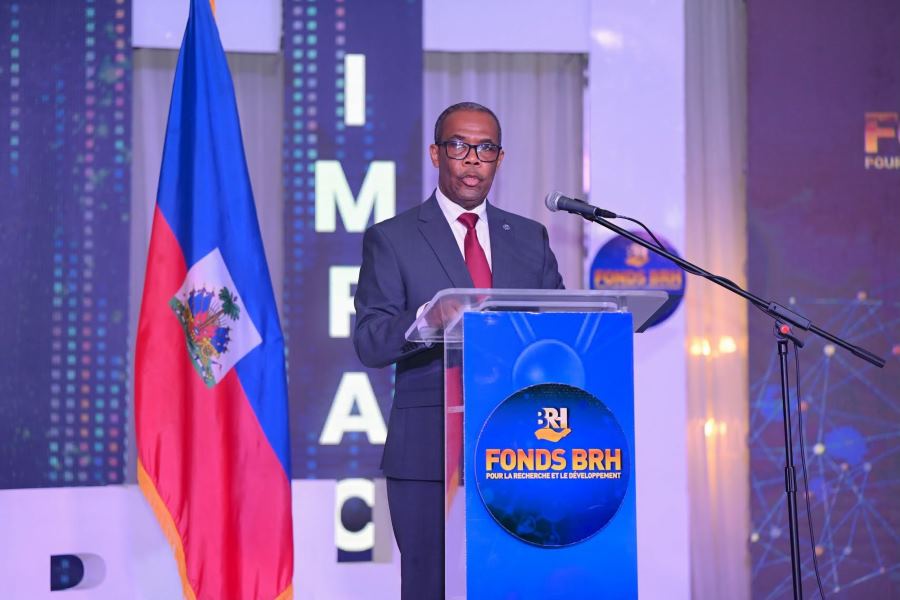
Six years after the creation of the BRH Fund for Research and Development and three years after the first edition of the BRH Fund for Research and Development (FRD-BRH) Scientific Days, Hotel Karibe hosted the second edition of these meetings on research, innovation, and development on Thursday, July 23 and Friday, July 24, in a magical atmosphere.
Six years after the creation of the BRH Fund for Research and Development and three years after the first edition of the BRH Fund for Research and Development (FRD-BRH) Scientific Days, the Karibe Hotel hosted on Thursday, July 23, and Friday, July 24, in a magical atmosphere, the second edition of these meetings on research, innovation, and development. Almost every sector of Haitian national life seemed to have made an appointment at this event, held with a triple goal: to showcase the results of research supported by the FRD-BRH, to encourage dialogue among different players in the scientific world, and to promote research as a driving force for innovation and sustainable development in Haiti.”Research in the service of development: optimizing the production and use of scientific knowledge” – this was the very revealing theme around which the 2nd Edition of the FRD-BRH Scientific Days took place, bringing together a very diverse audience that represented nearly all sectors of national life. Whether it was public administration, the private business sector, representatives of international organizations, entrepreneurs, researchers, academics, or students—including the young prodigies from Educare Haiti and Collège Catts Pressoir—they all took part in this flagship event on July 23 at the Karibe Convention Center, either in person or via video conference through digital platforms set up for the occasion.
To kick off the discussions, Dr. Sergot Jacob, a member of the FRD-BRH Scientific Council, acted as the master of ceremonies. Right from the start, he set the scene for the day’s event by explaining that after a period of interruption due to a difficult situation, the Bank of the Republic of Haiti (BRH), through organizing this 2nd edition of the Scientific Days, aims to put research back at the heart of Haiti’s economic recovery policies. This comes in a context of critical national issues as well as major global changes.For the BRH, according to Professor Jacob, research is the key step to understanding the phenomena at work before being able to propose sustainable solutions. So research is really the go-to tool for shedding light on decision-making processes, both in the public sphere and in the private sector.”It is in this perspective that the creation and implementation of the BRH Research and Development Fund took place six years ago. The goal of these two scientific days is first to inform the scientific and academic communities about the Fund’s activities and the progress of the projects funded by the BRH Fund for development. It also aims to establish a strategic framework to capitalize on and enhance the research work produced locally, especially those funded by BRH funds,” explains the master of ceremonies, who then calls on the first speaker, the governor of the BRH, Ronald Gabriel, to take the floor.Without wasting any time, the Chairman of the BRH Council first wanted to thank the individuals who helped make the 2nd edition possible. Among those praised by the governor are Prime Minister Alix Didier Fils-Aimé, who honored the ceremony with his presence; the Minister of Economy and Finance, Serge Gabriel Collin, whose ministry has been involved in the project from the very beginning, financing the Fund’s activities and sharing responsibilities with the business sector and the University within the Advisory Council; and the Minister of National Education, Vijonet Déméro, who naturally represents an institutional space for disseminating the results of research financed by the FRD.The enchanting atmosphere of the first day of the 2nd edition of the FRD-BRH scientific days stood in stark contrast to the harsh and overwhelming socio-economic situation that has characterized the metropolitan area of Port-au-Prince for the past few years. Faced with such a reality, the governor of the BRH, Ronald Gabriel, couldn’t help but say: “Definitely, despite all odds, the future looks bright, and that can only reassure us.”
Indeed, the budding geniuses from the Catts Pressoir and Educare Haïti schools amazed the audience on the first day by presenting and demonstrating live their achievements in fields as complex as robotics and artificial intelligence.The production of knowledge is at the heart of sustainable development
In an effort to highlight the importance of research and the production of useful knowledge for a country, the governor hinted that the production of knowledge is the core of any development process.
“A country’s sustainable development always starts with the production of knowledge. A nation’s ability to understand its own challenges becomes a factor of sovereignty. In other words, a country that doesn’t produce enough knowledge about its challenges is often forced to import solutions designed by someone else. This reality means that countries that don’t make the effort to have a seat at the table of international exchanges inevitably end up on the menu of those exchanges. So it’s up to us, first and foremost, to make the effort to climb collectively the rungs of the table of exchanges, especially since Haiti’s economic, social, and environmental conditions are unique enough to require solutions developed here by our researchers, universities, and institutions,” said Ronald Gabriel.”It is precisely this belief that led the Bank of the Republic of Haiti to create the BRH Fund for Research and Development,” said Ronald Gabriel, who added in passing, ‘No economic policy can be sustainable when it is not guided by reliable data, rigorous analysis, and quality scientific work. That is why, beyond these traditional responsibilities, the BRH has chosen to invest in a particularly valuable asset: Haiti’s intellectual capital.’
Following the BRH governor at the microphone, the rector of the State University of Haiti, Dieuseul Prédélus, began his speech with a question that touches on the very foundation of our collective relationship to knowledge: ‘What place has been historically given to knowledge in the country’s development strategies?’“The response, if we look at it without sugarcoating, reveals a deep fracture whose roots go back to our colonial and postcolonial history,” analyzes the head of UEH. Born from a revolutionary break with the colonial order, Haiti has never completely broken away from the ways of thinking inherited from that order, believes the rector of UEH. According to him, one of the colonial thought patterns that Haitians still guard jealously is the idea that knowledge is something that comes from elsewhere.On this topic, he explains that during the colonial period, legitimate knowledge was that of the metropolis, because the colony produced material wealth, not knowledge. The white person knew, while the slave and the freed person executed. This form of hierarchy was broken politically with the declaration of independence. But it left a lasting mark on our perceptions, that of knowledge imported, validated elsewhere, or produced internationally.
Breaking with this legacy doesn’t mean turning away from international scientific cooperation, which, according to Mr. Prédélus, remains valuable, necessary, even essential for Haitian researchers. Rather, it’s about flipping the priority order to make knowledge produced in Haiti by Haitians, based on Haitian realities, the starting point for public action, not just its possible supplement.This is the primary condition for true sovereignty, which isn’t just about territory and political institutions but also includes a people’s ability to think about their own development. Today, this historical issue is coupled with very real structural challenges.
The rector listed six structural challenges, including research funding; infrastructure and technical capabilities with serious operational shortfalls; and the lack of a national research policy clearly coordinated between the state, universities, the private sector, and technical and financial partners.Facing these challenges, Professor Dieuseul Prédélus advocates for a knowledge-based economy. As he emphasizes, ‘In a world where the wealth of nations is measured less and less by merely having natural resources, and more and more by the ability to innovate, train skills, and produce ideas, Haiti has an essential card to play: its intellectual capital.’Among the structural challenges, Dr. Prédélus first lists the issue of research funding. Haitian public universities (like private ones) operate with extremely limited research budgets. The second structural challenge concerns infrastructure and technical capacities, with serious operational deficits such as under-equipped labs, limited access to scientific databases—which is very important for research—and still fragile digital connectivity within faculties. The third challenge is the absence of a national research policy clearly coordinated between the government, universities, the private sector, and technical and financial partners. Too often, everyone acts independently without a common framework of priorities, leading to scattered efforts and a low critical mass in areas that are actually strategic for the country.The 4th challenge is the effective use of the knowledge produced. At the State University of Haiti, as in private universities and research centers, we have high-quality work on essential issues for the country’s development. Too often, this work goes unused, due to the lack of an established system for transferring it into public policy. There’s also a lack of a shared culture of decision-making based on scientific evidence rather than on immediate pressures.
In the face of these challenges, Professor Dieuseul Prédélus emphasized the importance of a knowledge-based economy. In a world where the wealth of nations is less and less measured by simply owning natural resources, and more and more by the ability to innovate, develop skills, and generate ideas, Haiti has a crucial card to play: its intellectual capital.The Minister of National Education and Vocational Training, Vijonet Déméro
The Minister of National Education and Vocational Training, Vijonet Déméro, a passionate advocate for knowledge, believes that the theme of the 2nd Edition of the FRD-BRH Scientific Days, titled ‘Research at the Service of Development: Optimizing the Production and Use of Scientific Knowledge,’ goes beyond mere ceremonial recognition. ‘It challenges us at the very heart of our actions and future project and questions the trajectory of our society,’ says the minister.
Mr. Déméro drew his faith in knowledge from ‘The History of Economic Thought and Development.’ This document teaches us that no nation has successfully transitioned to lasting prosperity without grounding its governance in the epistemology of knowledge, methodological rigor, and a culture of innovation.Now, given the many challenges Haiti faces, such as macroeconomic issues, social precarity, environmental constraints, and climate hazards, Haitians can’t keep relying on trial and error as public policy. According to the Minister of National Education, the state’s response to these challenges must be scientific, structured, and rigorously backed by empirical and solid data.Taking advantage of his speech at the launch of the 2nd edition of the Scientific Days at Karibe, Vijonet Demero made a heartfelt appeal to all his fellow policymakers and economic leaders, saying: “It’s time to fully embrace a culture of evidence. We need to make the results of our research the essential guide for shaping, implementing, and evaluating public policies. Deciding without science is like navigating blindly. Deciding with science is building the future on solid rock.”It was an opportunity for the education minister to send a string of requests to the BRH Board of Directors, first by inviting them to expand and strengthen their financial support for accredited doctoral schools operating in the country. Then, to maximize the impact of its strategic investments, the MENFP head invited the BRH to establish a close and institutionalized collaboration with the National Agency for Higher Education and Scientific Research, as well as with the Haitian Conference of Rectors of public departmental universities and with the State University of Haiti.The Minister of Economy and Finance, Serge Gabriel Collin, who also spoke at the 2nd Edition of the FRD-BRH Scientific Days, had nothing but praise for the Central Bank for the masterful organization of this initiative, whose outcomes will be positive. Indeed, these two days, according to the nation’s top financier, will allow us to gather study conclusions, important recommendations, and suggestions that will inform public actions through sectoral entities while also strengthening private business initiatives regarding investments to be made based on Haiti’s economic potential.
The Minister of Economy and Finance, Serge Gabriel Collin
According to Minister Serge Gabriel, Haitians still need to make more efforts in the field of research, because economically, the country is on its knees. Nowadays, you can’t talk about development or economic dynamism without thinking about innovation.
With the 124 projects received since its launch, the FRD-BRH clearly shows the scientific community’s interest in the major national issues. Also, this number makes us believe that the ideas are there and that the quality of researchers in Haiti is up to standard. What we especially lack are sufficiently broad and sustainable mechanisms to finance, support, and make use of the results of the research conducted by our scientists.Given our economic situation, we have an obligation as public decision-makers to invest in research or at least to encourage Haiti’s partners to fund the modernization of the state apparatus, to fund the university, education, and scientific research. A prosperous Haiti cannot rebuild itself without significant investments.
A major move by the BRH, according to Alix Didier Fils-Aimé
Prime Minister Alix Didier Fils-Aimé highlighted research, innovation, and knowledge in his speech. “The nations that build their future are the ones that take the path of knowledge, innovation, and excellence. By launching the 2nd edition of the FRD-BRH scientific days, we reaffirm our deep belief that scientific research must be at the heart of our choices. At the heart of our strategic decisions and our actions for development,” said the head of government, who spoke very highly of the BRH leaders.”By creating this space for reflection, dialogue, and excellence, the BRH is making a major move, showing that the future is built with knowledge, rigor, and innovation.”
“For Haiti, producing and using scientific knowledge isn’t just an option; it’s a must to better understand our challenges, guide our public policies, and build sustainable, Haitian solutions.”The head of the prime minister’s office encourages Haitians not to get discouraged and to look to the future with confidence and hope. ‘Beyond the challenges, we must look to the future with confidence. Haiti has an invaluable wealth—its people, its youth, and its talents. This scientific gathering is a shining proof of that. It shows a nation that is moving forward, innovating, and has chosen knowledge as a driver for economic and social progress.’”By supporting science, valuing research, and encouraging innovation, we are building the foundations of a more resilient and prosperous Haiti. I warmly congratulate the beneficiary researchers for their work that provides concrete solutions for the country and future generations. I wish these scientific days every success and renew my gratitude to the BRH Fund and all the partners of this great collective adventure. Together, in solidarity and regained stability, we will tackle the challenges of our time. Long live the BRH Fund for research and development! Long live democracy and the unity of the Haitian people,” concluded the Prime Minister.