
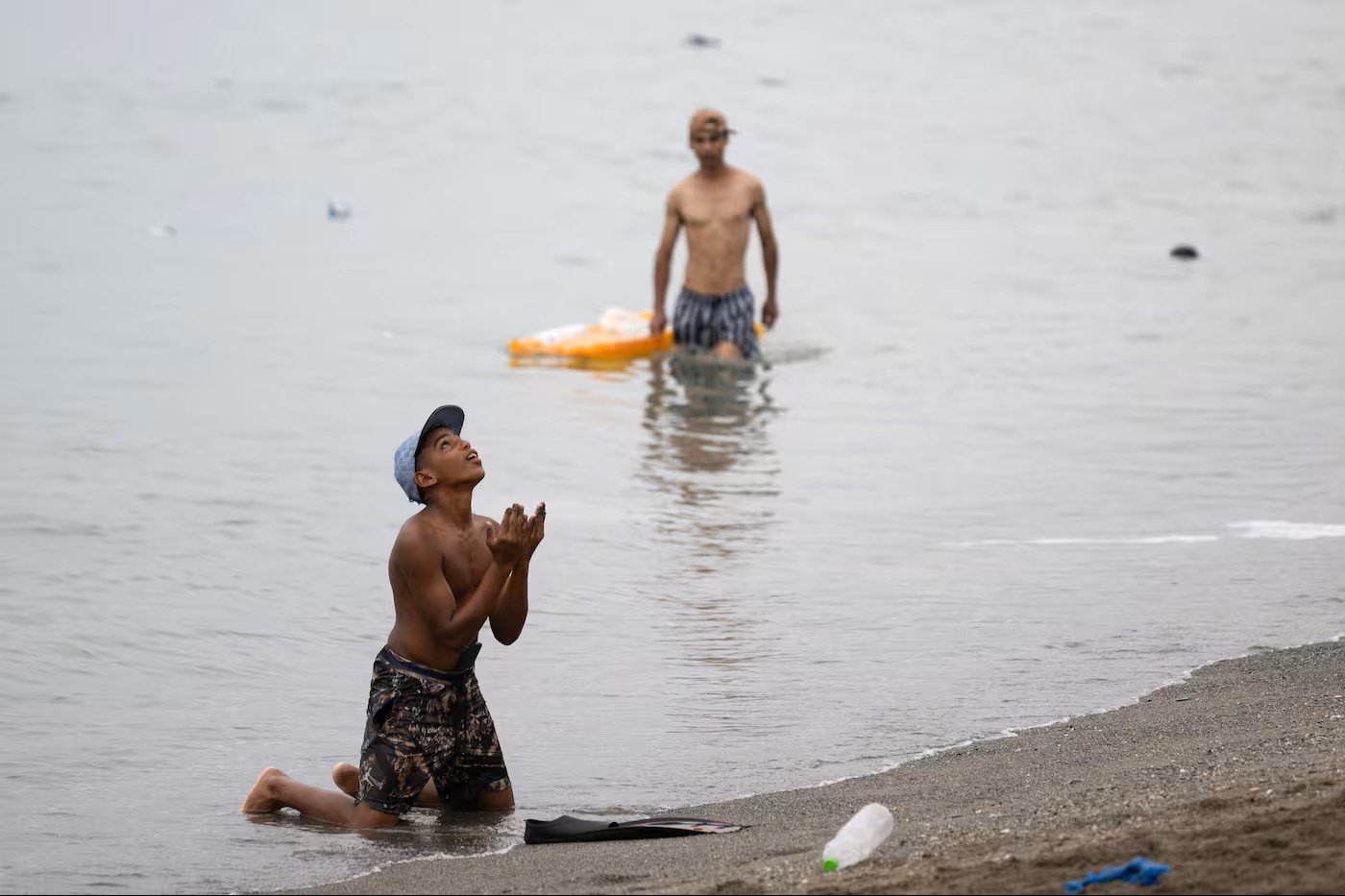
By Ismail BELLAOUALI and Hicham RAFIH in Fnideq with Françoise KADRI in Tunis A ‘shattered dream,’ among the thousands of candidates for emigration, mostly Moroccans, sent back from Ceuta after illegally crossing the border between the Moroccan city of Fnideq and the Spanish enclave, many return discouraged and advise against such an adventure.
By Ismail BELLAOUALI and Hicham RAFIH in Fnideq with Françoise KADRI in Tunis
A “broken dream,” among the thousands of candidates for emigration, mostly Moroccans, sent back from Ceuta after illegally crossing the border between the Moroccan town of Fnideq and the Spanish enclave, many return disheartened and advise against such an adventure.
Met by an AFP team on Saturday morning, Mohamed Nias, 23, barefoot and still out of breath, says he crossed into the enclave by sea, “since I can swim well.”
In Ceuta, he says he only experienced “suffering and racism.” “I haven’t eaten since Thursday, even though in fact, I live with dignity in my country,” reflects this seller at a fruit and vegetable store in Tangier, the metropolis 70 km away.To other potential candidates for exile, the one who had already tried his luck in 2021 says: ‘Never go there, you’ll just suffer.’
On Saturday, the Moroccan authorities continued a bus evacuation, which had started the night before, to send back those turned away from Ceuta to their home country.”Nothing better than Morocco” –
Like hundreds of others, Mohamed Nias left his job in a hurry on Thursday when he “heard that the border at Ceuta was open.” A rumor amplified by social media and images showing hundreds of young people making the victory V upon their arrival.
Youssef, a 27-year-old lifeguard, turned away from Ceuta, thinks that “in the end, there’s nothing better than Morocco,” after his “bad experience” on the other side.
The residents of Ceuta were “racist, I went two days without eating, they closed all the shops to starve us,” he says, while a small crowd chants: “Long live Morocco, long live the king.”
According to testimonies collected by AFP, the thousands of people who flocked to Fnideq, a town of 70,000 inhabitants, were not stopped by the authorities on their journey to Ceuta.Experts on the Moroccan security apparatus are wondering why there were no police or military reinforcements while migrants were flooding the area since the beginning of the week.
“There were normal gendarmerie checkpoints on the roads but no exceptional deployment,” a source close to the evacuation operations told AFP, saying they “could not stop crowds that big.”
Accompanied by a friend driving a “goods truck,” Mohamed Nias even passed the checks without any trouble.
Once in Ceuta, they were intercepted at sea by the Spanish civil guard and then managed to escape, he says. Wandering around this city of 80,000 people where many shops were closed, he says he and his friend faced the anger of locals, overwhelmed by the arrival of 60,000 people in just a few days.”They mistreated us, some chased us with sticks, they were racist, I spent the night in a forest, it was hell,” he said.
Sadi Tribak, a 38-year-old craftsman from Tangier, rushed to Fnideq by car with his children as soon as he heard the rumor. When he found out that ‘people were crossing by swimming,’ he ‘took his kids back home’ and went back to jump into the water alone.”Better future”? –
“I was disappointed. I thought they would welcome us well (in Spain) but there was nothing to eat and they didn’t even accept card payments,” recalls this man who has a job, but wanted to “go work there” to “give a better future” to his children.
Morocco is experiencing an economic boom—nearly 5% growth in 2025—but strong inequalities still persist.
Many emigrants were very young, like Ayoub El Abied, a 16-year-old high school student, a “good student” who mistakenly thought that Spain wouldn’t turn away minors.
In his eyes, Spain not only offers “papers for (irregular) migrants but also freedom” and the chance to escape unemployment, in a country where it still exceeds 13%.Originally from Rabat, 3 hours and 30 minutes from Fnideq, Abdelouahed Fetachi, 20, also found himself without food in Ceuta. “I wouldn’t recommend anyone to go there. We had a dream, but they shattered it,” says this carpenter, who will resume work on Monday.
Many like Rachid Aouchari, 32, who left because he didn’t have a stable job, are relieved to go back: “I just want to be with my kids again.”