
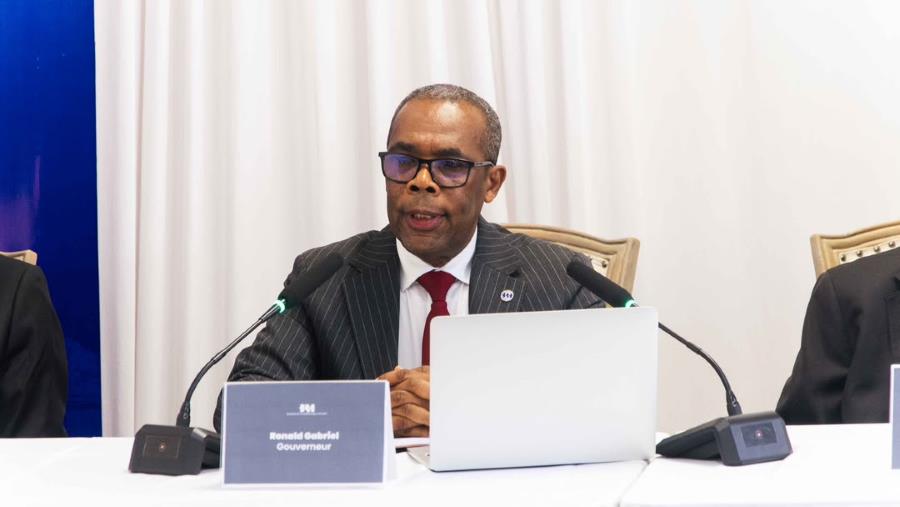
Monetary policy and economic and financial outlooks were on the agenda of the BRH Board of Directors’ meeting with the press on Tuesday, July 21, 2026.
Monetary policy and economic and financial outlooks were on the agenda at the BRH Board of Directors’ meeting with the press on Tuesday, July 21, 2026. No matter how much goodwill and motivation Haitian officials have, economic growth will always require an improvement in the country’s security conditions. As for the monetary policy implemented by the BRH, for now it is tight and focused on a tricky balance between fighting inflation and creating conditions favorable to growth, says the governor of the BRH.Looking at Haiti’s economic and financial outlook just a few weeks before the end of the current fiscal year, the Board of Directors of the BRH believes that, no matter the projections or the public policies put in place to support the economy financially, the expected results will always be dependent on the uncertainties of the situation and the very restrictive security environment in the Port-au-Prince metropolitan area.
“It is highly unlikely that profitable investments are possible in such an environment,” said BRH Governor Ronald Gabriel, adding that even with very favorable credit conditions, it is very difficult for economic agents to decide to invest, especially in sectors where operational areas are exposed to extremely high risks.Besides, that’s what explains why the Haitian financial sector experiences a high level of non-performing assets, the governor explains. According to him, this level of non-performing assets is linked to the fact that some businesses, in relation to the financial system, are located in challenging areas like the communes of Croix des Bouquets, Carrefour, etc.
“Everything we can do in terms of anticipating the results of the policies to implement will be conditioned by the evolution of the security situation,” says the head of the BRH Council.
A tight monetary policy
Regarding monetary policy, the BRH Board of Directors, through its governor Ronald Gabriel, advises that, until further notice, the Bank of banks will maintain a tight monetary policy aimed at a difficult balancing act between fighting inflation and creating conditions favorable to economic growth.
Economic agents, analysts, and economists keep wondering: How is it that in such an unusual way, the central bank keeps its interest rate unchanged while the country is facing a fairly restrictive inflation rate of about 20%?In response to this question, the governor says:
“For the BRH, we believe that the inflation we’re currently experiencing is monetary in nature. So far, there hasn’t been a monetary expansion that could justify changing the interest rate to counter negative effects coming from any monetary expansion. In fact, inflationary pressures mainly come from supply shocks caused by disruptions in supply chains, which prevent economic agents from moving from one part of the country to another. This directly affects relative prices and leads to higher inflation.”“Monetary measures to counter this inflation would not only risk missing the mark but could also make the situation worse for indebted companies, because whenever the BRH adjusts its key interest rate, financial and banking institutions make automatic and more than proportional adjustments to the interest rate. This explains why the central bank remains cautious by keeping the key rates unchanged.”
As for the disinflation process in the Haitian economy that has been underway for a few months, the BRH Council, through its governor, is committed to continuing this process, but at a slower pace. “However, according to Ronald Gabriel, such a commitment depends on the assumption that the US-Iran conflict doesn’t lead to a rise in oil prices, which could impact domestic prices.”