
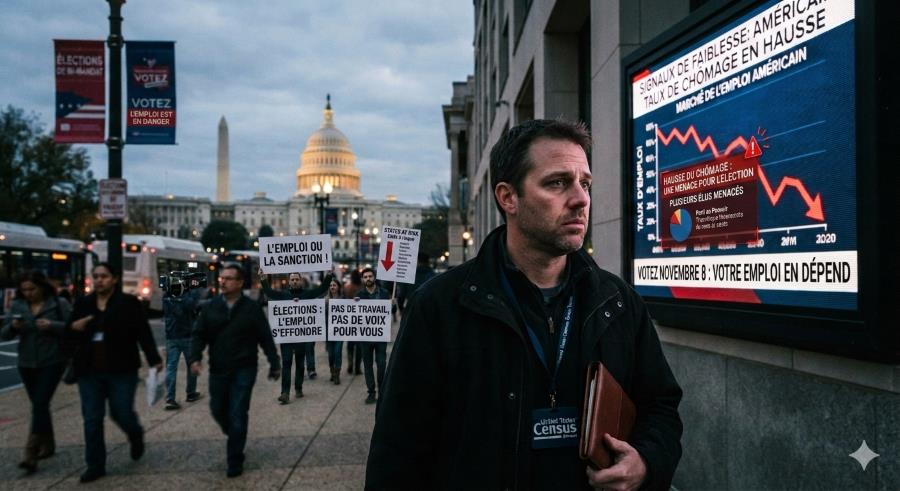
By Erwan LUCAS The job market in the United States showed signs of slowing down in July, bad news for American President Donald Trump as purchasing power remains the main concern for Americans just a few months before the midterm elections.
By Erwan LUCAS
The U.S. job market showed signs of slowing down in July, which is bad news for President Donald Trump as purchasing power remains the main concern for Americans just a few months before the midterm elections.
In July, the U.S. job market lost 23,000 jobs, even though analysts were expecting a modest increase of around 83,000 jobs for the period, according to the consensus published by MarketWatch.The previous months also saw a big downward revision: the Labor Department’s statistical service (BLS) actually removed 103,000 jobs from the period compared to initial estimates. In the end, only 83,000 jobs were added over the two months.
But at the same time, the unemployment rate, which investors expected to stay steady at 4.2%, fell to 4.1%.
Two seemingly contradictory trends that, nonetheless, can be explained by a third piece of data: the labor force participation rate.
This ratio takes into account the number of people participating in the labor market compared to the number of people of working age. And it has dropped by 0.7 points since the start of the year.This represents several hundred thousand working-age people who are no longer part of the job market, either because they are taking some form of early retirement or simply because they have excluded themselves from the labor market or have been excluded.
“The size of the gap” between expectations and the reality of the job market shows “that it could be losing momentum and can no longer be considered a sign of strength,” said Charlie Ripley, head of investment strategy at Allianz Investment Management, in a comment.
In total, 6.9 million Americans are unemployed, including 1.8 million who are considered long-term unemployed (27 weeks or more).
Worrying signal for the Fed
Job losses are mainly affecting sectors like local public education, small businesses, and, to a lesser extent, financial services.
On the other hand, the healthcare sector, which has been the main source of jobs in the United States for many months, has kept going but at a slightly slower pace compared to previous months.
As for the manufacturing and raw materials sectors, which are the ones Donald Trump has focused on, they have hardly seen any change, whether in mining or oil and gas extraction, construction, or industry.
Yet, the main economic advisor to the US president, Kevin Hassett, said on Fox News that “if we set aside [temporary jobs related to] the World Cup and local public jobs, [they would have] an increase of 100,000 jobs.”The sectors that were strong remain so, construction, industry, etc.,” he added.
Industrial employment increased by 16,000 jobs between May and July, and construction added 3,000 jobs over the same period.
The consequence of these employment statistics is that “this should lower expectations for a Federal Reserve rate hike in the coming months,” said Nationwide’s chief economist, Kathy Bostjancic, in a note.
The Federal Reserve (Fed) kept its rates unchanged at its last meeting in July, holding them in a range between 3.50% and 3.75%, despite persistent inflation in the United States.But, as a sign of tensions within its monetary policy committee (FOMC), three members spoke out in favor of a rate hike, judging that it had been far too long since inflation came close to the Fed’s 2% target.
The Fed has a dual mission: keeping price increases at a moderate level and full employment; the fact that the job market has remained strong so far has allowed it to focus primarily on inflation when making its monetary policy decisions.