
The blue economy, which relies on aquatic and coastal resources to create economic growth, generates nearly 2,500 billion USD globally each year.
The blue economy, which relies on aquatic and coastal resources to create economic growth, generates nearly 2.5 trillion USD globally each year. That’s the equivalent of the world’s seventh-largest economy. Covering a wide range of sectors, from fishing and aquaculture to coastal infrastructure, maritime transport, and tourism, it holds economic potential that is still largely untapped.
But a sustainable blue economy can also provide a powerful boost to resilience, especially in small island developing states (SIDS). Well-designed investments in the blue economy can help diversify livelihoods, strengthen local food systems, and support the sustainable management of coastal and marine ecosystems that help mitigate the effects of climate shocks.That’s why 23% of projects supported by IFAD include fishing and aquaculture activities, with $2.1 billion invested since 2010. IFAD’s investments help stabilize incomes, reduce the damage from climate change, and promote sustainable growth.
In Haiti, an IFAD-funded project offers valuable lessons. Launched in 2022 as IFAD’s first investment in the blue economy in Latin America and the Caribbean, the Inclusive Blue Economy Project (or I-BE, its acronym in English), with $26.6 million and implemented by the Ministry of Economy and Finance, shows that strengthening the blue economy allows coastal rural communities to support growth, even in the most fragile contexts.
A Strategic Lever for Resilience
Many obstacles hinder the economic development of Haiti’s coastal communities because persistent insecurity and political instability disrupt value chains, increase market access costs, and push many people to leave. At the same time, these areas are also among the most exposed in the world to the effects of climate change.
In this fragile context, strengthening long-term resilience is essential. The I-BE project shows that investing in the blue economy can be a solution. On the country’s northern coast, IFAD is funding essential rural infrastructure as well as the revitalization of local industries to improve the resilience of communities, food security, and self-sufficiency.As economic opportunities open up, the project is also changing the way coastal rural communities manage marine resources, so that they can continue to support livelihoods in the years to come. For example, I-BE is currently installing fish aggregation devices at sea that reduce fishing pressure on already overfished coastal coral reefs. This way, local fishers can increase their catches and incomes in a sustainable way.In the small coastal community of Jacquezil, the locals work together to restore the mangroves with the support of the I-BE project. These ecosystems act as natural barriers against rising sea levels, helping to prevent coastal erosion and reduce the risk of flooding. By providing breeding grounds for marine wildlife, they also support local fishing communities. So far, six mangrove nurseries covering a total area of about 1,500 m² have been established, with an estimated production of 117,000 seedlings.
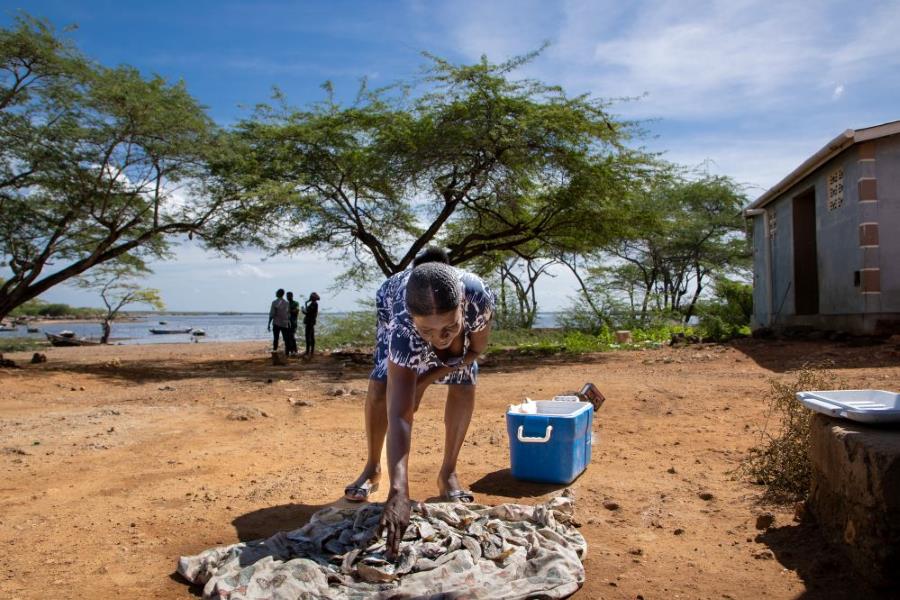
Guilène, 58, and mother of ten children, hopes to grow her business and continue to secure her family’s future. © IFAD/Galvany Nicolas
From Fish Sellers to Entrepreneurs
On the shores of Fort-Liberté Bay, the I-BE program helps small fish sellers turn their work from just a way to make a living into a small, profitable business capable of handling all kinds of challenges. Many of them had been working in the trade for decades without having the tools needed to turn this informal work into a viable business.
At the start of 2026, nearly 200 fish sellers took the leap thanks to an intensive training program covering small business management, sales techniques, and hygiene and product preservation standards. Building on their long practical experience, the project trained them to make smarter economic decisions.Whereas they used to work in precarious conditions and struggled to keep the fish fresh long enough to reach buyers, they are now ready to run small businesses that are set to grow and can access organized markets. Local vendors no longer see themselves as mere small shopkeepers, but as entrepreneurs building a more prosperous future.
These vendors are among more than 23,000 people who have benefited from I-BE project activities since its launch. That number is expected to nearly quintuple by 2028. As Haiti continues to face economic uncertainty, climate shocks, and insecurity, the project shows how the blue economy can help build more resilient coastal communities.
Thanks to the training received, Nixon now manages his business better and has mastered product preservation techniques.