
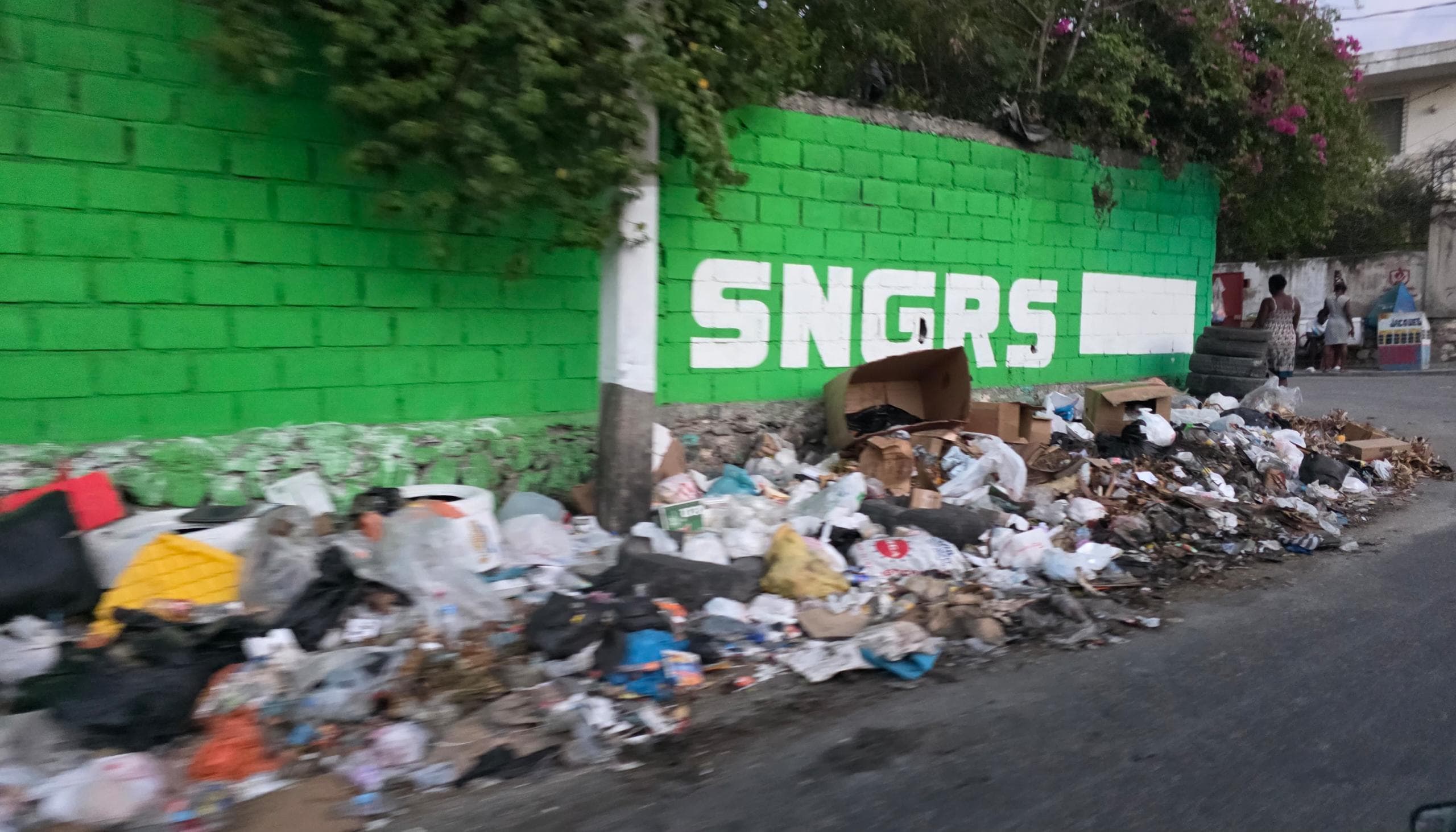
Responsible for sanitation, each at their level, the Ministry of Public Works, Transport and Communications (MTPTC), the Ministry of Environment (MdE), and the National Solid Waste Management Service (SNGRS) all seem to be nowhere to be found.
Responsible for sanitation, each at their own level, the Ministry of Public Works, Transport and Communications (MTPTC), the Ministry of the Environment (MdE), and the National Solid Waste Management Service (SNGRS) seem to be nowhere to be found.
In the streets of the metropolitan area of Port-au-Prince, from Delmas to Pétion-Ville, sites that used to serve as open-air dumps are now cleaned and repainted. These places, once crowned with heaps of all kinds of trash, are now painted green and white. On the walls, there are tags like ‘SNGRS,’ ‘MdE,’ ‘Konbit Haïti zero waste,’ or warnings of a 25,000 gourde fine for those who persist in throwing waste on these sites.These decisions, which are more like a drop in the bucket, aren’t enough to permanently get rid of trash on roads and sidewalks. When it’s not piling up in the places that are cleaned and repainted, the garbage is thrown onto other sidewalks, other streets, and sometimes in several scattered heaps. Some end up in ravines or canals, where they get burned at all hours of the day and night.During a tour of several streets in the Port-au-Prince metropolitan area on Monday, July 10, 2026, Le Nouvelliste noticed the presence of several piles of garbage that had not been collected. While authorities are focusing entirely on discouraging residents from throwing their trash in the streets, no alternatives are being offered to encourage environmentally responsible waste management. Only the Port-au-Prince city hall has taken the initiative to install garbage bins to make waste collection easier.
The newspaper tried, without success, to reach the ministers responsible for sanitation and the director of the SNGRS to ask about their plans to address the waste management problem. Le Nouvelliste referred to their recent statements in the press to find out what they intend to do.During a visit to Le Nouvelliste last April, the Minister of the Environment mentioned the ‘Konbit Haiti Zero Waste’ project, an initiative aimed at providing a sustainable solution to waste management issues. Designed in two phases, the project will first focus on an ‘urban sanitation program involving municipal roads.’ The second phase is expected to lead to a reform of the SNGRS, intended to improve its efficiency and ability to address governance challenges.
There had also been talk of strengthening equipment capacity, with the minister noting that about 75% of the existing equipment was currently out of order or needed to be decommissioned.
Referring to the situation of the SNGRS, the minister pointed out that its ‘health is very critical.’
‘It’s a patient who is very sick and needs assistance. We need to give it a much stronger operational capacity,’ he said.
After this assessment, the measures to save the ‘patient’ were never presented.For his part, the director of the SNGRS, Daril Balthazar, had expressed his ambition to enforce the environmental principle of ‘the polluter pays.’ ‘Companies that pollute have to pay. Manufacturers and distributors of plastic products have to pay,’ he had promised.
Later in his inauguration speech, Mr. Balthazar announced the development, across the national territory, of controlled landfills and technical storage centers for the recovery and processing of household waste. In the long run, these sites are expected to become key parts of the circular economy in producing biogas, charcoal, and electricity, he said.To date, no follow-up has been announced by the director of the SNGRS on these files. Regarding the announced restructuring, on July 16, an evaluation and restructuring commission of the SNGRS submitted its report to the Director General. The content of this report has not been made public, nor have the actions taken based on it.
In the metropolitan region, for years, only the Truitier landfill in the commune of Cité Soleil has been operational. At times, due to gang activity, the site can be inaccessible for weeks. The opening of spaces that could serve as temporary landfill sites has been mentioned by the Minister of the Environment. So far, the opening of these centers has not been officially announced.The MTPTC, for its part, is responsible for building roads and cleaning canals. Every now and then, the MTPTC makes announcements about road construction or rehabilitation, but almost nothing has been done when it comes to canal cleaning.
The canals are left abandoned, and for the few canals that have had some work done, the results haven’t been shared.

