
Conflicts in the Middle East and Ukraine are now hitting several key shipping routes at the same time.
Conflicts in the Middle East and Ukraine are now hitting several key maritime trade routes at the same time. On Monday, the UN chief warned about their ripple effects on energy, fertilizer, and food prices, and suggested a mechanism to secure the passage of essential goods through the Strait of Hormuz.Wars no longer just cause ports to close or threaten ships. They’re starting to squeeze the main arteries of global trade at the same time. From the Strait of Hormuz to the Black Sea, through the Red Sea and the Gulf of Aden, António Guterres warned on Monday about a convergence of conflicts whose effects are felt far beyond the battlefields.
“These crises are choking the arteries of global trade and putting the world food system under particularly strong pressure,” said the UN Secretary-General to the press in New York. And, he added, there’s now a tangible consequence: “higher prices, worsening hunger, lower harvests, and increased difficulties, especially for the most vulnerable populations in the world.”
The observation comes as maritime traffic in the Strait of Hormuz, through which a crucial portion of the world’s hydrocarbons passes, remains extremely low. According to data reported in the press on Monday, only four ships carrying raw materials passed through on Sunday and 13 on Saturday. Over the past week, traffic detected by ship identification systems was still about 90% lower than its level before the conflict between the United States and Iran.
Tensions increased further on Monday with Tehran’s announcement that 45 tankers had been added to a blacklist for alleged violations of Iranian transit rules. According to the country’s authorities, they now face fines, or even the detention or confiscation of their cargo.Straits Turned into Weapons of War
The battle over Hormuz, which connects the Persian Gulf to the Gulf of Oman, has become one of the focal points of the conflict. Negotiations led by Oman to try to restore navigation haven’t managed to break the deadlock. Last week, U.S. President Donald Trump told the press that no new talks with Tehran were planned, while insisting that the strait was “open and operational.” Iran, on the other hand, says that the passage won’t be fully reopened until Washington meets its demands.For António Guterres, freedom of navigation should not become a bargaining chip. “The rights and freedoms of navigation are not abstract principles. They fall under international law,” he emphasized, calling for the protection of civilian ships and sailors and an end to attacks on commercial shipping. “Maritime chokepoints must never become instruments of coercion. And global food supplies should never become collateral damage of conflicts.”
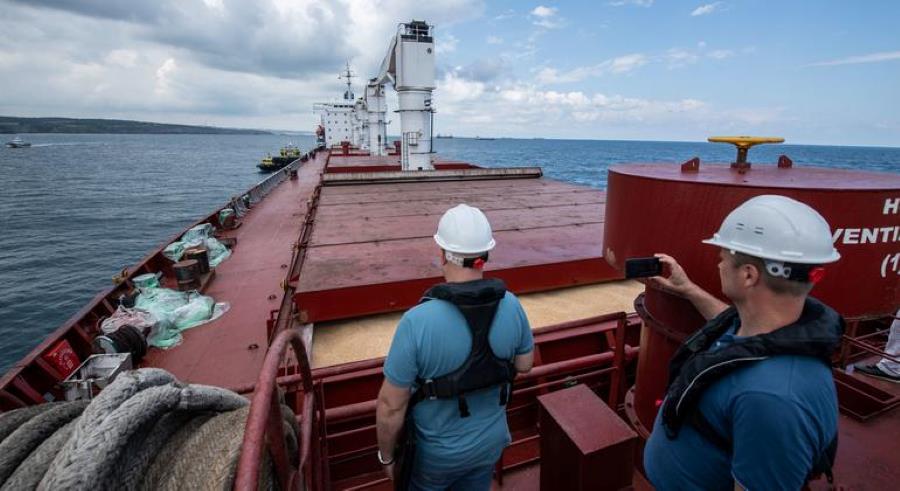
Because the threat now stretches from one sea route to another. At Bab el-Mandeb, a strategic passage between the Red Sea and the Gulf of Aden, attacks on shipping have also disrupted a vital route between Asia and Europe. For the UN chief, Hormuz, Bab el-Mandeb, and the Black Sea outline a global trade network where several key passages are simultaneously caught up in conflicts.A ship carrying Ukrainian grains through the Black Sea.
The Black Sea, the second food front
Thousands of kilometers away, the war in Ukraine is posing another threat to global food supplies. In recent weeks, attacks on ports, ships, and export infrastructure in the Black Sea have disrupted shipments from two agricultural heavyweights, Russia and Ukraine.
The wheat trade is already feeling the impact. Prices in Chicago have risen by more than 17% since the beginning of July, while dozens of shipments have been delayed or canceled right in the middle of export season. Countries that rely heavily on Black Sea grains are the most exposed. Egypt, the world’s largest wheat importer, sourced over 82% of its supply from Russia and Ukraine in the first half of the year.On Monday, Ukrainian President Volodymyr Zelensky said that Moscow was “not ready” to agree to halt attacks on ships carrying agricultural products in the Black Sea, with Russia wanting to include in any potential deal Ukrainian strikes on its refineries and energy infrastructure. Moscow, for its part, assures that it is taking measures to safeguard its grain exports.
A new mechanism for the Strait of Hormuz
This buildup is what the UN is now trying to stop. On Monday, Mr. Guterres outlined a mechanism that a team has been working on since March, involving, among others, the United Nations Conference on Trade and Development (UNCTAD), the International Maritime Organization (IMO), and the International Chamber of Commerce.The plan, initially focused on fertilizers and the raw materials needed to make them, would make the UN a neutral middleman: shipments would be identified and checked beforehand to make their passage through Hormuz more organized and predictable. However, it wouldn’t create any right of passage or change countries’ obligations under international law, with sovereign decisions still in the hands of the participating nations.
Beyond the flow of goods, the UN hopes this limited cooperation will rebuild enough trust between the parties to encourage de-escalation and diplomacy. The plan could be rolled out quickly, Guterres says, but it’s still missing the key ingredient: ‘the cooperation and political will of the parties.’This mechanism, the secretary-general admitted, won’t replace the full restoration of freedom of navigation or the political resolution of conflicts. Its more modest aim is to prevent several wars, by converging on the sea routes, from eventually sending their bill to the countries that are the farthest away – and least able to pay it.

