
The Haitian Institute of Training and Services S.
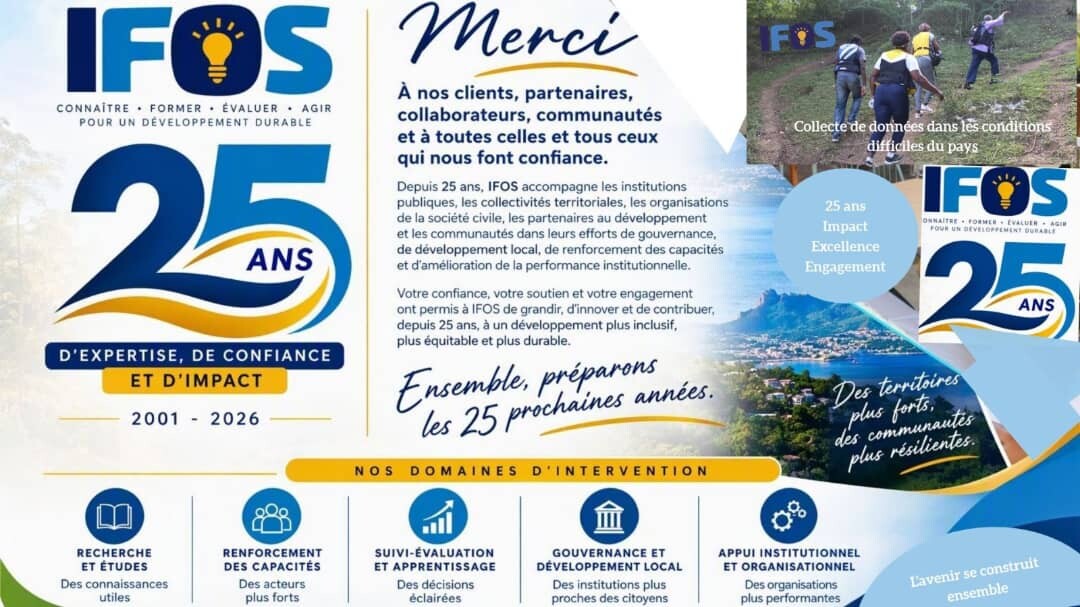
The Haitian Institute of Training and Services S.A. (IFOS) just celebrated 25 years of existence on October 21, 2026. A quarter of a century in such a fragile and turbulent environment as Haiti represents a heroic journey for this institution, created in 2001 by Ulrick Jean Claude, who holds a PhD and is a certified PMP, as well as being a professional trainer and facilitator. Le Nouvelliste met with him, and he spoke about the celebration of IFOS’s 25th anniversary and also traced the path of this institution, which is immediately recognized as a key player in development planning in Haiti.
Founded on October 21, 2001, by Ulrick Jean Claude (who holds a PhD and is PMP certified), the Institute of Training and Services S.A. (IFOS) is a Haitian consulting firm working in several areas, including local governance, capacity building, project management and evaluation, microfinance, and territorial development.We’ve been active in the Haitian market and beyond for about three decades, but since October 2001, with the creation of IFOS, we’ve been on the ground offering our expertise. On the occasion of celebrating these 25 years of existence last October, IFOS was first invited to Les Cayes with the Growth Group to lead a discussion at the American University of Les Cayes and the Les Cayes City Hall about the development of the country’s third city.“Then, we had an event at our office in Delmas 52 with the staff made up of colleagues, collaborators, and consultants scattered all over the country who came to celebrate with us throughout the entire day, both in person and through social media,” explained the founder of IFOS to the newspaper Le Nouvelliste, who also pointed out that October 21, 2026, was a special day for the institution, as a quarter of a century of existence in such a challenging environment deserved to be marked.Introducing IFOS, Mr. Jean Claude explained that the ‘Institut de Formation et de Service’ is a public limited company in which businesses and individuals have partnered by buying shares. ‘Today we have four shareholders in total,’ Mr. Jean Claude noted, adding that when it was founded in 2021, IFOS stood for ‘Institut de Formation du Sud,’ because, being originally from the South of Haiti, Ulrick Jean Claude planned to create a firm that would provide its services mainly to the southern community. But with the growth the institution experienced during its first two or three years of operation, the leaders decided it was necessary for IFOS to have a branch in Port-au-Prince and in the North.
“At that moment,” recounts the general director of IFOS, “we understood that it was strategically necessary to change the name of the institution while keeping the same acronym. So, instead of ‘Institut de Formation du Sud’ (the original 2001 name of IFOS), from 2003-2004 it became ‘Institut de Formation et de Services.’” According to its founder, this move of IFOS to the Haitian capital was strategic since it allowed the institution to be closer to its potential clients.
Main partners, projects, and specific achievements
In terms of clients, IFOS works with several partners from different sectors, such as:
- Public administration: the Ministry of the Interior and Local Authorities (MICT), the Directorate of Local Authorities (DCT), and the Ministry of Social Affairs and Labor (MAST);International organizations and agencies: World Bank, Pan American Development Foundation (PADF), CARE Haiti, and Global Affairs Canada;
- Technical firms and universities: RTI International, Tetra Tech, Social Impact, Papyrus S.A., and Tulane University;
- Local players: Group Croissance, Haitian Foundation for Integrated Development of the Northern Region (FHADIRN), and the Chambers of Commerce of the Greater North.”Initially and up until now, most of our clients have been cooperation agencies. Development projects in Haiti are mostly funded by international cooperation. We work with national actors, state institutions, and local-level actors, particularly municipalities. Sometimes we work with private sector groups, but much more with associative sectors. But the clients who give us contracts, by responding to calls for tenders, are the cooperation agents,” emphasized Ulrick Jean Claude, who also took the opportunity to list some projects and achievements of IFOS in the country, especially in the South region.
- “We get involved in local governance and territorial development with PADF and Tetra Tech to provide technical assistance for the creation of Communal Development Plans (PCD) and the establishment of Municipal Development Councils in several municipalities like Côteaux, Port-Salut, Caracol, Pignon, and Anse-à-Galets. IFOS has also contributed to the LOKAL PLUS program and the ongoing strengthening of municipal staff with the DCT. We carry out a lot of PCDs in Haiti, so this is one of our biggest efforts in supporting many town halls,” acknowledged Mr. Jean Claude.Regarding territorial development, IFOS works with many town halls, helping them set up administrative procedures, strengthen the skills of municipal staff, and establish dynamics of collaboration, participation, and teamwork with civil society and private sector agents in the area.
- “Our work as a consulting firm is to strengthen the capacities of our clients and the stakeholders we work with,” said the head of IFOS, who also made a name for himself in socio-economic research by conducting many surveys across the country as part of his respective projects: Social Protection (KLERE CHIMEN project) with MAST, and the Clean Energy and Agriculture project with Papyrus S.A.The consulting services market in Haiti
- Whether in Microfinance or Project Management, IFOS has established itself as a go-to reference across the country in providing services for the benefit of its local and international partners. On this topic, Le Nouvelliste wanted to know if there is some competition between service firms in the consulting market in Haiti. To this question, the founder of IFOS answered yes.“Of course, there are plenty of other firms, consultancies, and even NGOs that offer the same services as us, and that’s not surprising. In fact, it’s quite interesting. There are even Haitian firms that we work with as partners, and sometimes we pool our skills and resources to perform better or manage certain projects,” admitted Mr. Jean-Claude, who noted that alongside Haitian competitors present in the market, there are also other firms from abroad doing the things that IFOS has the skills to do.
- “We can’t prevent that. On the contrary, we see it as a motivating factor, encouraging us to work every day to improve the way we work, train more, and expand our network,” he continued.
- How did IFOS experience the crises and changes that have occurred in the country since its creation?
- This situation isn’t unique to IFOS. All institutions in all areas of activity have felt the impact of the upheavals of all kinds that the country has gone through over the decades and up to today. We, just a baby, really hit a rough patch. In fact, only three years after IFOS was created, the government of President Jean Bertrand Aristide was overthrown in 2004. The situation was really tough for consulting firms, especially IFOS, which was just getting started on the ground.
The crisis calmed down a bit around 2006 with René Préval’s second presidency. Strangely, even the 2010 earthquake, which greatly shook the country, brought some opportunities for organizations like IFOS that work in development. From 2012 to 2017, international cooperation really had its eyes on Haiti, investing a lot, according to the head of IFOS. He pointed out that at that time, there were many projects on the Haitian market that offered interesting opportunities.”Unfortunately, starting in 2018, the troubles started again and have continued up to today, resulting in a situation seen as a never-ending descent into hell, which has worsened over the days, months, and years with the closure of several institutions and businesses,” worries Ulrick Jean Claude. For him, one of the most striking shocks for Haitian institutions and businesses is the closure of the U.S. Agency for International Development (USAID) in 2024.
This decision, given the Americans’ significant role in development funding, has had impacts on many sectors, especially the cooperation sector, disrupting the entire dynamic, even within foreign agencies that had nothing to do with USAID.What inspired you to create such an institution at the very beginning of the 20th century?
Creating an institution like IFOS was not at all part of Ulrick Jean Claude’s career plans during his secondary school years at Lycée Philipe Guerrier des Cayes. Very strong in Math, his career choice, once he finished secondary school, was swinging between the Ecole Normale Supérieure, the Faculty of Law and Economic Sciences, or the Faculty of Sciences. He wanted to become a teacher, engineer, or banker, and settle in the South to teach his passion.
For a reason he doesn’t know, chance led him to INAGHEI where he met Professor Danielle Lustin. She saw abilities in him that he had never noticed before. One day, she assigned him a take-home project on Project Management as part of her courses at INAGHEI.Mrs. Lustin found my work excellent and approached me to say, ‘No, no, no, you deserve another path. Let me guide you.’ And indeed, she guided me towards adult education and also project management, which are two of the themes focused on development projects,” admitted the CEO of IFOS. He now acknowledges that the courses and advice Mrs. Danielle Lustin gave him really gave a whole new direction to his professional life.
“A career path that I am not only very proud of but also very grateful to this benefactor who, unfortunately, was not spared by the wave of insecurity that tragically took her life in 2003.”Long before this tragedy, Ulrick Jean Claude trained in Development Sciences at the Faculty of Ethnology in Port-au-Prince. He then went to Quisqueya to do a master’s in project management. Finally, he received a scholarship from the U.S. government to also work on adult education, community organization, and development.
All of this training prepared me for these fields. So I spent nearly 15 years working on development projects in Haiti, mainly projects funded by the U.S. government.
“And then in 2001, I decided to quit everything to go back to Haiti to start a consulting firm, as planned in my post-training work after my time in the United States in 1996,” concluded the founder of IFOS.

