
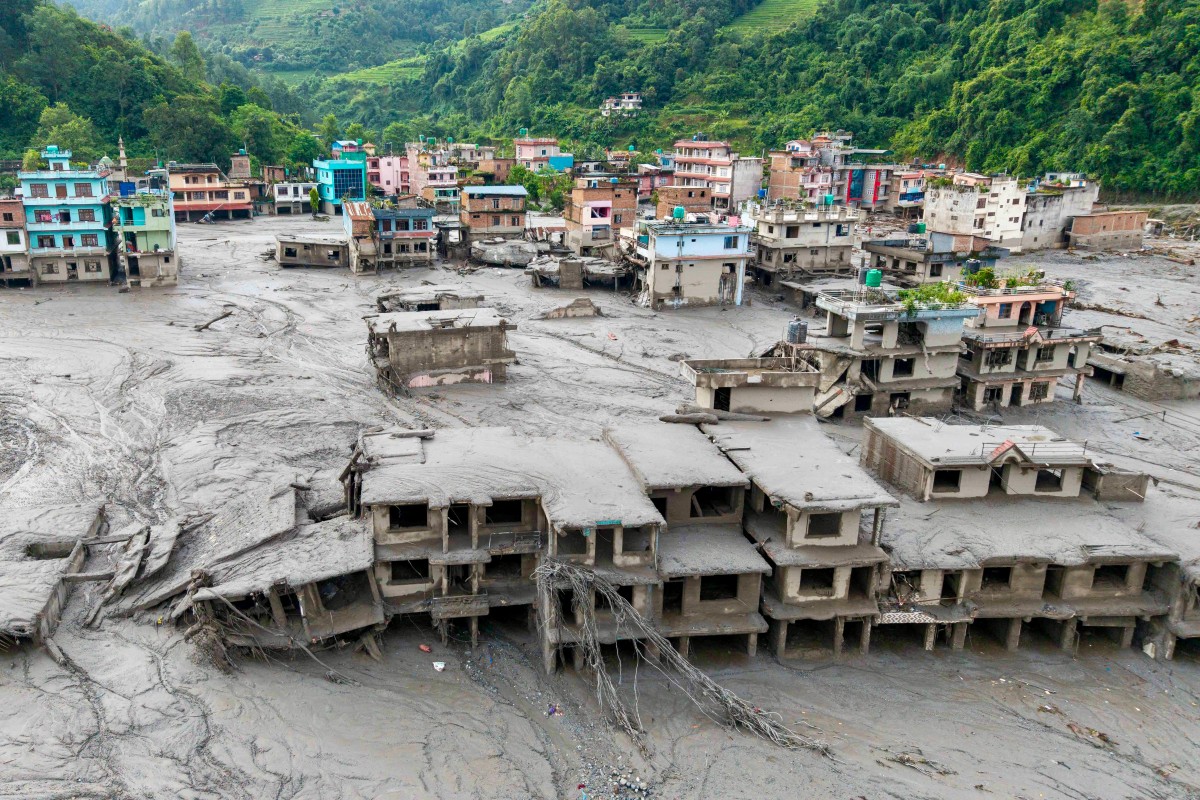
The toll of Wednesday’s devastating flood in Nepal has risen to 579 deaths, while 1.
The toll from Wednesday’s devastating flood in Nepal has risen to 579 dead, with 1,924 people still missing, the emergency management authority announced on Friday.
Chinese authorities, for their part, reported 5 deaths in their Tibet region, bringing the total provisional death toll of the disaster to at least 584.According to the United States Geological Survey (USGS), the wave was caused by the collapse of part of a glacier, so violent that it was recorded as a 5.2 magnitude earthquake and caused numerous landslides.
In Nepal, it swept through the Trishuli River valley in Nuwakot district, north of Kathmandu, and the Bhotekoshi valley to the east of the capital.
“Everything is gone,” said 35-year-old Omkar Joshi, a survivor from the Nepali town of Timure, to AFP. “It’s just one huge cemetery now. There’s nothing left but sand and stones soaked red with the blood of the dead.”
Twenty-four hours after this mini-tsunami hit, Nepali authorities were still without news of 910 people on Thursday, according to the Nepali emergency management authority.
Among them are 517 foreign nationals.”We’re still searching” –
On the other side of the border, which is off-limits to foreign journalists, Chinese state media reported that 558 people, including 260 foreigners, were still missing after the ‘mudslides’ that buried Gyirong Port.
A spokesperson for the Ministry of Foreign Affairs, Lin Jian, also said that about a hundred Chinese nationals were reported missing on the Nepalese side, including tourists and pilgrims.
In the heart of the Himalayas, this region of Nepal is very popular with hikers and climbers from all over the world, especially for climbing Mount Everest.
Surveillance footage verified by AFP shows a multi-story building and several people trying to flee, suddenly swallowed by the floodwaters.Another one, also authenticated, shows a gigantic wave, comparable to a tsunami, crashing onto a parking lot overlooking a river, which had been calm just moments earlier, sweeping away buses and a building with devastating force.
“My older brother is among those who have disappeared,” Subash Khatani told AFP. He came to Bir Hospital in Kathmandu on Thursday morning, hoping for news about him. “They’re still looking for him.””The rest is gone”
Searches continued all day, especially with military helicopters that evacuated 351 people, according to the army, which said that more than 9,000 soldiers and police officers were deployed to evacuate the victims.
“We spent the whole night in a school with about a hundred other people” from the town of Syabrubesi, reported Laloma, 27, who gave only her first name. “Everything else (in the village) is gone.”
In a rare move, Chinese President Xi Jinping spoke shortly after the disaster.
“The top priority is to mobilize all means to search and rescue missing people, evacuate and rehouse residents in danger, quickly treat the injured, and minimize the number of victims,” he said.Among the missing foreign nationals are 178 Indians and dozens of Ukrainians, Malaysians, Brits, Canadians, or Australians, according to the Nepalese tourism office. In Washington, the State Department reported 90 Americans unaccounted for.
The Nepalese trekking organizer Himalayan Glacier told AFP that they had lost contact with one of their groups of 47 people. “Our teams are going around the hospitals where the victims are being taken,” said its director, Sanket Pandey.”Risk”
On Thursday, the Dalai Lama offered his “prayers” to the victims, Pope Leo XIV said he was “deeply saddened,” and King Charles III of England, “shaken” by the disaster, donated 5 million pounds (5.5 million euros) for relief operations.
The Nepalese government on Thursday issued multiple warnings about a possible second surge due to the lake formed by the glacier collapse.
“It seems that the flow of the Lhende River is still blocked upstream” by the collapsed ice block, noted the emergency management authority.
“Due to the risk of further flooding, all downstream populations are urged to remain extremely vigilant,” the institution added.
Floods and landslides are common during the summer monsoon (June–September) in Nepal, Tibet, and across South Asia.
According to scientists, climate change is increasing the intensity and frequency of such events.

