
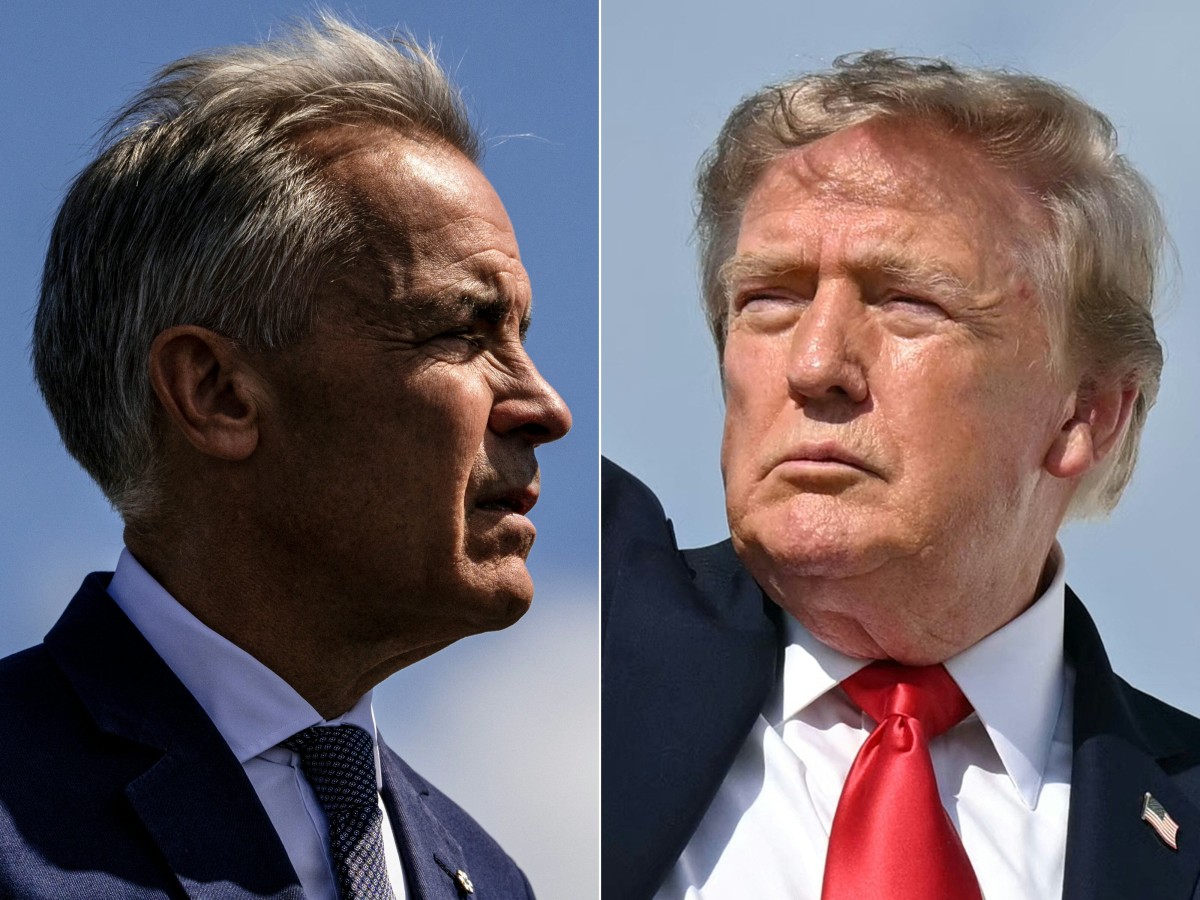
Canada decided to stand up to the Trump administration by breaking off trade talks with the White House and retaliating.
Canada decided to stand up to the Trump administration by breaking off trade negotiations with the White House and retaliating move for move.
But the economic power of the two countries isn’t comparable, and analysts say Canada is the one with the most to lose, even though it also has some cards to play.
The two economies in numbers:
The United States is the world’s leading economic power with a Gross Domestic Product (GDP) of $32.5 trillion (€27.85 trillion) compared to $2.5 trillion for Canada.
“This isn’t a fight on equal footing,” says Christian Lawrence, an analyst at Rabobank, “with exports to the U.S. accounting for 25% of Canada’s GDP.”
The U.S. is, by far, Canada’s number one trading partner.
Nearly 60% of Canadian imports come from the United States, and about 70% of its exports go there, figures that highlight the country’s heavy reliance on the American market.
In comparison, U.S. imports of Canadian goods accounted for only 11.5% of the total in the first half of the year, a figure that is still higher than those coming from China.
Who has the most to lose?
Canada, without a doubt. The Canadian economy “cannot separate itself from the United States” given how deeply integrated it is with the world’s leading power, says Christian Lawrence.
Already hit by Donald Trump’s trade offensive, the Canadian economy was starting to bounce back after having contracted since the end of 2025. But “the risk of a new downturn is high,” and a new escalation “would certainly increase the risks of a recession,” says James Knightley from ING.In case of escalation, the automotive industry, one of the pillars of the Canadian economy, is being particularly targeted by Donald Trump, who threatened it on Monday with a tariff increase from 25 to 50% on January 1.
Trevor Tombe, an economist at the University of Calgary, estimated that nearly 90,000 jobs could be lost due to the U.S. tariffs that came into effect on Saturday, which would push the unemployment rate up by 0.4 points to 6.8%.
What levers does Canada have?He has at his disposal natural resources that are crucial for the American economy, which imports 60% of its crude oil from Canada. And some voices are calling to use them as a means of leverage.
“I would really love to see” Donald Trump “drive cars without oil,” “try to grow vegetables and fruits without potash,” and go without certain “critical minerals,” joked Doug Ford, the leader of Ontario, Canada’s richest and most populous province, on Monday.
Canadian Prime Minister Mark Carney says that Canada’s underground resources are “what the world needs” and has been traveling the globe for a year to negotiate economic partnerships that could reduce his country’s dependence on the United States.”But to do without, in any truly significant way, the world’s largest consumer literally at your doorstep is impossible,” emphasizes Christian Lawrence.
Ottawa also claims that its ‘fiscal discipline’ and good credit ratings put it in a ‘position of strength’ and allow it to support the economy ‘for as long as needed,’ according to Finance Minister François-Philippe Champagne.How badly are the United States affected?
American importing companies located near the border are logically the most impacted, according to James Knightley, because they import from Canada many intermediate goods (wood, hydrocarbons, steel…) that go into the production of their products.
Canada’s boycott of American alcohol also has a heavy impact, with American spirits exports to Canada having collapsed by more than 70%. Just like the drop of over 25% in the number of Canadian visitors to the United States between 2024 and 2025, which affects employment in the tourism sector.
A few weeks before the midterm elections, fuel prices are on everyone’s mind in the United States. And any action at that level from Canada, which has excluded it so far, would hit American voters in the wallet.

