
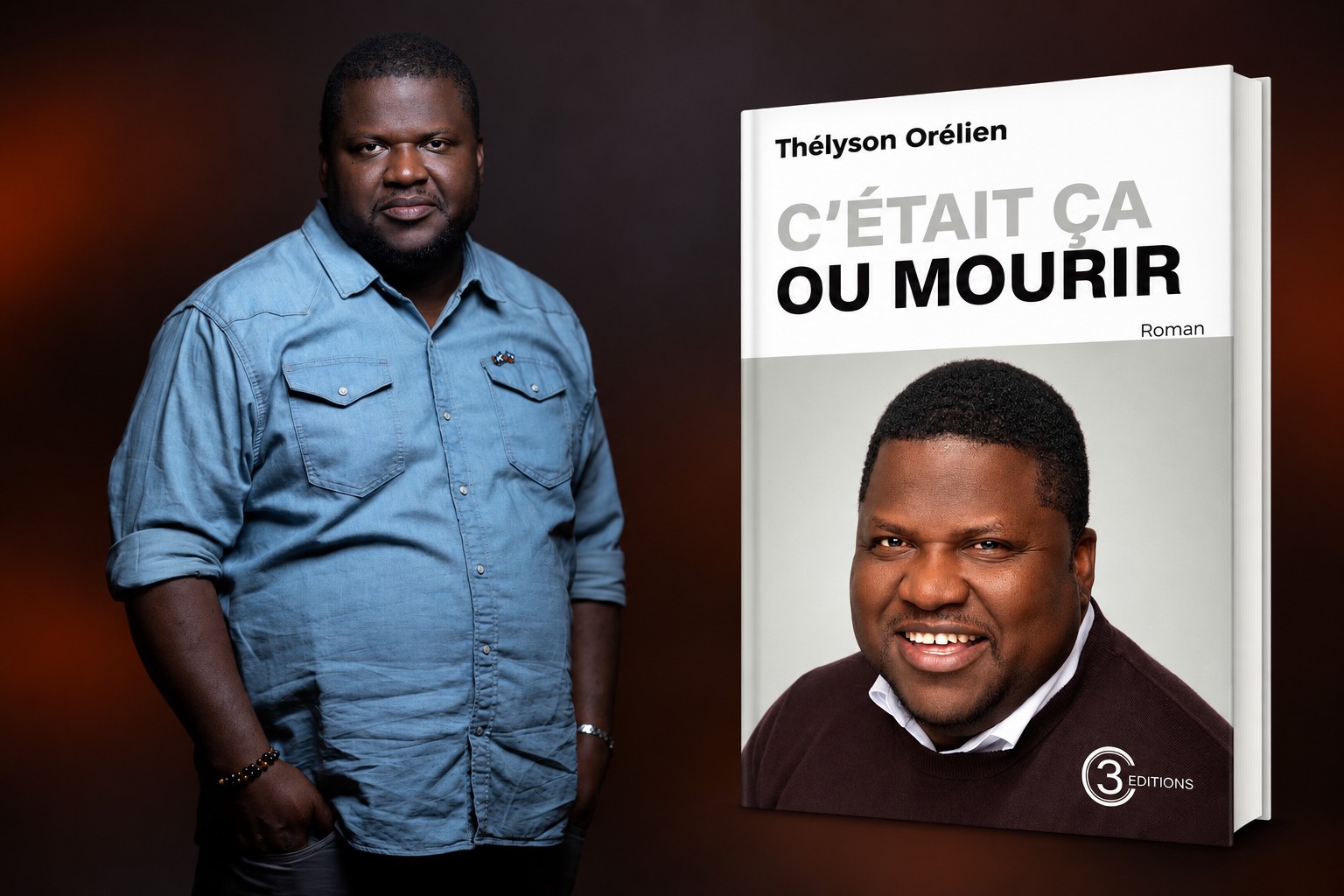
When Fred Brutus, the CEO of C3 Éditions, sent me a WhatsApp message to suddenly suggest that I produce a review of Thélyson Orélien’s novel C’était ça ou mourir, I didn’t hesitate to say yes.
When Fred Brutus, the CEO of C3 Éditions, sent me a WhatsApp message out of the blue to propose that I write a review of Thélyson Orélien’s novel C’était ça ou mourir, I didn’t hesitate to say yes. Fred took me at my word and asked me to have a copy sent from his publishing house. And I’m thrilled to have this novel, which was given to me. This book of over 240 pages was originally published by Éditions du Boréal (Canada) and later by Grasset and C3 Éditions in France and Haiti, respectively.
The novel has stirred quite a bit of attention: it has already won four French awards and has been shortlisted for several other prizes in France, including the prestigious Goncourt and Renaudot.To be honest, I didn’t really know what to write that hadn’t already been said about this objectively successful text, which, at first glance, doesn’t really raise any questions or issues. But I only write to raise a question or tackle a problem. I admit I’m not very good at writing exercises of an apologetic nature. Still, I was itching to write something about this novel. And I finally figured out what to say. Eureka! I’ll say right away that there’s practically nothing to criticize about this text. It’s fully literary. The narrative is engaging. It’s full of emotion and sensitivity. The reader is carried from place to place. And while serving the one and only cause of the illegal migration journey to its ultimate, redeeming destination, each place reveals its own tragicomedy. This novel truly deserved to be internationally acclaimed.
Facing the collective drama: leave or fight?
This enthusiasm leads me to consider two things: first, why do so many distinguished Haitian novels, or those selected for international awards, share the tendency to foreground an imagination of violence, misery, exile, and departure? In contemporary terms, Haiti is a cursed country that one must leave in order to be reborn elsewhere and finally enjoy the pleasures of life. It seems that our living novelists are only likely to win a prestigious international prize if they write about Haiti as a place synonymous with despair and exile. There is thus the literal exile of actually leaving the country, and the symbolic exile that conveys the idea of being in the country against one’s will, without truly living there. Yet, major literary works often have a role of engagement or even a cathartic function in times of acute crisis, like the one that has been ongoing in Haiti for many years.French literature illustrates the above. Some great French works have created, during critical periods, heroic figures of resistance who can serve as civic role models. These heroes neither flee, submit, nor give up in the face of dangers threatening their community. They face them courageously until they achieve victory, not for themselves, but for the land they inherited and must pass on to their descendants. They must defend it under all circumstances, against all odds, against attackers from elsewhere, or even against natives unworthy of belonging there. This land is their living space, where the blood of their ancestors was shed and where their dead are buried. So, it’s not about leaving it.
This perspective runs through French literature, where it is often a question of recalling the greatness of Greco-Roman civilization to reinvigorate national genius and call for heroism in order to create the psychological conditions for collective preservation. We find it in Classicism, notably in Corneille’s Horace (1641), where the eponymous hero willingly sacrifices his family and personal feelings for the glory of Rome. It is no less noticeable during the Enlightenment. In Voltaire’s Brutus (1730), the hero sacrifices his own son for the restoration of political freedom. Similarly, it appears in the work of a Romantic like Victor Hugo, who judges the reality of France, in the wake of the 1851 coup, through the lens of Rome’s greatness and decline. Finally, the twentieth century is no exception. In his play The Flies (1943)Sartre presents us with a hero (Orestes) who embodies the refusal to submit to the German occupation and thus freely chooses resistance. With Camus, the story is practically the same. In the journal Combat (1944-1947), the author lays out his idea of engagement based on revolt, dignity, and the refusal to submit.
The equation is as follows: if the heroes of most of our talented contemporary novelists only know how to leave, it follows that posterity will learn from them, and at the expense of society, that fleeing is the solution that seems to be imposed on problems.
French: A Colonial Legacy More Profitable than Harmful
So, does this praise challenge the critics of using the French language in Haiti?
Nowadays, there’s a narrative that particularly blames French for our underdevelopment. It seems just as hard to me to understand how a language could hold back the development of a people as it is to imagine squaring the circle. This is even more incomprehensible to me considering that Haiti is not the only country in the world or in history to have inherited a language from a former colonizer. But, apart from Haiti, I don’t think I’ve ever read or heard that English or Spanish have faced such disapproval from our Caribbean and Latin American neighbors.
When it comes to our literature, how can anyone deny that it has really benefited from our linguistic connection with France? The international fame of our writers is largely due to the fact that they produce quality works in French. Jacques Stéphen Alexis is undoubtedly a great writer. But we must remember that his initial recognition came from the very prestigious French publishing house Gallimard, which originally published all of his known works during his lifetime. Where would academician Dany Laferrière and René Depestre be if they weren’t Francophone writers? And Thélyson Orélien, who is now our national pride, would he have reached this level of international recognition if he didn’t write in French? Edwige Danticat, too, has for some time enjoyed exceptional recognition in the English-speaking world.And, in that sense, she honors Haiti, her home country. Honestly, I think things would be completely different if she only wrote in Creole. I even wonder if there has ever been a single writer from the global South who gained international fame whose ideas weren’t conveyed in one of those so-called colonial languages.It’s the same with languages as with legal-judicial systems, among others. Our judicial system is said to belong to the Romano-Germanic family, which means it inherited the Justinian Code and the Napoleonic Code. It incorporates the new paradigmatic trends of French law—while adapting them. Every year, we lawyers, jurists, judges, notaries, and legal professionals in Haiti happily and willingly commemorate the memory of our patron saint, Saint Yves Hélory de Kermartin. Isn’t this a colonial legacy? Let’s not fool ourselves: no matter how far back in history we go, every world order stems from a sacred agreement between the dominant powers at the time. Middle powers and small powers like Haiti just have to follow!For example, during the preparations for the creation of the United Nations, the victorious powers of the Second World War wanted a universal organization that, in its various structures, would be as representative as possible of the cultural realities of its member states. They came to consider particularly the issue of linguistic diversity. They thus realized that overly democratic linguistic representation would lead to a Tower of Babel and would make communication between states virtually impossible. In the end, they agreed on a compromise whereby English, Chinese, Spanish, French, and Russian were adopted as the official languages of the new organization with a universal mission. Arabic joined this list later in 1973. These are official languages of former colonial powers, except for Chinese, which became predominant due to its weight.
Through the force of historical events, especially marked by conquests, forced or voluntary annexations, and colonizations, other states, at crucial moments in their history, came into fairly lasting contact with these six languages. So this is really a practical compromise aimed at making communication between them easier. Therefore, they couldn’t really complain about being victims of any kind of linguistic alienation.A Hyphenated Language
In the current debate between Creole and French, some people advocate a return to African ancestry while believing that their approach is original and successful. However, they might not realize that such a claim isn’t new. It was promoted in the twentieth century by the literary and political movement known as Négritude, which began in 1934 and took shape with the publication in Paris in 1935 of the journal L’Étudiant noir, created by Aimé Césaire, Léopold Sédar Senghor, and Léon-Gontran Damas. But Négritude quickly lost its appeal, because this return can only be theoretical. Depestre expresses this disillusionment in his collection titled Bonjour et adieu à la négritude (1980).For his part, in his scathing attack on Césaire called Aimé Césaire or the Paradoxical Crossing of a Century (1997), Édouard Glissant lays out the limits of Négritude. So why such disillusionment? It’s because the existential realities of the Afro-descendant must be seen as they are and understood as such. They can’t simply be reduced to a poetic ideal that might consume a lot of creative energy without actually improving the material living conditions of the Afro-descendant. Both Afro-descendants and Africans suffered under colonization and have retained not only its scars and traumas but also its legacies, especially linguistic ones. As a result, by force of circumstance, I can only communicate with my African cousin through the language of our former common colonizers.
Similarly, when a Haitian meets a French person from overseas, they both find themselves forced to use French, a shared linguistic heritage. In Hegelian terms, this is a matter of historical necessity. We have to get used to it rationally.
In the case we’re looking at, it’s not about opposing Creole to French or preferring one over the other. This problem, which unfortunately we have experienced in the past, has been definitively resolved by the Constitution, which established the cohabitation and equal official use of both languages. That’s been in place for nearly forty years. And if, after all this time, the constitutional provision hasn’t materialized, we need to rationally look for the causes elsewhere, not in the French language. After all, no one would think to say that democracy — also mandated by the Constitution — is impractical just because we haven’t been able to organize regular elections up to now.Today, it’s no longer appropriate to defend Creole as if it were a fragile identity whose existence is threatened by French as a conquering language. Claiming to want to defend the Creole language on its own chosen ground isn’t exactly a heroic act. That would be like pushing an open door. Because this has been understood since the founding of modern linguistics by Ferdinand de Saussure: there is no hierarchy between languages, since a language is defined above all by its primary function, which is communication. That said, it doesn’t change the fact that not all languages have reached the same level of development.

