
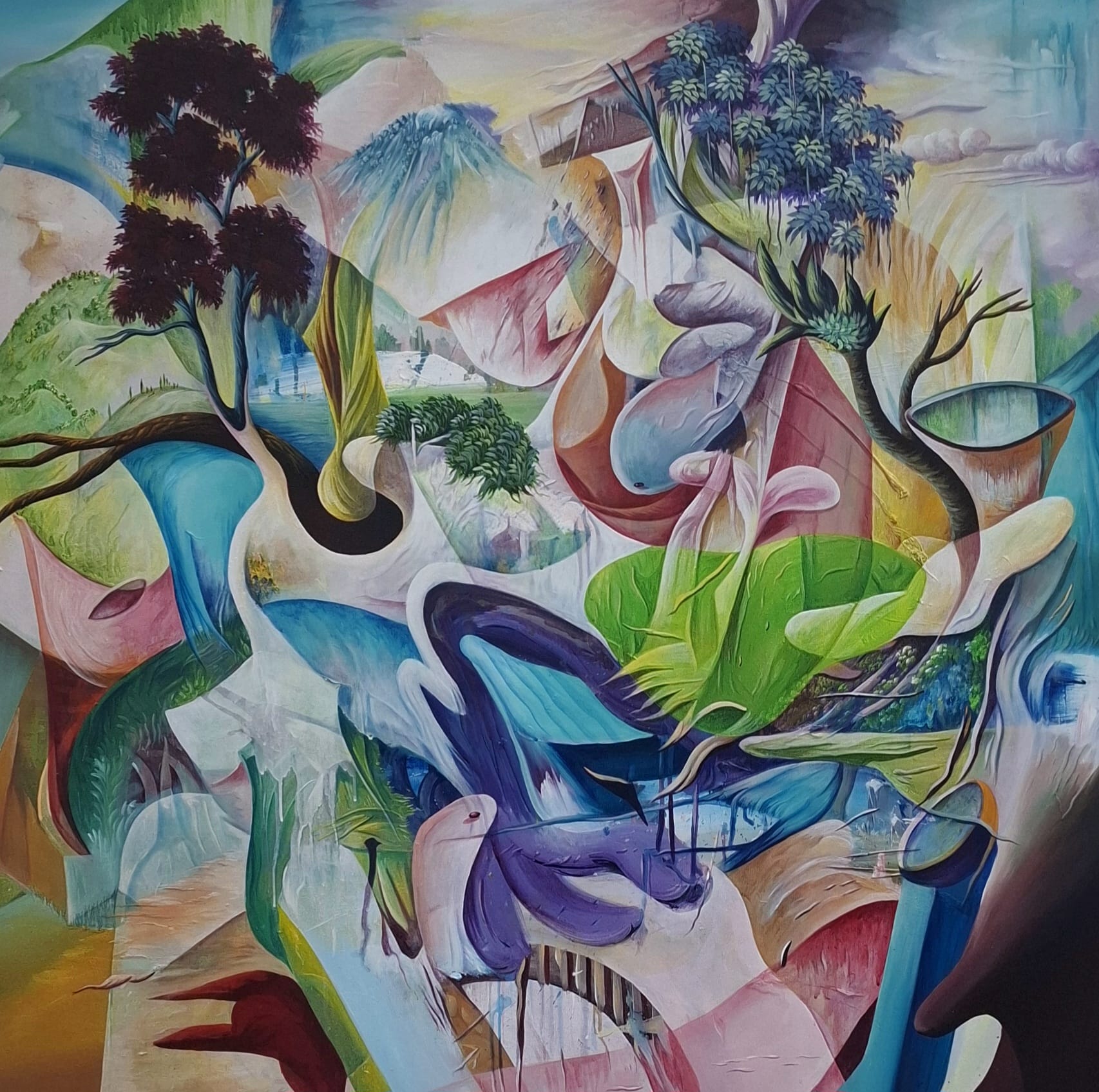
The special thing about this exhibition is its retrospective nature. It traces thirteen years of artistic creation and painting research from 2013 to 2026.
From Haiti to Brussels, painter Kévens Prévaris follows an artistic journey fueled by memory, influences, and questions about the contemporary world. Back solo at Galerie Brachot – Extra Muros with his exhibition “From Chaos to Light,” he offers a retrospective of thirteen years of creation, from 2013 to 2026. Between Haitian heritage, European influences, and a search for new artistic territories, he reflects on his path and the thoughts that run through his work.Le Nouvelliste: Kévens Prévaris, you’re back solo at Galerie Brachot – Extra Muros with ‘From Chaos to Light.’ How are you experiencing this artistic moment, as the exhibition continues until November 14, at 15 Darwin Street?
Kévens Prévaris: Between hanging the works, which started on Monday, November 2, setting up the exhibition, and the final preparations for the opening, which took place on Thursday, November 5 in front of more than 250 people from different backgrounds, I can tell you that this moment really feels like a dream. I’m still on a little cloud on the eve of the closing.I am experiencing this exhibition with a lot of emotion and gratitude. It represents an important milestone in my journey as a painter, as it brings together several years of research, experimentation, and artistic development. After having worked for a long time in the solitude of the studio (laughs…), seeing my works meet the public’s gaze, spark conversations, and evoke emotions is a particularly rewarding experience.
Le Nouvelliste: Compared to your previous exhibitions, what does this one offer differently to the public? What is particularly close to your heart in this new artistic proposal?
Kévens Prévaris: The uniqueness of this exhibition lies in its retrospective dimension, presented by a gallery founded in 1915. It covers thirteen years of creation and pictorial research, from 2013 to 2026, giving the public the opportunity to discover different phases of my artistic journey.Among the works presented are two pieces from my years at ENSAV – La Cambre, in Brussels. This training marked an important turning point in my journey. It led me to deconstruct my previous pictorial language to develop a new artistic expression, notably through a cool palette and references to modern and contemporary painters.
In this way, I deepened my artistic skills and learned to better integrate my Haitian roots with influences from my European cultural environment. Today, these two worlds are a great source of richness in my painting and also help shape my identity as a painter. In a way, it’s the artistic link between Haiti and Belgium.It’s important to point out that this exhibition is also the result of a long process of preparation and reflection, carried out in close collaboration with my partner and my gallerists, Isy, Sabrina, and Nathan Brachot. Their perspectives, support, and expertise have been invaluable.
Finally, what really matters to me is the theme’s ability to spark curiosity and provoke questions in the audience, while also opening up a space for reflection that goes beyond the purely aesthetic aspect of the works. Chaos can evoke tensions, ruptures, uncertainties, and questions that mark both human existence and the creative process. Light, on the other hand, suggests a sense of revelation, transformation, and reconstruction.This exhibition is an invitation for visitors not just to look at the paintings, but to take the time to feel them, question them, and create their own interpretation. My painting doesn’t necessarily demand an answer; it leaves everyone free to project their own sensitivity onto it.
Le Nouvelliste: You’re presenting “From Chaos to Light,” your latest solo exhibition of the year. Does this show raise questions for visitors? What are the questions that come up most often?Kévens Prévaris: Indeed, I received a lot of questions about the exhibition, starting with the first letter sent out, and then with every promotional post on social media. Visitors are especially curious about the use of color, the depth of the compositions, the density of the images, but also about the choice of venue: an artist’s studio from 1902 and a bourgeois house built in 1905, designed by architect Ernest Blerot for sculptor and painter Louise de Hem.
This ensemble, in a floral Art Nouveau style, features stained glass motifs that perfectly complement my work. Visitors are also interested in the themes explored. Some are particularly struck by how sometimes difficult subjects are approached and highlighted with a clear-eyed optimism, according to the words of my gallerists.

