
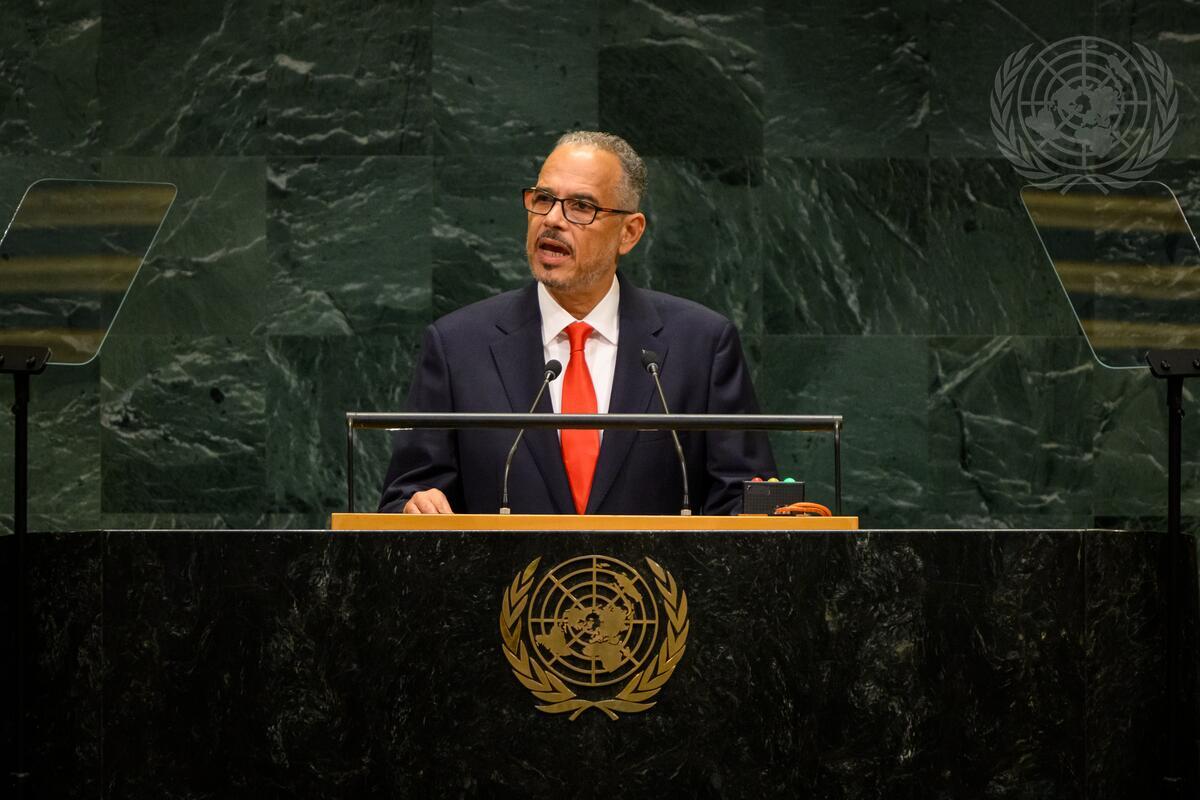
Prime Minister Alix Didier Fils-Aimé praised, on Thursday, September 25, at the United Nations General Assembly podium, the decision of the administration of U.S. President Donald Trump to extend the HOPE/HELP law until 2028.
Prime Minister Alix Didier Fils-Aimé praised, on Thursday, September 25, at the United Nations General Assembly podium, the decision by U.S. President Donald Trump’s administration to extend the HOPE/HELP law until 2028. At the same time, the Haitian government leader called for another ten-year extension of these trade preferences, presenting them as a tool for the country’s economic recovery.
In his speech, Alix Didier Fils-Aimé argued that restoring security alone won’t be enough to ensure lasting peace without economic activity resuming. “Peace isn’t maintained just by weapons: it’s strengthened through work, production, and development,” he said, describing economic recovery as “the other essential pillar” for Haiti’s stability.It is in this context that the Prime Minister brought up the HOPE/HELP law. He expressed the Haitian government’s gratitude to the U.S. administration for extending the program until 2028, calling this decision a ‘gesture of friendship’ and an ‘important step for the recovery of our economy.’ The head of government also called for a ten-year extension of the said law.
The Prime Minister also praised the United Kingdom’s Developing Countries Trading Scheme (DCTS) and encouraged other countries to adopt similar mechanisms to help Haiti access markets.
In the same vein, the head of government advocated for a shift in the nature of economic cooperation with Haiti.
‘Haiti needs investment to build its future,’ he emphasized.Alix Didier Fils-Aimé summed up the desired direction in three phrases: ‘From aid to investment. From assistance to production. From dependency to partnership.’
According to the Prime Minister, some of the resources currently being used to tackle the crisis should gradually be turned into investments that can create jobs and sustainable opportunities, especially for young people and women.
Finally, the head of the government described the economic recovery as one of the tangible signs of the peace sought in Haiti. ‘When we no longer hear the sound of weapons, we should hear the sound of peace, the roar of engines starting up again, construction sites resuming, markets coming to life, women starting businesses, and young people working,’ he envisions.

