
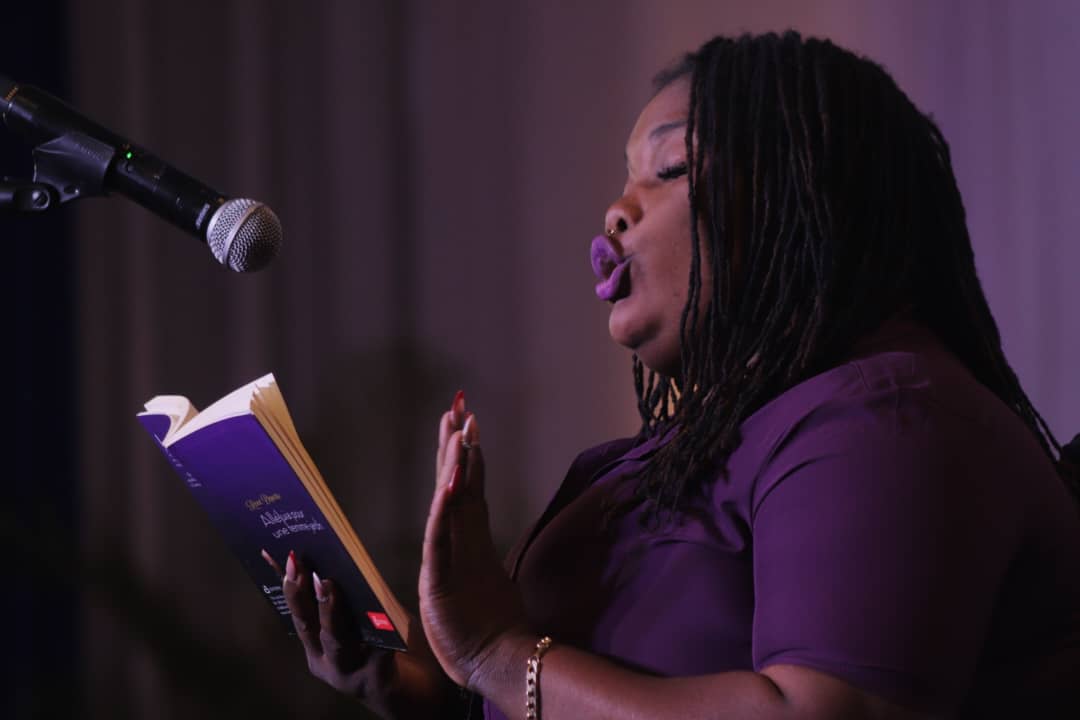
In the 23rd edition of the ‘Festival Quatre Chemins,’ a text by Rolaphton Mercure brings to the stage love, religion, hypocrisy, violence, taboos, and women’s struggles for rights and emancipation in love without shame.
In the 23rd edition of the ‘Festival Quatre Chemins,’ a text by Rolaphton Mercure comes to the stage covering love, religion, hypocrisy, violence, taboos, and women’s fight for rights and emancipation in love without reservation.
Some plays are written to make people grit their teeth. Likewise, there are others that tell a story full of depth and reflection. There are also those that go straight into society’s wounds, dig into them, open the bandages, and force us to look at what we’ve always been afraid to see.
Furieuses, a dramatic text, seems to fall into this category.
As part of the 23rd edition of the “Festival Quatre Chemins,” this play gets a fresh breath on stage under the direction of Jenny Cadet, a stage woman who has already left her mark on the Haitian theater scene as an actress. The festival itself, since its creation in 2003, has worked as a meeting space for different writings, aesthetics, and generations of artists, in a dialogue that connects Haiti with other creative spaces in the Francophonie.
Furieuses isn’t just a simple encounter between a text and a team of actors. It’s a meeting between the stage and some of the toughest questions we carry in our society.
It’s a play that asks us to look at love when society decides which love is allowed to exist. It asks us to look at religion when faith gets tangled up with control. It asks us to look at family when certain beliefs become stronger than the blood in our veins. It asks us to look at women when violence continues to pass through their lives, while society sometimes learns to live with their pain as if it’s something normal.Three Ezilis to Tell a Single Great Sadness
One of the strengths of the text lies in the presence of the three Ezili figures, which come together like a chorus, a memory, an inner voice, and a conscience observing human tragedy.
Ezili Mapyang, Ezili Red-Eye, and Ezilizi Kawoulo carry the story into another dimension.
In this universe, Ezili is not just a spiritual presence. She becomes a way for the text to have a dialogue between human life, memory, desire, suffering, and the Haitian imagination.
That’s where the theater goes beyond the story of the characters to touch on a larger question: What happens in a society when people are not allowed to live what they feel the way they feel it?Èzili comes like three mirrors reflecting different sides of women’s lives.
They bring love.
They bring anger.
They bring memory.
They bring pain.
They bring secrets.
And, above all, they bring what people live through but can’t always say.
Miryam and Gertie: a love that has to fight to exist
At the heart of the story are Miryam and Gertie, two women who fall in love with each other.
But this love doesn’t happen in a world where everyone is ready to accept it.
Miryam is a woman who is freer in her thinking and outlook on life. Gertie, on the other hand, comes from a religious world where church principles and moral convictions play a big role in her existence.
When these two women fall into a love relationship, it’s not just the start of a sentimental story.It’s a conflict that arises between desire and prohibition, between the individual and society, between what someone feels deep in their heart and what they’ve been taught they should feel.
This is where The Furieuses comes in to ask society a fundamental question:
Should a society have the right to decide who someone is allowed to love?
The text doesn’t take the easy route. It doesn’t just talk about love between women. It digs into the social, familial, spiritual, and psychological consequences of a love that’s considered ‘forbidden.’
In Myriam and Gertie’s universe, love becomes a battleground.
The Church: faith, hypocrisy, and human contradictions
One of the aspects that gives the play so much power is the way it handles the relationship between religion and people’s lives.
Gertie is a churchgoing woman.
That’s where the question gets even more complicated.
Because when someone lives between what they believe and what they feel, who should win?
Conviction?
Love?
Family?
Society?
Or the freedom for someone to choose their own life?Furieuses goes beyond just questioning religion. It dives even deeper. It puts in front of us the problem of hypocrisy that can develop when people’s words don’t match their actions; when some people use morality to judge others, while their own contradictions remain hidden.
No one knows how many gay men and women are inside the church.
The text touches on a reality that goes beyond the church: the way societies build people who are ‘acceptable’ and people who are ‘unacceptable.’
In such a context, faith can become a source of light, but it can also turn into a tool of pressure when people use it to crush someone else’s freedom.
It’s one of the questions Furieuses leaves for the audience without necessarily giving an answer.
When beliefs put the family in danger
Another major thread running through the text is the alienation of the believer, especially when a belief system becomes more important than human relationships.
What happens when someone loses the ability to see their child, brother, sister, or loved one as a person before seeing them as a ‘sinner,’ an ‘abnormal person,’ or someone who doesn’t follow their principles?
That’s when the play hits one of society’s foundations: the family.
Because the family can be a refuge.
But the family can also become a person’s first court.
And when moral judgment takes the place of love, relationships start to take a hard road.
“Furieuses” makes us think about the price someone might pay when they have to choose between truth and acceptance by family and society.
Taboos: what we don’t want to talk about is always there
Rolaphton Mercure’s text isn’t afraid to go into areas that many people prefer to avoid.There are taboo subjects in it.
There are questions about sexuality.
There are questions about violence.
There are questions about family.
There are questions about power.
There are questions about religion.
There are questions about women’s bodies.
There are questions about desire.
And there are questions that touch on certain forms of family relationships and social taboos that rarely find an open place in public discussion.
That’s what makes Furieuses a text that can spark debate.
Because theater isn’t always there to comfort us.
Sometimes, its mission is to disturb us where we feel most comfortable in order to ask the questions.
Women and violence: another truth we tend to pretend not to see
Behind the story of Myriam and Gertie, there is a broader question about the condition of women.
Violence against women doesn’t always come in the same form.
There is physical violence.
There is sexual violence.
There is psychological violence.
There is economic violence.
There is family violence.
There is social violence.
And there is violence that happens when a woman is made to feel that her voice has no value.
Furieuses steps into this territory too.It reminds us that a woman can be hurt not only when she is hit, but also when she is not believed, when she is silenced, when she is shamed, when her right to make decisions about her own life is taken away.
In this sense, the play engages in a broader reflection on Haitian society, where questions about the condition of women, violence, and inequality still need more space for discussion.
Jenny Cadet: a stage woman who chooses to tackle difficult areas
It is within all this complexity that Jenny Cadet’s work as a director makes sense.
Jenny Cadet is not a new name in Haitian theater.
The « Festival Quatre Chemins » presents her as an actress and director with multiple talents, and about 20 years of experience in the theater field.Her work has already tackled questions about women, girls, violence, discrimination, and women’s place in society. In the project TIFI, for example, she participated in a theater approach that showcased the experiences of young Haitian girls to the public and linked artistic representation to reflections on gender, violence, and resilience.
In Furieuses, she enters again into a universe where body, speech, religion, love, and society are in conflict with each other.
And there’s another important dimension: Jenny Cadet is not just directing the play; she acts in it too.
This creates a dual presence.
She’s the one organizing the rhythm of the show, but she’s also a body entering the characters’ universe.
She guides the audience’s gaze, while her own presence becomes part of the questions the play raises.A team of actors bringing the story to life
To give the text life on stage, Jenny Cadet is working with a team that brings together several figures from the Haitian acting generation:
Chelson Ermoza, Félix Federson, Néhémie Lamarre, Widelande Andresil, Roy Assey André, and Nichanda Préval.
Each presence becomes part of a dramatic mechanism where people, memory, religion, family, desire, and power intersect.
It’s a collective effort.
Because a text like this can’t rely on just one character. It needs a chorus of voices.
It needs bodies.
It needs silence.
It needs movement.
It needs conflict.
It needs moments where a word lingers in the air even after the actor has finished speaking.
“Furieuses”: a text that moves from literature into the bodies of the actors.
Rolaphton Mercure wrote Furieuses as a contemporary tragedy where religion, desire, and madness intertwine. The official presentation of the book places Myriam and Gerthie at the center of the story and highlights how the text delves into issues of stigmatizing same-sex relationships, social taboos, and the way women’s voices often solve big doubts. The book was published in September 2026 in the Délinéaments collection.
Here’s what’s interesting about the passage from the page that leads to the scene: a text written by an author comes to need the bodies of actors to breathe.
Words turn into movement.
Movement turns into emotion.
Emotion turns into conflict.
Conflict turns into questioning.
And questioning enters the minds of the people sitting in the room.
That’s where theater does its work.”‘Quatre Chemins’ as a space to ask difficult questions
Since its creation in 2003, the ‘Quatre Chemins Festival’ has presented itself as a space where Haitian artists and artists from elsewhere meet, share research, writing, and experiences. The name ‘Quatre Chemins’ itself refers to the idea of the Crossroads: a place where multiple paths intersect and where new directions can be born.
In this context, the presence of Furieuses has a special significance.
Because the play is another kind of crossroads.
It is a crossroads between tradition and modernity.
Between religion and freedom.
Between family and individuality.
Between what society says and what the person feels.
Between what people show and what they hide.
Between what we call morals and what real life forces us to question.
Theatre as a space that creates disagreement
A play like Furieuses doesn’t have to make everyone agree.
On the contrary.
Perhaps one of its greatest functions is to make people leave the room with a question in their mind.
A question they wouldn’t have asked before.
An image they can’t forget.
A word that keeps ringing.A situation that makes them think about their own family, their own beliefs, their own prejudices.
This is what theater can do when it takes risks.
It doesn’t always try to provide answers.
It can simply open a door.
After that, it’s the audience that steps in.
When the stage turns into a mirror
In a country where many subjects remain in a secret box, where questions about women, sexuality, religion, family, and violence are often hard to discuss without judgment, Furieuses brings work that asks us to listen before condemning.
The story of Myriam and Gertie is not just a story about women.
It can be read as a reflection on anyone who has had to hide a part of themselves to find their place in society.
It can be read as a question about the cost of hypocrisy.
It can be read as a reflection on the power of religion.
It can be read as a cry against violence.It can be read as a question about people’s right to love.
It can be read as an invitation for us to talk about taboos.
And it can also be read as a statement about the Haitian theater’s ability to enter painful areas without fearing the light.

