
Emotional calls for climate justice and crucial negotiations over billions of dollars—funding dominated the talks at COP31 on Friday in Antalya, Turkey.
From emotionally charged calls for climate justice to crucial negotiations over billions of dollars, financing dominated the discussions at COP31 on Friday in Antalya, Turkey.
UN Secretary-General António Guterres criticized an international financial system that leaves the most vulnerable countries sinking deeper into debt, even though they are often the least responsible for global warming. He specifically called for taxing the extraordinary profits of fossil fuel companies.
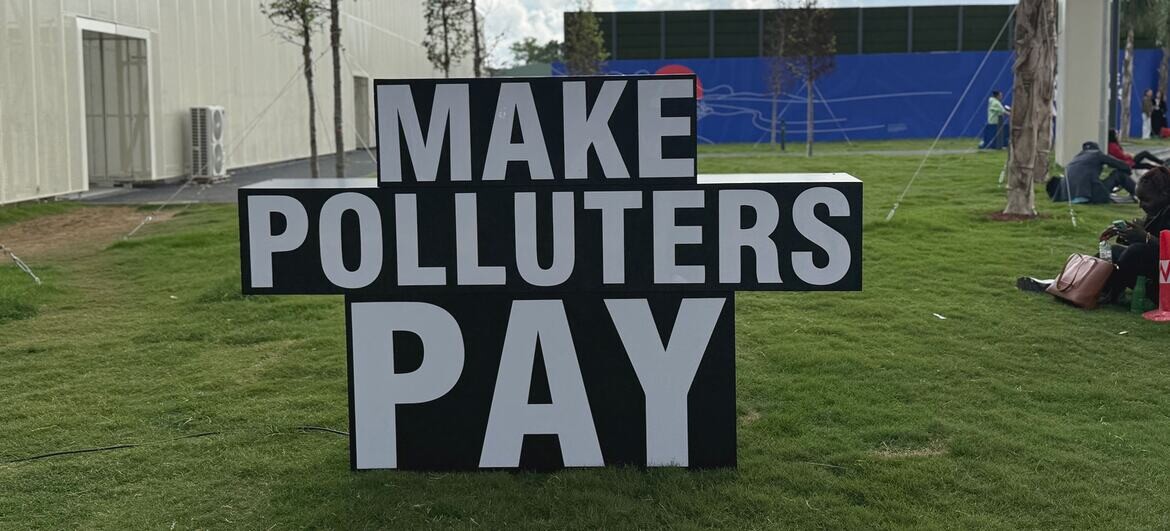
In the corridors of the summit, activists were holding up signs demanding that ‘polluters pay.’ Others, dressed as chefs, were offering a recipe for climate action with the secret ingredient being debt cancellation.Behind these demands, the same anger: that of people who are directly suffering the consequences of a crisis they barely contributed to.
Speaking about Lake Chad, where drought and water level fluctuations have devastated communities and forced people to move, a Nigerian activist particularly denounced the exorbitant cost of the loans his country has to take on to cope with climate impacts, compared to that of rich countries.
Activists are holding banners that read ‘Cancel the debt’ and ‘Reparations’ at a COP-31 event, while a Black man wearing a keffiyeh speaks into a megaphone on an outdoor square.The meeting quickly took on the feel of a protest, with participants chanting ‘Make the polluters pay!’.
A huge funding gap
At a press conference on Friday, António Guterres highlighted the scale of the funding shortfall.
‘Even if we triple funding for adaptation, we wouldn’t cover 30% of the real needs,’ he warned.
Climate disasters wipe out decades of development progress and worsen the debt of vulnerable countries. For the UN chief, the climate crisis cannot be separated from issues of poverty and international security.“We cannot build peace on a planet on fire. We cannot eradicate poverty when climate disasters keep plunging populations back into it,” he said.
He also criticized the economic interests that are slowing down the energy transition. “The future of our planet cannot be negotiated according to the conditions of those who profit from its destruction,” he insisted.
The debt trap
Climate financing is also hampered by bureaucratic red tape and the inequalities of the international financial system, Mr. Guterres pointed out. He is calling for a reform of institutions designed in the aftermath of World War II, where developing countries had little say.A reform would notably allow for mobilizing more resources: according to the Secretary-General, every dollar invested in the capital of a development bank could generate eight to ten dollars in funding.
The head of UN Climate, Simon Stiell, also criticized a vicious cycle linking debt, disasters, and prohibitively high borrowing costs. Developed countries are being called on to mobilize at least 300 billion dollars per year for developing countries by 2035, as part of an overall goal of 1,300 billion. But current trends could leave an annual shortfall of 840 billion dollars compared to this target.
To try to close this gap, financial institutions from the UK, Norway, and Canada have announced an initiative aiming to mobilize 10 billion dollars for climate projects in emerging markets by 2030.Protecting livelihoods
For millions of farmers, climate funding can mean the difference between being able to adapt to an increasingly hostile climate and losing their livelihoods at the first disaster. Yet, only about 5% of climate-related development funding goes to agriculture, and that share keeps shrinking, laments Kaveh Zahedi from the United Nations Food and Agriculture Organization (FAO), in an interview with UN News.
These investments, however, make it possible to restore degraded lands, improve water management, and develop crops that are more resistant to droughts and floods. These measures are all the more crucial as weather conditions become more unpredictable and the El Niño phenomenon threatens the harvests.“The biggest risk is not investing in agriculture,” warns Mr. Zahedi. “Because then you expose yourself to food insecurity. You expose yourself to worsening hunger.”
An insurance to bounce back
Even the best-prepared communities aren’t safe from disasters. When a cyclone destroys a farmer’s crops in Fiji, for example, the harvest is gone, but the bills keep piling up. As for the next crop, sometimes you have to wait several months.
In these situations, the speed of financial aid is crucial. That’s the whole point of so-called “parametric” insurance, an innovative mechanism that automatically triggers compensation as soon as certain predefined thresholds are reached, like wind speed or rainfall levels.Farmers can thus receive funds quickly, without waiting for the usual long damage assessment procedures.
Sinja Buri, from the Institute for Environment and Human Security at the United Nations University, emphasizes the importance of this speed: ‘The longer the aid takes to arrive, the longer the recovery will be. And the costs will only be higher.’
Deployed in eight Pacific countries, this system has already helped tens of thousands of people.A profitable investment
Beyond protection against disasters, climate transition can also generate savings and strengthen community resilience.
“Climate action is a good investment; it’s profitable,” says Hunter Lovins, founder of the NGO Natural Capitalism Solutions, to UN News.
With fuel prices soaring in the United States, she cites the example of her own electric car, charged using the solar panels installed at her home. It’s a way to reduce both energy costs and dependence on oil price fluctuations.She was also able to see firsthand the benefits of this energy independence during floods in her community in Colorado. While roads were cut off and her neighbors were without power for over a week, her solar-powered home kept running. Some neighbors even came to store their frozen goods there.
“It’s real security within your community,” she points out.
Today, Ms. Lovins helps mobilize over 1,000 organizers in 57 countries to encourage local climate initiatives and to inspire citizens to take action without waiting for government decisions.Guterres leaves COP, but not the climate fight
Climate commitment also took on an emotional dimension during a meeting between António Guterres and civil society representatives, gathered to honor the Secretary-General on the occasion of his last COP in office.
For nearly ten years, they recalled, he had been their ‘champion’ and ‘the best spokesperson they could have hoped for.’
They presented him with a symbolic award called ‘Make Polluters Pay,’ before giving him a long standing ovation. Some even invited him to return for a future climate conference, this time with an NGO badge.
The meeting quickly took on the feel of a protest, with participants chanting ‘Make Polluters Pay!’Visibly moved, Mr. Guterres went back to one of his main battles: making companies in the fossil fuel sector contribute to funding the consequences of a crisis whose most vulnerable populations are the first victims. He is particularly advocating for taxing their exceptional profits.
“We are facing lobbies. We are facing powers that exert pressure on governments,” he warned, calling on activists to keep up the pressure.
As he leaves his last climate summit as Secretary-General, António Guterres left a clear message: the fight for climate justice will not stop with his departure. He himself, he assured, “will not stop fighting.”

