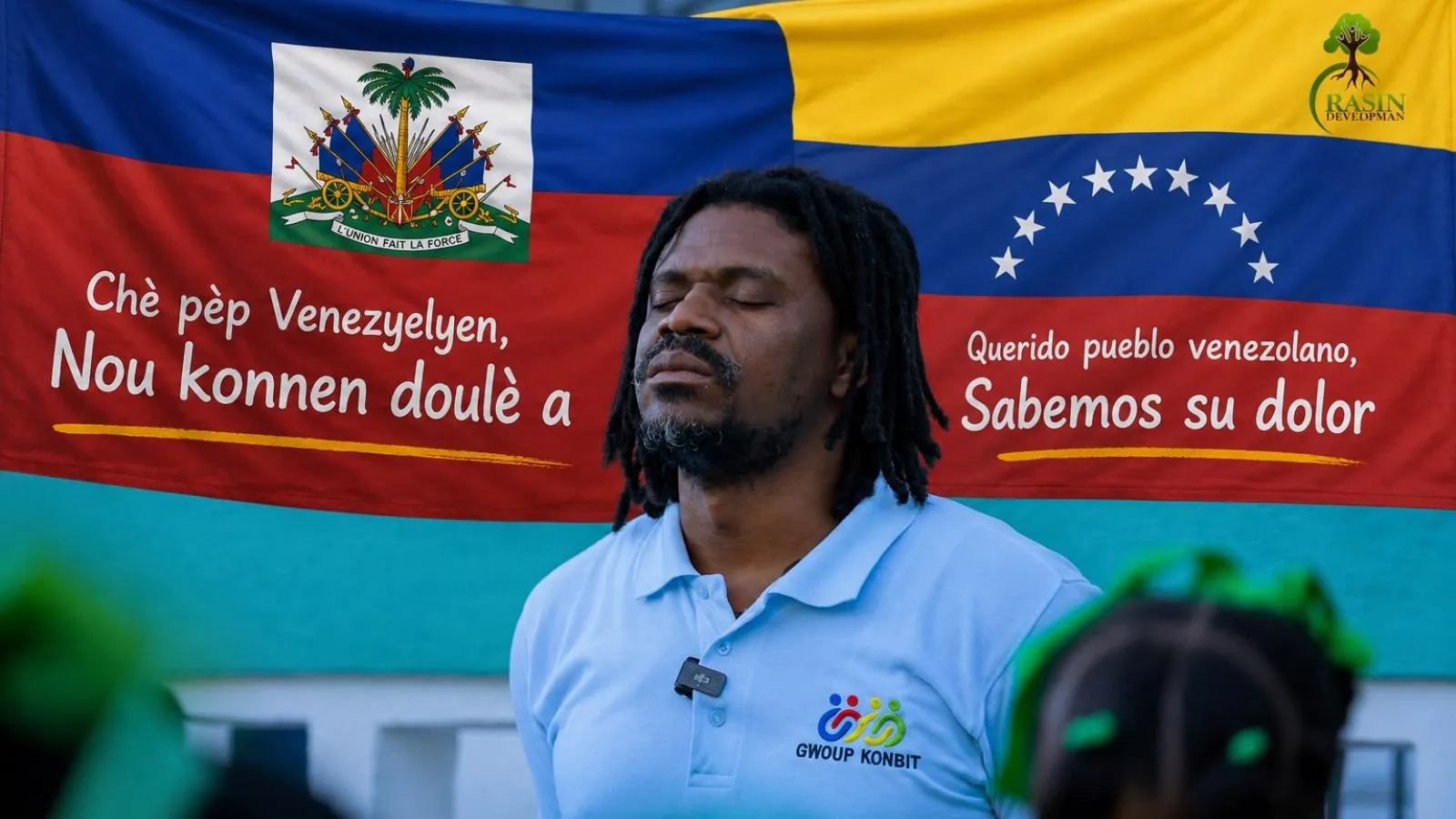
Open letter from Louino Robillard, a Haitian, to the Venezuelan people following the earthquake of June 26, 2026
Dear brothers and sisters of Venezuela,
I am writing to you from Haiti, with a heavy heart.
I am not writing to you as a mere observer. I am writing to you as a Haitian who knows what it means to wake up one morning and discover that nothing will ever be the same again. I belong to the generation that still carries the scars of January 12, 2010. That is why every image I see from Venezuela—every family searching for a loved one, every person sifting through debris, every neighbor running to help another—revives in me a pain I have never forgotten.
The Haitian people have not forgotten.
Even though Haiti continues today to struggle with political instability, armed violence, economic hardships, food insecurity, and so many other crises, we could not remain silent in the face of your suffering. A people who know pain cannot look away from that of another.
We may not have much to offer today.
But we have a wealth that no one can take from us: our experience, our solidarity, and the lessons learned from our own suffering.
That is what I want to share with you.
We have not forgotten the historical ties that unite Haiti and Venezuela. We have not forgotten the solidarity that the Venezuelan people showed us after our earthquake. That generosity will forever be engraved in our hearts.
Pain doesn’t need translation.
We know what it means to lose in a few seconds what it took a whole lifetime to build.
But I also know one other thing.
I know the Venezuelan people.
I know that you are a people of dignity, courage, and resilience. What gives me the most hope today is not just the rescue teams. It’s ordinary citizens. I see neighbors helping their neighbors. I see people sharing the little they have. I see a people who refuse to abandon their own.
Please, never lose that spirit.
As a Haitian, allow me to share with you one of the greatest lessons we learned after January 12, 2010.The whole world rallied to help Haiti. We will always be grateful to every country, every organization, and every person who reached out to us. Countless lives were saved thanks to this solidarity.
But our experience has also taught us another truth.
Aid alone is not enough.
Many organizations came to Haiti with compassion, skill, and sincerity. Their contribution deserves our gratitude forever.
But there were also tougher lessons.
Some actors arrived with their own priorities.Some didn’t take the time to listen to local communities.
Some didn’t work enough with local authorities and organizations that already knew the realities on the ground.
Sometimes projects were designed for communities without them actually taking part in the decisions.
When the funding stopped, many left.
The communities, however, stayed.
Over time, many started calling Haiti the ‘Republic of NGOs’.Not because all NGOs have failed, nor because all of them had bad intentions. That would be deeply unfair. Many have done remarkable work.
But our experience shows that when a state that is already fragile is not strengthened, when communities don’t lead their own reconstruction, when coordination is insufficient, and corruption and impunity persist, even the greatest international solidarity cannot achieve all the results a people hope for.
More than fourteen years later, Haiti is still struggling to rebuild.
That’s why I feel the duty to tell you this.
Many hands will reach out to you.
Many people will come with good intentions.
Others will come with their own interests.
Many promises will be made.
Significant resources will be announced.
Welcome the world’s solidarity with gratitude.
But never give up the leadership of your country’s future.
Hold your leaders accountable.
Because when community solidarity weakens, when citizens stop trusting each other, and local institutions are not strengthened, the void that appears can take generations to fill.
In Haiti, we call this spirit Konbit.