
Artificial intelligence promises to transform medicine, education, the economy, and even the very way we organize societies.
Artificial intelligence promises to transform medicine, education, the economy, and even the very way societies are organized. But it could also widen the gaps that already exist in the world. That was the message delivered Friday by United Nations Secretary-General António Guterres at the opening of a global AI conference in the Chinese megacity.
As AI models grow more powerful, one question becomes central: who will decide the rules of the game? A few states and tech giants, or the international community as a whole?
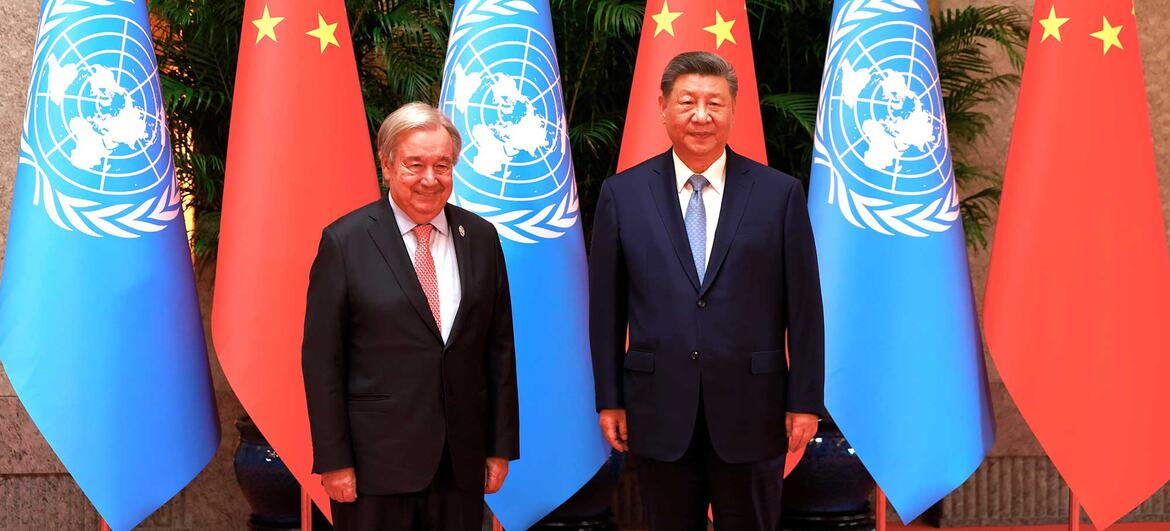
For the UN chief, the stakes go far beyond just technological innovation. It touches on the distribution of power in the 21st century.”A technology that will shape the future of humanity must be shaped by all of humanity,” he said, in the presence of Chinese President Xi Jinping. “The governance of AI cannot be in the hands of just a few countries or companies.”
The risk of a new global divide
Since the rise of generative AI systems, the race for computing power has sped up. Data centers, the most advanced semiconductors, investments, and technical skills still remain concentrated in a limited number of countries.
A situation that worries the United Nations.”A third of humanity still doesn’t have access to the Internet,” reminded António Guterres. At the same time, the computing power needed to develop the most advanced models remains largely out of reach for most countries.
For the Secretary-General, the danger is clear: AI could become a new driver of inequality between rich and poor countries.
“If these disparities aren’t addressed, artificial intelligence could lead to more inequality, with bigger gaps in income, opportunities, and security,” he warned.The UN is trying to find its place in AI governance
Faced with this concentration of technological capabilities, the UN is trying to carve out a role in a field that has so far been dominated by major powers and private companies.
The organization has launched multiple initiatives since last year’s adoption of the Global Digital Compact. An independent scientific group focused on AI was created under the General Assembly to analyze the consequences of AI, while the first global dialogue on AI governance was held this month in Geneva.The goal is to build cooperation mechanisms that allow countries to share their knowledge, develop common standards, and give developing countries more influence in the decisions that will shape this technology.
António Guterres also announced that he will soon present recommendations for the creation of a global artificial intelligence fund. More than twenty countries, including China, have already proposed centers to join a future international capacity-building network supported by the UN.
António Guterres (3rd from the left) poses for a group photo with Chinese President Xi Jinping (in the center) and other world leaders who came to Shanghai to attend the global AI conference.
A Technology That Needs Regulation
The Secretary-General does not dispute the potential of artificial intelligence. According to him, it could speed up medical discoveries, improve food systems, transform education, and help achieve the sustainable development goals.
But in his view, this promise does not exempt countries from setting safeguards.
Among the priorities he listed are adopting international safety standards, protecting human rights, and keeping human oversight over the most critical decisions.”Human rights must be protected,” he insisted. “Human beings must retain control over any decision involving life or death.”
The UN chief also called for special attention to be given to children, saying that “no artificial intelligence system should be placed in the hands of a child until its safety has been proven.”The energy battle
Another challenge is starting to emerge: the environmental footprint of AI.
The explosion in computing needs is driving increased electricity and water consumption to power the data centers that run the most sophisticated models. António Guterres has called on major companies in the sector to make the ecological footprint of their systems public and to power their infrastructure with renewable energy by 2030.
Beyond the announcements, the Secretary-General summed up the dilemma facing the international community. AI is no longer just a technological revolution. It’s becoming a political test of the world’s ability to share the benefits of innovation.
“The crucial question is whether this transformation will reduce inequality or increase it,” he concluded. “Whether it will concentrate power even more or expand opportunities for the majority.”