
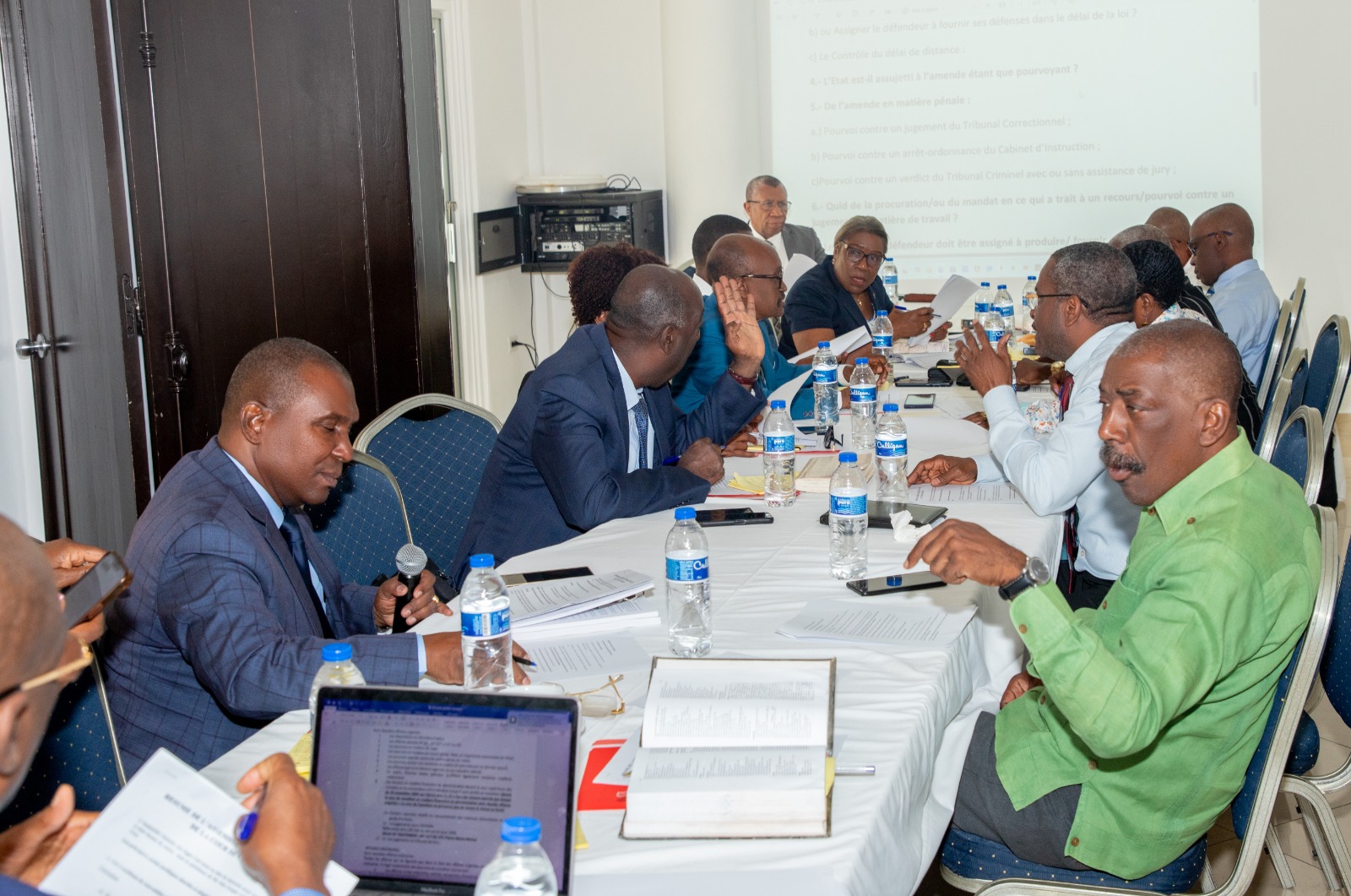
The Court of Cassation concluded, on Friday, July 17, a three-day institutional retreat during which the honorable judges of the bench and the prosecution adopted a series of decisions intended to strengthen the quality of case law, improve the drafting of judgments, accelerate the processing of certain procedures and modernize the tools for disseminating judicial decisions.
The Court of Cassation concluded a three-day institutional retreat on Friday, July 17, during which the honorable judges of the bench and the prosecution service adopted a series of decisions aimed at strengthening the quality of jurisprudence, improving the drafting of judgments, expediting the processing of certain procedures, and modernizing the tools for disseminating court decisions.
Held from July 15 to 17 in Pétion-Ville, this retreat brought together judges for working sessions devoted to examining legal issues, selecting judgments to be published in the Bulletin of Judgments, presenting the forthcoming Review of the Court of Cassation, and officially launching the institution’s new website.One of the main outcomes of this work concerns the upcoming publication of the Bulletin of Judgments. After two days of in-depth analysis, the judges selected 66 of the 71 judgments examined, rendered between 2014 and 2017, for inclusion in this authoritative publication.
Accompanied by Ms. Camille Fièvre, the participants meticulously examined each decision. Discussions focused on identifying the judgments, their subject matter, the decisions under appeal, the applicable legal provisions, and the quality of their drafting. Several lively debates also took place among the judges on certain legal issues where interpretations differed.To facilitate this analysis, Mr. Fièvre had designed an evaluation grid presented before the examination of each ruling. He particularly emphasized the need to standardize the drafting of judicial decisions, both in the use of logical connectors and in the overall structure of the rulings.
According to him, this harmonization is essential since the Court of Cassation remains the only court in the country responsible for ensuring the uniformity of the interpretation of the law and case law.
In this context, the President of the Court of Cassation, the Honorable Judge Jean-Joseph Lebrun, announced the creation of a commission tasked with correcting certain errors identified in previous decisions. This commission is composed of the Honorable Judges Barthélemy Alténor, Kébreau Zamor, and Maguy Florestal, who will serve as its coordinator.Participants also considered ways to make the rulings more precise to facilitate their enforcement by the lower courts after a cassation ruling. Attorney Camille Fièvre recommended that the Court more clearly indicate the legal issues that should guide judges called upon to rehear cases, in order to avoid repeating the same errors.
During the discussions, Judge Maguy Florestal also raised the possibility of drafting certain rulings in Creole, with the aim of making justice more accessible to citizens.
The second day of the retreat was also marked by the presentation of the first draft of the Court of Cassation Review. The judges made several observations to improve the content before its final approval by the main committee.
President Jean-Joseph Lebrun commended the subcommittee for its work and requested that the review be finalized before the start of the next judicial year, scheduled for the first Monday in October. He stated that this publication will serve as a new tool to facilitate the dissemination of case law, encourage scholarly reflection, and promote a more transparent and accessible justice system.
The judges also attended the official launch of the Court of Cassation’s new website, which will provide judges, lawyers, researchers, students, and the general public with easier access to case law, institutional information, and the main activities of the country’s highest court.The final day of the retreat was devoted to examining 17 legal questions that had given rise to divergent interpretations.
The judges notably studied ways to expedite the processing of recusal requests, the conditions for the admissibility of requests for removal from a case in criminal matters, the application of fines in recusal proceedings, the interpretation of Article 391 of the Code of Civil Procedure relating to civil petitions, and the applicable time limits in social matters before the Court of Cassation.
The discussions also covered the exercise of habeas corpus, the nature of the mandate required to file an appeal to the Court of Cassation, the effects of joint and several liability on appeal, the rules applicable to cassation with or without referral, the jurisdiction of the Superior Court of Auditors and Administrative Disputes in individual labor disputes, and the admissibility of certain appeals in cases of violations of public policy rules in criminal matters.At the end of these three days of reflection, the honorable judges of the bench and the prosecution service reaffirmed their commitment to strengthening the consistency of jurisprudence, improving the quality of judicial decisions, and promoting a more uniform application of the law across all jurisdictions in the country.
In closing the proceedings, President Jean-Joseph Lebrun thanked all the judges, as well as Ms. Camille Fièvre, for their contribution, stating that the recommendations resulting from this retreat represent an important step in the process of modernizing the Court of Cassation and consolidating legal certainty in Haiti.Present at the retreat were: Jean-Joseph Lebrun, President of the Court of Cassation; Jean-Claude Théogène, Vice-President; and Judges Barthélemy Alténor, Marie Joceline Cazimir, Frantz Drice, Maguy Florestal, Anès J. Joazéus, and Patrique R. Metéllus. The Public Prosecutor’s Office was represented by Jean Carvès, Government Commissioner to the Court, and Judges Kébreau Zamor, Fritz Gérard Chery, Yves Altidor, Vincent Carlet, Jean Sainclair Joassaint, Belette Larose, and Durin Duret Jr. The Chief Clerk of the Court, Juliette Garçon Véus, attended the discussions.