
At the press conference of the Board of Directors of the Bank of the Republic of Haiti (BRH), held on Tuesday, July 21, 2026, Governor Ronald Gabriel gave an overview of the country’s economic and financial situation.
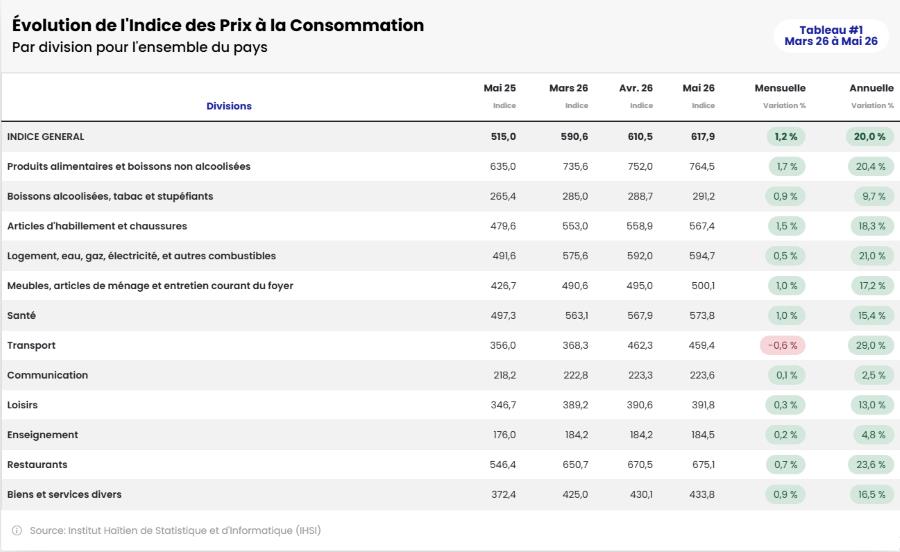
During the press conference of the Board of Directors of the Bank of the Republic of Haiti (BRH), held on Tuesday, July 21, 2026, Governor Ronald Gabriel provided an overview of the country’s economic and financial situation. Among the indicators analyzed, he pointed out a slowdown in inflation, estimated at 20% in May 2026, after reaching a peak of 32.2% in October 2025. In this piece, we’ll go back over this observation, which caused some confusion among the public, even though the governor had made a point of clarifying that it wasn’t a drop in prices, but rather a slowdown in their rate of increase.This detail, though essential, highlights a widespread confusion between inflation and the price level. For many Haitian households, food, transportation, housing, or healthcare remain out of reach. So, how can we talk about a drop in inflation when the cost of living keeps rising? The answer lies in the very definition of inflation: an increase in the general price level. As long as the inflation rate is positive, it means prices have continued to rise. Prices are increasing more slowly.People are right to say that life is getting more expensive. Despite the drop in overall inflation in May 2026, prices rose at a worrying pace in most of the main components of the consumer price index. According to the bulletin from the Haitian Institute of Statistics and Informatics (IHSI), in the “Food and non-alcoholic beverages” category, which represents the largest share of the household consumption basket in Haiti, several basic necessities saw a decrease in inflation rates in May 2026. Rice inflation went from 24.6% in April to 23.6% in May, corn from 21.2% to 20.0%, meat from 28.5% to 27.4%, fresh fish from 27.2% to 26.7%, herring from 24.9% to 23.0%, cooking oil from 21.6% to 20.8%, bananas from 21.5% to 19.7%, and peas from 23.3% to 22.1%.
The same trend showed up in the clothing and footwear sector. Inflation tied to clothing manufacturing saw the sharpest drop, going from 22.9% in April to 18.3% in May, while that of suits and jackets went from 21.0% to 20.3%. Spending on housing, water, gas, electricity, and other fuels also helped slow down inflation. Rent inflation went from 24.8% to 22.0%, charcoal from 28.4% to 27.5%, and propane gas from 29.8% to 26.8%.The transport sector experienced one of the biggest slowdowns. Inflation for private vehicle maintenance went from 28.0% to 26.0%, while that for gasoline and diesel dropped from 34.4% to 30.0%, helping ease inflationary pressures in several other areas of the economy. Finally, the ‘Restaurants and Accommodation Services’ category also followed this trend. Inflation for eating out went from 24.6% in April to 23.6% in May, showing a slowdown in rising dining costs.Taken as a whole, these results show that the slowdown in inflation observed in May 2026 isn’t limited to a few isolated products, but affects most of the major components of household consumption. It’s worth remembering, though, that this trend doesn’t mean prices are falling. Households are still paying more than before for all of these goods and services. Only the rate at which their prices are increasing has slowed down.Inflation is basically the rate at which prices go up from one period to the next. When inflation drops from 32% to 20%, it means prices are still rising, just not as quickly as before. Let’s take a simple example. Suppose a bag of rice cost 1,000 gourdes in October 2024. With an annual inflation of 32%, its price goes up to 1,320 gourdes in October 2025. If annual inflation then slows to 20%, that same bag would cost around 1,584 gourdes in October 2026. So the price never actually went down. It just increased at a slower pace. It went up by 320 gourdes between October 2024 and October 2025, then by 264 gourdes between October 2025 and October 2026. So the price has never actually gone down. It has just increased at a slower pace. It went up by 320 gourdes between October 2024 and October 2025, then by 264 gourdes between October 2025 and October 2026. In other words, a drop in inflation doesn’t mean consumers are paying less. It only means that the speed at which prices rise is slowing down from 320 gourdes to 264 gourdes.
At the supermarket or market, the consumer simply sees that prices have gone up across all the categories mentioned above. They don’t notice any improvement. Except that these prices would be even higher if inflation stayed at 32%. Instead of 1584, they would see 1742.2 gourdes. And life would be even more expensive.Consumers’ feelings depend more on the absolute level of prices (the ones shown on labels) than on the inflation rate. After several years of high inflation, successive increases add up. This is particularly tough in Haiti, where incomes generally haven’t kept pace with prices. Even if inflation slows down, purchasing power remains seriously eroded. In other words, 20% inflation might be seen as an improvement from a macroeconomic perspective while still being extremely hard on households. They keep spending a growing share of their income on food, transportation, and essential, unavoidable expenses.Good news for macroeconomic stability
Even though households don’t feel it, the slowdown in inflation is an encouraging sign for the economy. Slower inflation generally reflects a better balance between the supply and demand for money, greater exchange rate stability, and improved economic expectations. It also reduces the uncertainty weighing on businesses and investors.
For the Central Bank, this trend suggests that the monetary policy measures taken in recent months are gradually having their effects. Controlling liquidity, intervening in the currency market, and more cautious management of money creation can help curb inflationary pressures. However, it would be premature to see this as a definitive victory.It’s especially important to distinguish between two often-confused economic phenomena: disinflation and deflation. Disinflation refers to a slowdown in inflation. Prices keep rising, but more slowly. Deflation, on the other hand, means a drop in the overall level of prices. 0% inflation indicates stability in the general price level, meaning prices are no longer increasing. A decrease in this level, however, characterizes a situation of deflation. Deflation is relatively rare and can itself cause serious economic problems, especially when it affects investment. A level of 20% is still extremely high inflation. Western countries aim for a 2% inflation target, ten times lower than the rate observed in Haiti in May 2026. Inflation needs to keep going down to reach this 2% threshold, or at least drop to a rate below 10%.The slowdown in inflation shouldn’t hide the structural problems that Haiti’s economy still faces, which prevent it from aiming for a 2% inflation rate in the short or even medium term. Low domestic production, reliance on imports, insecurity disrupting supply chains, logistical issues, government budget constraints, and the vulnerability of the gourde keep putting pressure on prices. On top of that, the labor market is marked by high unemployment, a large informal sector, and slow growth in real incomes.For the average person, the indicator that matters most isn’t just the inflation rate, but their ability to buy essential goods and services. Price stability is a necessary condition for economic growth, but it’s not enough to significantly improve living standards. Real improvement also requires an increase in national production, the creation of productive jobs, higher incomes, sustained investment, and a secure environment that allows economic activities to run normally.The drop in inflation highlighted by the BRH is a positive development that deserves recognition. It shows a slowdown in inflationary pressures and is an encouraging sign for macroeconomic stabilization. It doesn’t mean that prices are going down or that life is getting cheaper. For Haitian households, a real return to a better quality of life won’t come just from lower inflation, but from strong and inclusive economic growth that can sustainably restore purchasing power and create bright future prospects. Unfortunately, for the eighth year in a row, the economic growth rate will be negative.