
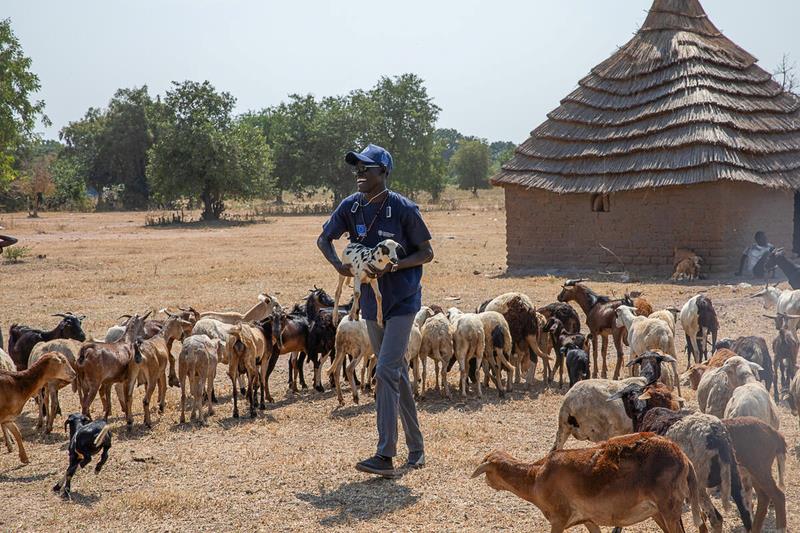
The proposed Global Partnership Program meets the request from member states for a broader, country-led platform.
The United Nations Food and Agriculture Organization (FAO) today unveiled an action plan for a new global approach to tackling transboundary animal diseases. Without control, these diseases can quickly threaten livelihoods and trade, hit low- and middle-income countries the hardest, and spread to human populations with devastating consequences.
The FAO’s Global Partnership Program for Transboundary Animal Diseases (GPP-TAD) is a country-led initiative that strengthens the prevention and control of priority diseases through national partnership platforms bringing together governments, the private sector, producers, foundations, farmers’ organizations, and financial institutions within a single national framework.”We need to make sure that the next chapter of global animal health is not marked by crises, but by cooperation, responsibility, and shared success,” said FAO Director-General QU Dongyu at a high-level meeting attended by ministers and senior government officials. He emphasized that transboundary animal diseases (TADs) remain one of the most urgent threats to food security, livelihoods, and health worldwide.
Cases of highly pathogenic avian influenza, foot-and-mouth disease, African swine fever, and cutaneous myiasis, among others, show that TADs “spread faster, farther, and have a bigger impact on economies and livelihoods than ever,” Mr. Qu added.
The Director-General emphasized that prevention costs far less than inaction, noting that the recent introduction of the SAT1 serotype of foot-and-mouth disease in Asia could lead to annual losses of $2 billion, according to the FAO’s impact assessment, and that investing upstream in prevention, through a “One Health” approach, is the only way to avoid downstream crises. “We can no longer just talk about zoonoses. We need a proper understanding of the holistic ‘One Health’ approach that includes the health of soils, animals, plants, humans, and the environment,” he addedDuring the 44th session of the FAO Conference in July 2025, member states recognized the crucial importance of preventing, detecting, and responding to the spread of transmittable animal diseases (TADs) and strongly emphasized the need to ensure adequate resources for the FAO. Since then, extensive consultations have been held with member states, during regional conferences and at FAO headquarters, to propose a renewed model of funding, partnership, and solidarity to tackle high-impact animal diseases. These consultations are ongoing to gather feedback and refine the plan under development..To date, 110 countries have sent official letters to the FAO Director-General expressing their interest in joining the Global Program for the Prevention of Transboundary Animal Diseases (PMP-TAD), showcasing a strong political and financial commitment to sustainably managing the most persistent and costly threats.
The high-level meeting featured speeches from the Agriculture Ministers of Italy, Cameroon, Jordan, Mali, Mongolia, Nepal, Burkina Faso, Serbia, Kenya, Brazil, Indonesia, Kyrgyzstan, Tonga, the Solomon Islands, Egypt, and Papua New Guinea. These statements highlighted strong international support for a more coordinated and sustainable response to diseases that spread rapidly across borders.A new approach
The goal of the Global Programme for the Control of Transboundary Animal Diseases (GPP-TAD) is to strengthen and sustain the core capacities that have been developed for over 20 years by the FAO Emergency Centre for Transboundary Animal Diseases (ECTAD). GPP-TAD offers a new approach to funding collective action against transboundary animal diseases, representing a fundamental shift in how the FAO supports its member states.Previous efforts mainly relied on donor-funded projects, with the FAO primarily playing an implementation role. GPP-TAD introduces a new global governance structure and a diversification of funding models. In this new setup, the Director-General highlighted the shift from a traditional, project-by-project approach to an integrated platform designed as a global public good. On this platform, countries lead the implementation, with additional technical support from the FAO tailored to local needs and context. Regional hubs will coordinate cross-border action – an area where animal diseases cause the most damage and no single country can tackle them alone.Through its EMPRES program, FAO will continue to provide information on diseases, early warnings, and guidance standards, and to step in as a last resort and when needs spike significantly. National platforms are key, regional hubs coordinate technical assistance and encourage collaboration, and FAO will ensure global coordination to support sustainable prevention, preparedness, and collective action at all levels.
FAO will act as a global platform and facilitator, as well as a provider of guidelines and normative support at the global, regional, and national levels. It will also offer technical support to countries in developing and implementing their national plans.
The Global Programme for the Prevention and Control of Animal Diseases (GPP-TAD) will work in five complementary areas: prevention and progressive control of diseases; digital surveillance, early warning, and innovation in animal health; preparedness and early, anticipatory measures based on risk analysis; coordinated and rapid emergency response; and legislation, partnerships, and financing models.
One key aspect of the Programme is its financing model. It introduces a diverse and supportive approach, where all participating countries contribute according to their capacities, supplemented by voluntary contributions from development partners, as well as co-financing provided by international financial institutions and the private sector.At the global level, a Steering Committee will be set up to define strategic directions. Participation and representation from different regions of the world will be balanced. A technical advisory group, made up mainly of key technical partners, including the governing bodies of the FAO, will ensure overall strategic oversight of the GPP-TAD.
“The GPP-TAD is a strong global platform for solidarity, shared responsibility, and sustainable, predictable investment,” said Qu, before concluding by emphasizing that “healthy food comes from healthy soils, healthy plants, and healthy animals for a healthy environment and a healthy life.”