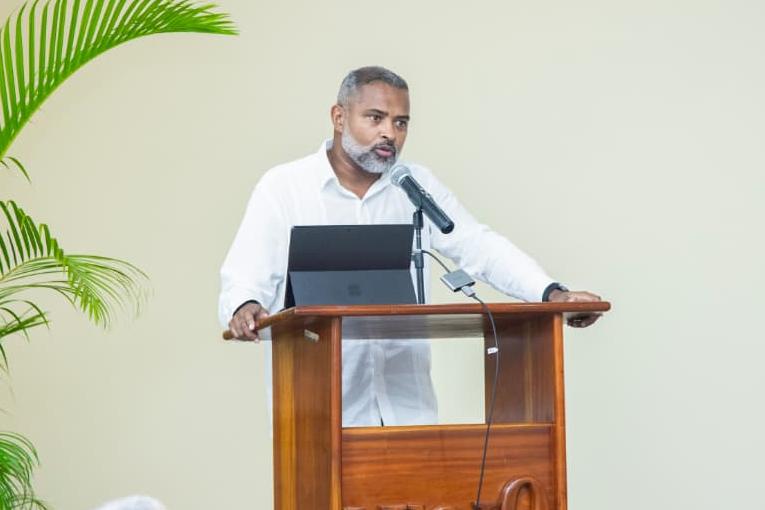
At a conference organized by Quisqueya University on August 6, 2026, on the theme “Private sector and political governance in Haiti: opportunities, possibilities, and limits,” financier Robert Paret argued that the emergence of a Haitian middle class is a crucial step for the country’s development.
At a conference organized by Quisqueya University on August 6, 2026, on the theme “Private sector and political governance in Haiti: opportunities, possibilities, and limits,” financier Robert Paret argued that the emergence of a Haitian middle class is a crucial step for the country’s development.The diagnosis is made bluntly. Haiti, as described by the president of ProFin, is “a state with no revenue, a country losing its talent, and a society without a middle class.” Three realities that reinforce each other and which, according to him, explain why development policies struggle to produce lasting results. The country’s tax pressure is only 4.4%, one of the lowest in the region. 84% of Haitian graduates live and work abroad. And the middle class makes up only about 2% of the population. Numbers that show the scale of the challenge and the urgency of making it a priority, according to Robert Paret.For the financier, a strong middle class brings several key benefits: strengthening human capital, increasing domestic savings, fostering entrepreneurship, creating a solvent demand, and improving institutional accountability. Entrepreneurship, he says, is a fundamental basis for development, and the middle class represents a significant potential for starting businesses. Authorities should therefore see it not just as a result of development, but as a central goal of all plans.
Assist or Expand: Presenting Two Strategies for the Future
Robert Paret presented two possible approaches for the country’s economic future. The first, focused on fighting poverty through assistance, risks creating more dependency, fragile growth, and persistent poverty. On top of that, beneficiaries would have little real power, and it would be a recurring burden for the state. The second approach, expanding the middle class, would instead help promote shared growth, sustainably reduce poverty, create citizens more capable of holding people accountable, and broaden the tax base.He clarifies, however, that this doesn’t mean abandoning the most vulnerable populations, but rather flipping the hierarchy of priorities. In Haiti, crisis responses often rely on aid mechanisms and one-off resource injections like after the earthquake, or today, with the current crisis. The challenge is therefore to move from a mindset of aid to a strategy of sustainable economic building. He sums up this approach with a saying: ‘You don’t improve what you don’t control, but you don’t control what you don’t measure.’Because, for the financier, the middle class is both the cause and the consequence of development, he proposes setting up a tool: the Middle Class Emergence Index (MCEI). It’s a tool meant to measure, audit, and periodically publish data on the evolution of the Haitian middle class, while also allowing precise and measurable goals to be set. The question he raises in conclusion is meant to be central: ‘How many Haitian households will this plan help enter the middle class, and by when?’ According to him, this question should be at the heart of all development plans implemented in the country.
Towards a New Approach to Financing
Robert Paret also emphasized the need to strengthen financial inclusion in order to reduce transaction costs and make access to financing easier. Guarantee funds alone are not enough. He therefore suggests turning the reserves of pension schemes, particularly the civil pension and ONA, into real springboards for productive investment. For him, a middle-class market represents a bigger opportunity than any import monopoly.
The former banker concluded by paying tribute to two figures from the private sector who have passed away, namely Ralph Auguste and René Max Auguste; men who believed that the Haitian private sector could be a driver of change. He says the absence of such men, gone too soon, is felt. The same goes for a middle class, which is also slow to emerge.