
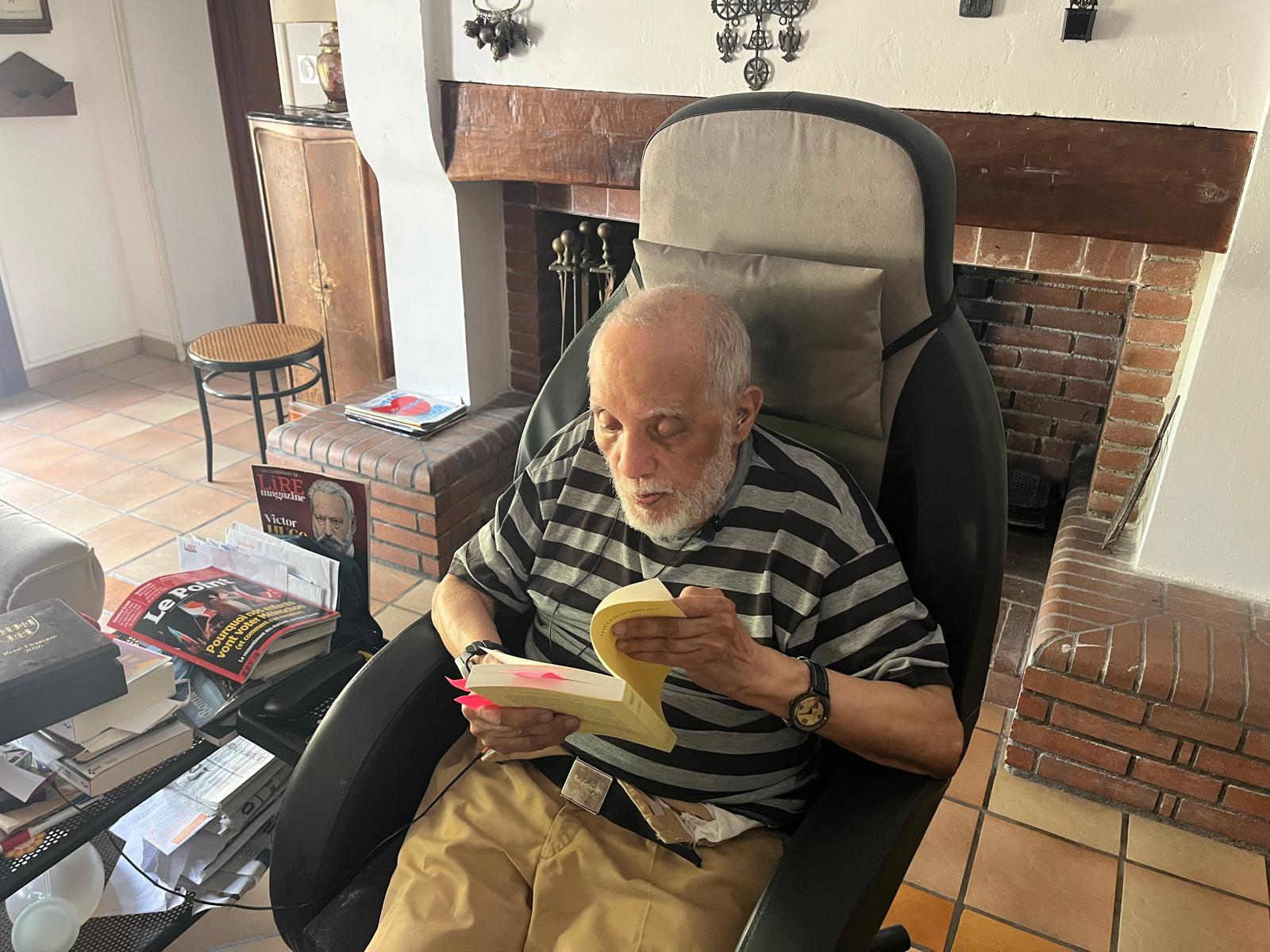
A tribute to the ‘so-called’ centenarian gave the opportunity to pay him a memorable visit in Lézignan Corbières. The Nouvelliste had been there a year earlier…
It was a year ago that Frantz Duval, editor-in-chief of this newspaper, called me to find out how to get in touch with René Depestre, knowing that I visit him regularly, or at least check in on him from time to time.
Passing through France, the journalist indeed wanted to meet him, preparing to celebrate his centenary in Haiti, which everyone believes will take place on August 29, 2026.
However, just like when I went to visit him a little earlier that summer in 2025, after the Banquet du livre in Lagrasse, a village in the Corbières near Lézignan-Corbières (Aude) where the writer has lived for forty years, he said: ‘But I’m already 100! I was born in 1924.’
No one expected such a revelation, and at the risk of being disrespectful, everyone wondered if, given his age, the poet might have confused things, perhaps? Even though, on the other hand, the conversation with Depestre, who was present and alert, shows absolutely no sign of that. So? So Frantz Duval doesn’t stop there, and as readers of Le Nouvelliste know, back in Haiti after his visit to the poet, he goes on to dig through the archives of his homeland to find the birth certificates of René and his brother Maurice.
The proof is right there, and on the eve of the Book Banquet on the theme ‘The House and the World’ https://www.abbayedelagrasse.fr/banquet-du-livre-dete-2026who was asking me to organize a tribute to Lézignan’s neighbor for his 2026 edition (from July 25 to 31) I bring to René Depestre, at his Villa Hadriana, the printed acts in question, sent digitally by my colleague: yes, he is indeed from ’24, and his little brother from ’26. The most curious thing being that the writer placed the mistake at the time of his French naturalization (1991), saying that an officer had confused him with his brother. Yet, if you open Rage de vivre (Seghers), his complete poetic works, and even better if you have the original editions in hand, you notice that the preface of Étincelles, Depestre’s first poetry collection published in Port-au-Prince, mentions the age of the young author: 19 years old. You don’t have to have done advanced math to deduce that, as early as 1945, the fact that Depestre was apparently born in 1926 was public knowledge.This Friday, July 23, the poet is visibly impressed to be able to hold these papers in his hands, and when asked why he let it persist for his whole life, a little vanity of a seducer? “Not at all!,” he replies, “I don’t know where the confusion comes from. But if I haven’t tried to correct it, it’s because 1924 or 1926 didn’t matter to me, what’s the importance…”
His youngest son Stéfan, who lives not far from René Depestre in the same city, was himself left stunned by these documents suddenly aging his father by two years! Clearly, the ‘marvelous real’ has yet to stop knocking at the poet’s door, because for him, turning 102 on the upcoming August 29th is ‘wonderful! I never thought I’d reach this age.’ A fine age for someone who continues to read—Flaubert is on his table—receive honors, more than enough, between the almost and the real centenary (and who cares!), to be studied from conference to conference, and to be awarded the Goncourt Prize for poetry in 2026. It’s never too late for the author of Alléluia pour une femme jardin (Goncourt Prize for short stories) and Hadriana dans tous mes rêves, Renaudot Prize 1988.Depestre is still writing short poems; he dedicated one to his nurses and sent his latest ones to Seghers editions for the volume of the Year’s Poetry Anthology, which will be published in early 2027. Let’s bet we’ll see him with this book in hand at the next Lagrasse Book Banquet, by which time he’ll be 103! The essential thing, the writer keeps in his eyes: “being a poet is having stars in your sight,” he told us. On Sunday afternoon, July 26, the audience at the Lagrasse Book Banquet was charmed by his voice, recorded with Radio Caillasse and broadcast through large speakers, amidst readings of poems that were even translated into sign language. “Mési anpil René Depestre,” the banyan man.
While waiting to listen to this tribute, which will be posted on the Book Banquet website in the fall, you can read the article from Le Point covering the visit.https://www.lepoint.fr/culture/rene-depestre-bientot-102-ans-jai-une-joie-de-vivre-a-toute-epreuve-4LOEG33ODNFGNBSW3TTFQGJANQ/ along with a video where he reads the first poem from his first collection: ‘I will not come tonight.’ One of the most moved by this reading will be the Haitian novelist Thélyson Orélien, whose ‘It Was That or Die,’ published in Quebec, will be released by Grasset on August 19, and yet, his hero quotes lines from this poem and returns to Depestre several times, proof that poetry, even if it cannot literally save a life, gives the literary strength to keep going!