
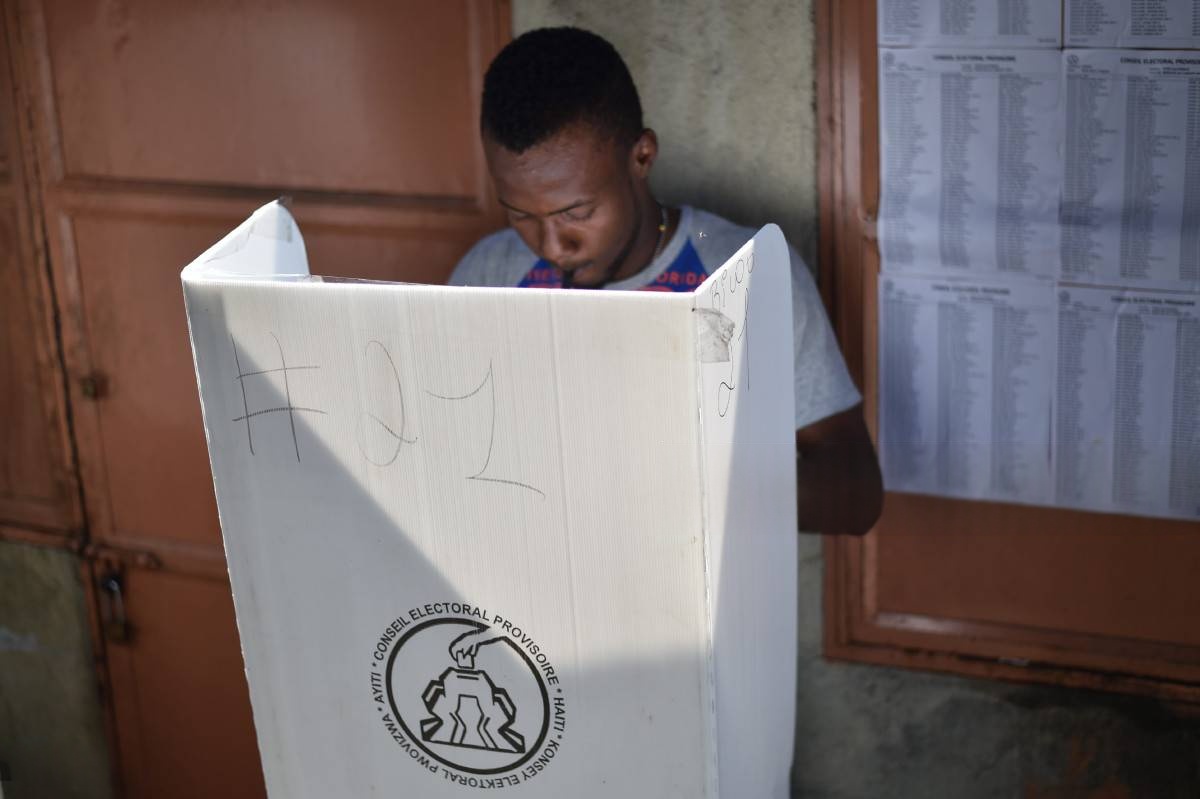
Next week, on August 20, the Electoral Council will start registering candidates for the upcoming elections.
Next week, on August 20, the Electoral Council will start registering candidates for the upcoming elections. From that date until October 2, the country will have a clear idea of who wants to lead it as elected officials. Among the most sought-after positions is, of course, the presidency. What are the requirements in the electoral decree to run for president?The first part of the answer to this question can be found in Article 135 of the Constitution, also cited by the electoral decree. ‘To be elected President of the Republic of Haiti, one must: be Haitian by origin and never have renounced Haitian nationality, and not hold any other nationality at the time of registration; be at least thirty-five (35) years old on election day; enjoy full civil and political rights and never have been sentenced to a severe and disgraceful punishment for a common law crime; own at least one property in Haiti and have a habitual residence in the country; have lived in the country for five (5) consecutive years before the election date; have received a discharge for financial management if one has been an accountant of public funds.’
Next, there are the requirements from the electoral decree in its Article 76. ‘To run for the Presidency of the Republic, you must: have a valid national ID card; be registered on the electoral roll; be in good standing with the tax authorities; prove that you have paid your taxes regularly each year by providing annual certificates; have your asset declarations if you were subject to that obligation; never have been found guilty of electoral fraud; never have been subject to administrative measures by the CEP; never have been dismissed by a Public Administration institution under Article 199 of the May 17, 2005 Decree revising the general status of public service; and not be subject to sanctions from the United Nations Security Council.’The many requirements of Article 153
The requirements of Article 153 of the electoral decree apply to all candidates for an elective position, which definitely includes presidential candidates.
To be admissible, the application file for elective positions, according to this article, includes, among other things, the following documents: “a notarized copy certified as conforming to the original property title proving that the presidential candidate owns at least one property in the country; a notarized copy certified as conforming to the original property title proving that the candidate for legislative elections owns a property or a certified copy of a document proving that they practice a profession or work in an industry in the concerned Department or district; a notarized copy certified as conforming to the original receipt of the Land Tax on Built Properties (CFPB), if they are the owner […]Next, the candidate must also present “a criminal record certificate dated less than six (6) months, issued by the registry of the Court of First Instance in the candidate’s residence, certifying that the candidate has never been sentenced to a punitive or disgraceful penalty; a sworn statement signed before a notary certifying that they have never been convicted or detained either in Haiti or abroad for economic crimes, sexual violence, illegal arms trafficking, drugs, kidnapping and unlawful confinement of persons, or any other criminal or delinquent offenses […]”Article 153 also requires “the certificate of clearance of management, if the candidate has been an accountant or manager of public funds or money; the residence or domicile certificate following verification carried out free of charge by the local justice of the peace, signed and issued with an attached official record; a negative police certificate issued by the Central Directorate of Judicial Police (DCPJ); a notarized copy certified as true to the original of the asset declarations, if the candidate was required to submit them […]”
The candidate must also submit “certificates from the General Directorate of Taxes (DGI) proving regular compliance and each year with the final tax declaration, over the last five (5) years. Certificates of final tax declarations made outside the due fiscal year are not accepted; a certificate from the National Old-Age Insurance Office (ONA) and the Industrial Development Fund (FDI) confirming that”[…] a certificate from the Bank of the Republic of Haiti (BRH) confirming that the candidate is neither insolvent, bankrupt, barred from using checkbooks, nor has been subject to repeated payment incidents.”
At the same time, according to the provisions of Article 153, “[…] the independent candidate submits a list of supporters enjoying their civil and political rights, with their full names, gender, and valid NINU: a) for the presidential elections, a list of one hundred fifty thousand (150,000) supporters […]”
The presidential candidate must also pay registration fees to the DGI: two million (2,000,000.00) gourdes. He files his candidacy declarations at the BED headquarters in West 1.

