
By Fanny ALARCON Canada, hit on Saturday by a new round of American tariffs after the failure of last-ditch negotiations, has been trying since last year to reduce its economic dependence on the United States at all costs.
By Fanny ALARCON
Canada, hit on Saturday by a new round of U.S. tariffs after the failure of last-minute negotiations, has been trying at all costs since last year to reduce its economic dependence on the United States.
A strategy launched by its Prime Minister Mark Carney, right after he took office two months into Donald Trump’s term, which involves the frantic search for new markets and the launch of major projects.
Impact on the Canadian economy
The United States is by far Canada’s top trading partner, with Canadian exports to this country currently making up around 70% of the total. By comparison, exports to the EU were around 4% in June.
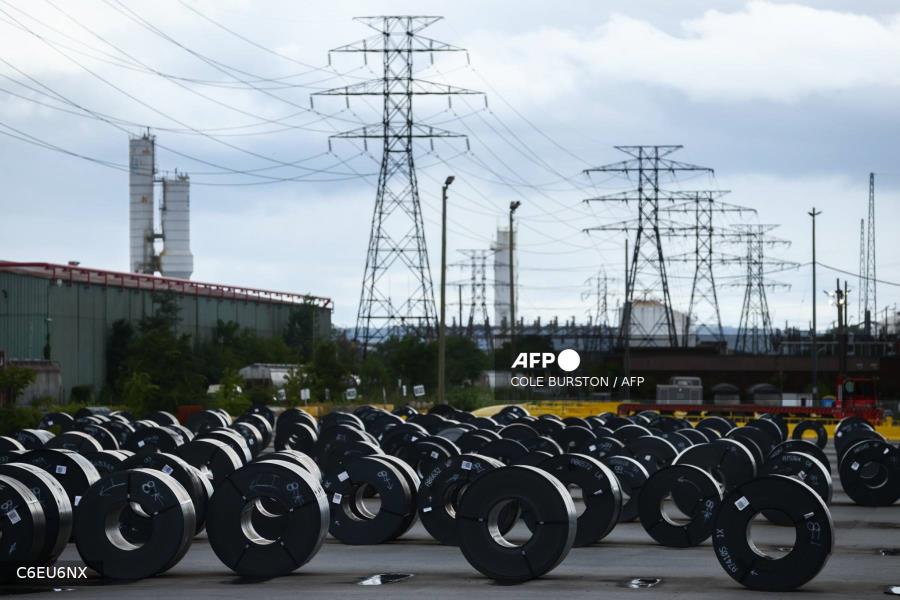
While more than 80% of Canadian products remain duty-free in the U.S., the tariffs imposed by the Trump administration since last year have already had a strong impact on the aluminum, steel, and automotive sectors.
The Canadian economy even briefly entered a technical recession in the first quarter but has shown some ‘signs of improvement’ since then, according to the Bank of Canada.The new 50% tariffs targeting products as varied as wine, hockey sticks, or cement affect “only about 5%” of Canadian exports to the United States, according to RBC Bank, which doesn’t see Canadian growth being hit “significantly.”
But they concern products that were so far protected by the Canada-US-Mexico Agreement (CUSMA).
“It’s a first” that “scares” Canada, says Laval University international economic law professor Richard Ouellet, since this free trade agreement “has so far been a kind of shield.”
“The Americans” – who decided on July 1 not to renew this agreement, now subject to an annual review – “are opening a breach,” the scholar adds.Forced Diversification
Since taking office in March 2025, Mark Carney has been implementing a strategy to diversify economic partnerships in order to reduce the country’s dependence on the U.S. market.”Canada has what the world needs,” said Mr. Carney after the failed negotiations with Washington, referring in particular to its natural resources, “and we will not let any nation determine our future.”
From India to China, and even Saudi Arabia, the former central banker has traveled extensively to reconnect with countries where relations were tense or even frozen.
In January, he signed a preliminary deal with China, notably including the import of electric vehicles to Canada, which angered the Trump administration.
Relations with Europe, especially France where Mark Carney was received in June, have also been strengthened. In fact, Ottawa chose the German company TKMS in July to build its new submarine fleet.
This strategy quickly got its first results. In 2025, Canadian exports to markets other than the United States increased by 11.1%, making up nearly a third of total exports, “the highest level in 40 years,” according to the Ministry of Foreign Affairs.
The government also got various Canadian provinces to ease the existing customs barriers within Canada itself. As a result, “the Canadian market has been revitalized and more goods are being imported within the country,” says Richard Ouellet.Big Projects
Carney has also focused his efforts on launching big projects like expanding the ports of Montreal and Vancouver, aimed at Asia, as well as opening new mines.
He also wants to build a new pipeline connecting Alberta’s oil sands deposits to the Pacific coast to export Canadian oil, which is currently mostly sent to the United States, to Asia.
Overall, over the next five years, Canada plans to spend 115 billion Canadian dollars on infrastructure development and 82 billion on defense, an unprecedented increase in the military budget.

