
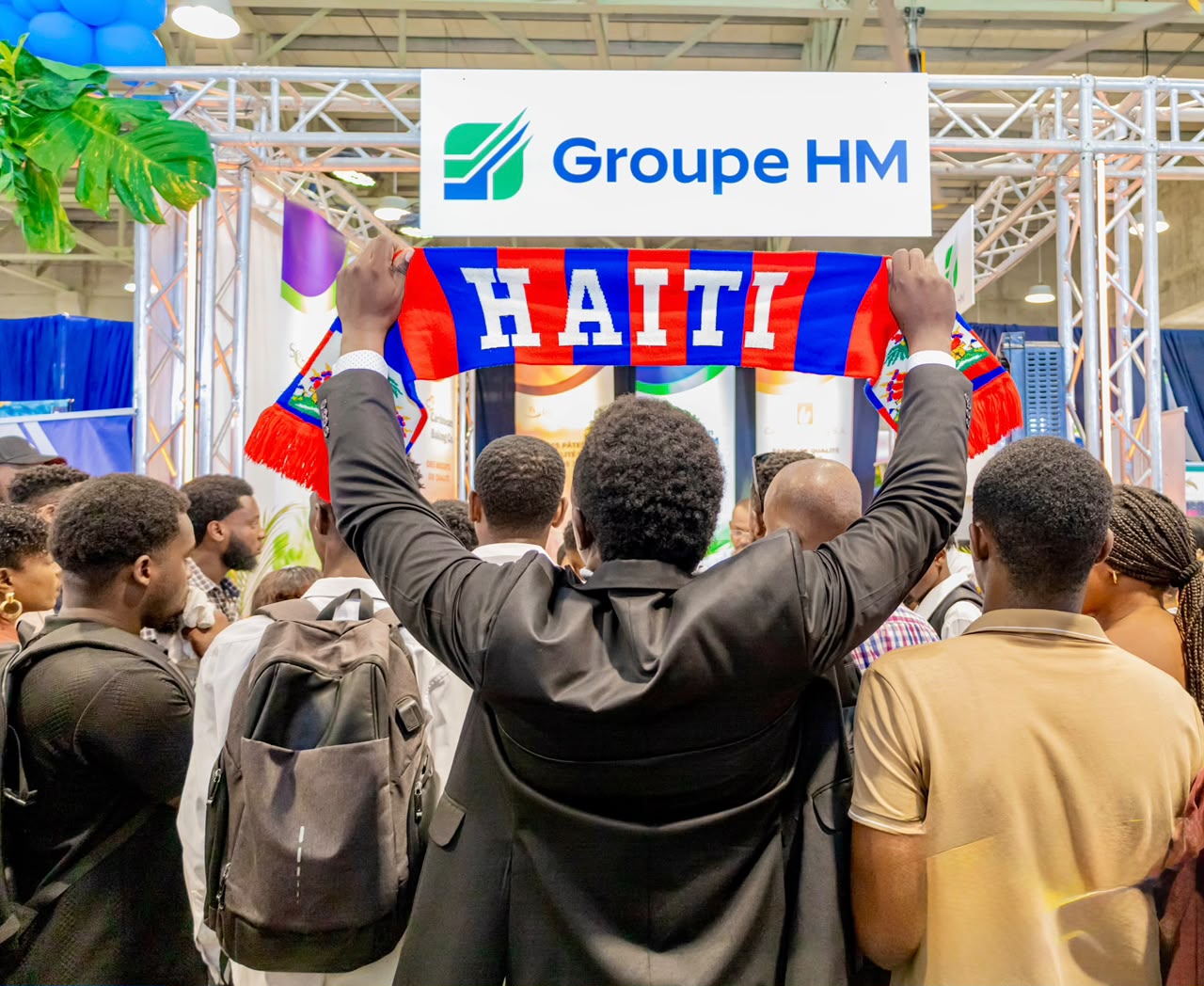
To wrap up Industry Week, the Ministry of Commerce and Industry (MCI) held an industrial fair at the El Rancho Convention Center on October 3, 2026.
To wrap up Industry Week, the Ministry of Commerce and Industry (MCI) organized an industrial fair on October 3, 2026, at the El Rancho Convention Center. More than twenty companies and institutions took part in this event, which focused on local production, innovation, and employment.
The last day of Industry Week was celebrated in a festive atmosphere. From the entrance, visitors could see booths set up to showcase products, services, and initiatives. Free entry allowed the public to move between different areas and discover a range of companies, especially from the manufacturing, production, handicraft, and pharmaceutical sectors.Rhum Barbancourt, the HM group, Culligan, la Couronne, the tobacco company Comme Il Faut, the agro-food companies Mèt Fèy Vèt, Huileries haïtiennes S.A. (HUHSA), as well as several other institutions and companies were all part of it. Some businesses took the opportunity to showcase their products, while others highlighted their initiatives. Rotaract, the Ayiti Bon contest, and the Young Mayor contest from the Ministry of the Interior and Local Authorities were also among the participants.At the Mèt Fèy Vèt booth, corn took center stage. Biscuits, flour, fertilizer, and animal feed were among the products shown to visitors. For Harry Nicolas, the head of the agro-food company, the fair is an important opportunity for businesses with limited means to promote themselves. “This event is not only a showcase for companies that can’t afford broad advertising, but it also allows young people to bring their resumes and apply for potential jobs,” he explains.
For the entrepreneur, the value of this initiative also lies in the closeness it creates between the ministry and businesses. He believes that the MCI didn’t just stick to theory but tried to engage directly with the industry players. “The ministry isn’t just about theories. It managed to get grounded and be there with the companies and industries,” he points out, while hoping that this first edition will lead to a long series of similar events.At Huileries haïtiennes S.A. (HUHSA), the fair is also a chance to meet consumers directly. The company, known especially for its oils, butter, and soaps, took the opportunity to showcase a new product: a wine that it will be the legal distributor of in Haiti. But behind the displayed products, the challenges of the private sector are still very much present. Like other companies, HUHSA has to deal with the consequences of the country’s economic and security situation. Transporting goods, in particular, is a source of extra expenses. Products have to go through several toll points before reaching their destination, which adds to the costs.Innovation also played an important role. At PL and Co, a company coordinated by Sheiline Derius Lucas, plants are used to make soaps and feminine hygiene products. The company, made up mainly of pharmacists, aims to combine traditional Haitian know-how with modern knowledge to offer products that are presented as more effective.
On its side, Eco H2O S.A., a company led by agronomist Cherenfant, presented solutions aimed at tackling some everyday problems. The company offered, in particular, a stove designed to reduce coal consumption as well as a water treatment system using clay. Research and experimentation were also on display at the Canado Technique booth. Several students showcased their projects and didn’t hesitate to perform demonstrations for visitors. Among them, Olivier Amy Henkels displayed a device designed for people with asthma. The equipment, both visual and auditory, would alert the user when certain parameters, like temperature, change, which could pose a risk for them.When the fair also becomes a job space
However, the event wasn’t just a showcase for companies. It gradually turned into a place where employers and job seekers could meet. With papers and resumes in hand, many people were walking around the booths looking for an opportunity. Some waited in front of the companies that had caught their interest. Others handed their resumes directly to the managers.Georges, a young electromechanic, was especially trying his luck with La Couronne. Other young people were heading towards Rhum Barbancourt or to the companies present at the fair. In some lines, the wait didn’t dampen the good mood. A few candidates were dancing to relieve stress, giving the job search an unusual vibe. No company accepted resumes without a long line forming in front of their booths. For both organizers and participants, the goal was also to create this direct contact between companies looking for talent and young people looking for a job.Financial institutions and support structures were also present. The National Credit Bank and the Investment Facilitation Center had set up their spaces to introduce entrepreneurs to the services available and the mechanisms that could support them. The Ministry of Commerce and Industry, for its part, had set up a booth dedicated to business formalization, allowing visitors to get information and carry out certain steps related to registering their business.As the afternoon went on, the atmosphere became even livelier. Several DJs and music bands took over and kept the crowd, especially the young people, moving. Music, demonstrations, trade exchanges, applications, and product discoveries all blended together until the end of the day.
It seems that the revitalization of the industry, chosen as the theme for this first edition, wasn’t just about businesses. It also brought producers, consumers, institutions, and young people seeking opportunities closer together, in a fair where the Haitian industry showed itself in many different ways.

