
3.7 billion people live in countries where interest payments on public debt are higher than spending on health or education.
- 3.7 billion people live in countries where interest payments on public debt exceed spending on health or education.
· – Developing countries paid nearly $1 trillion in net public debt interest in 2025, almost three times the level of 2010.
· – Narrowing the borrowing cost gap with developed economies could allow developing countries to save $500 billion a year in interest payments.
· – A new UNCTAD report identifies promoting the Borrowers’ Platform as one of the global actions needed to tackle structurally higher borrowing costs.Rising borrowing costs are putting more pressure on the public finances of developing countries, cutting the resources available for health, education, and other development priorities, warns UNCTAD in the latest edition of its publication ‘A World of Debt.’
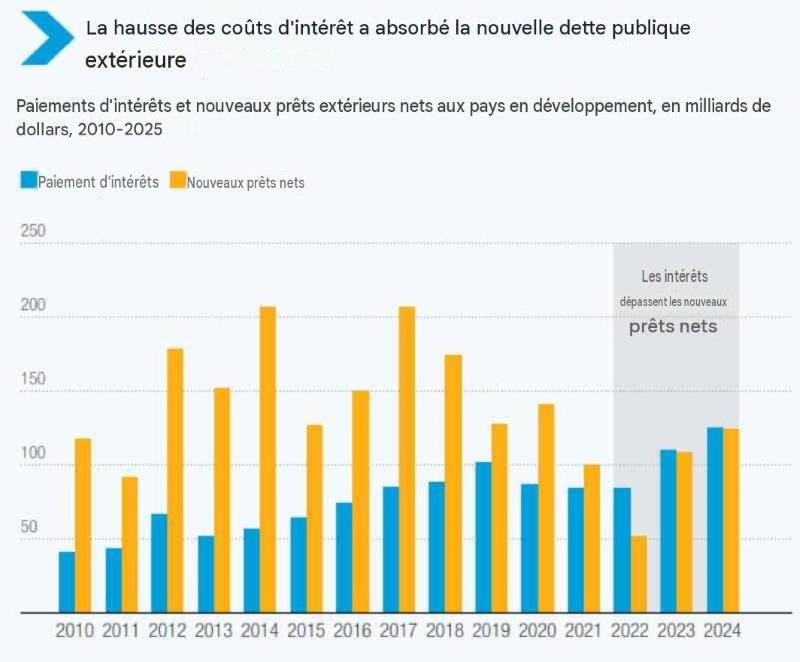
‘Debt is supposed to help countries invest in their future. But in many developing countries, servicing external debt now exceeds the amount of new loans received,’ the report notes, highlighting a broader shift in the role of debt.
Since 2022, interest payments on external public debt have surpassed the net new loans given to developing countries.This means that foreign borrowing doesn’t bring additional resources for development, but instead leaves developing countries increasingly dependent on domestic borrowing, which comes with higher costs.
The weight of debt is increasing
The UNCTAD report shows that global public debt reached 111 trillion dollars in 2025, up from 49 trillion in 2010.
Although more than two-thirds of the total stock is held by developed economies, debt has grown much faster in developing countries.As a result, interest payments on public debt in developing countries rose from $363 billion in 2010 to nearly $1 trillion in 2025.
Cost of interest and development constraints
The rising cost of debt is increasingly affecting governments’ ability to invest in essential public services.
In 51 developing countries home to 3.7 billion people, interest payments on public debt have exceeded government spending on health or education.Reducing the borrowing cost gap could generate substantial gains, suggests the UNCTAD report.
If developing countries could borrow at rates comparable to those of developed economies, they could save about 500 billion dollars a year in interest payments.
That amount could fund around 1.3 million primary healthcare centers or ensure a minimal, diverse diet for roughly 1.6 billion children each year.

