
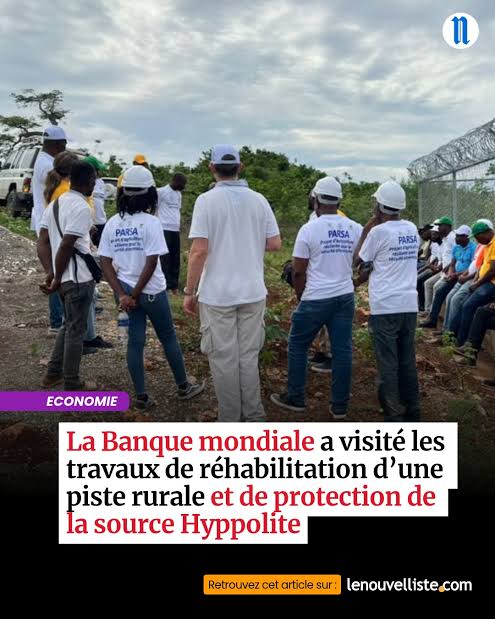
The M2 | SHACO group welcomed a delegation from the World Bank and representatives from the Ministry of Agriculture, Natural Resources, and Rural Development (MARNDR) in Fond-Rouge Torbeck, in the Jérémie area, on Wednesday, November 4, 2026.
The M2 | SHACO group welcomed a delegation from the World Bank and representatives from the Ministry of Agriculture, Natural Resources, and Rural Development (MARNDR) on Wednesday, November 4, 2026, in Fond-Rouge Torbeck in the commune of Jérémie. The visit focused on two projects under the Resilient Agriculture for Food Security Project (PARSA): the rehabilitation of the rural road connecting Carrefour Carton to Carrefour Prince, which has been completed and handed over, and the protection of the Hyppolite spring, which is 85% finished. Funded by the World Bank, these projects fall under the responsibility of MARNDR. The M2 | SHACO group is in charge of carrying them out as part of PARSA’s community participatory works.In Martineau, the delegation checked out the improvements made to protect the Hyppolite spring catchment, which supplies households in the local area and part of downtown Jérémie. The work, 85% complete, includes a stone masonry wall, a metal fence, and a gate. During the visit, Francis Alphonse, one of the leaders of the M2 | SHACO group, explained that marking the perimeter was meant to control access to the catchment and reduce the risk of water contamination.The national coordinator of PARSA went on, visibly pleased with the progress of the project, while Gérald Neuvième was delighted with the community participatory approach developed as part of this initiative.
With the PARSA project, ‘we have to do sustainable work that involves the active participation of the people.’ He also highlighted the dual importance of the project, which, he said, in addition to protecting the water source, also helped create jobs.This visit wouldn’t be complete without a few words from a local representative. Wearing a white T-shirt with the project logo and looking cheerful, Melord Jeanty, CASEC coordinator of the 9th section of the city of Jérémie, first thanked the World Bank for the concrete slabs built in the area. These structures, he said, have improved traffic, making it easier to access materials and transport agricultural products.
Mr. Melord then expressed his gratitude for the source protection dam, recalling the area’s vulnerability before the wall was built. The CASEC coordinator said he hopes to see the World Bank continue supporting the community through the PARSA project.The civil protection representative, head of a women’s organization and direct beneficiary of the project, Marie Jelissaint Mercure Breen, daughter of Martineau, praised the improvements made and said she was proud of the spring she had known since childhood. She did not hide her gratitude at seeing the World Bank and its team step in to protect this spring. According to Jelissaint Mercure Breen, the spring had been in poor condition: “Many trees were cut down, animals were allowed to live there, etc.” In her graceful voice, she thanked the entire team and requested a bridge, which would be very beneficial for the area. “Because when the spring overflows, we face huge difficulties and suffer many losses.”It’s worth noting that a track was also rehabilitated to make travel and transporting crops easier. These completed works include the construction of concrete driving lanes with stone paving between the lanes, the reshaping of unpaved sections, and the creation of drainage structures. This notably includes a reinforced concrete culvert at Carrefour Débarasse, which allows runoff water to flow under the track. The rehabilitated track has a usable width of 2.80m.
Concrete driving lanes 20cm thick were also done on three sections totaling 350m at Bas-Débarrasse, Débarasse, and Martinau. 200m of track were reshaped. All of these works have been completed and accepted.
Adlyne Bonhomme

