
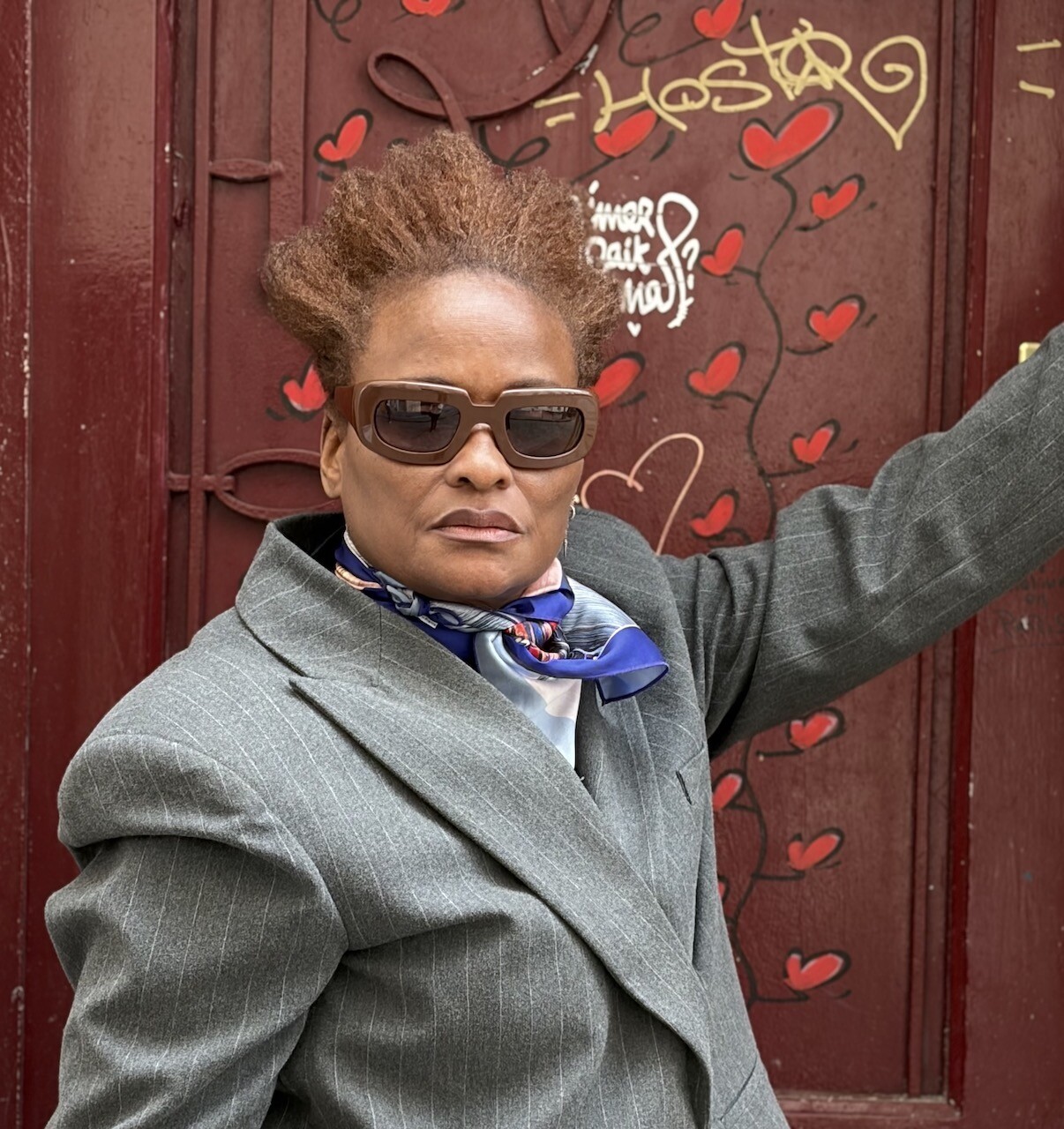
Here’s the continuation of the portrait that Monique Clesca paints of the artist Kettly Noël.
In the first part, you discovered the first upheavals in the life of Kettly Noël, dancer, actress, and choreographer. It is in Port-au-Prince that she fully commits to the path of dance. In this final part of the portrait, discover the continuation of her journey, marked by encounters, learning, and her first opportunities. At only 13 years old, Kettly Noël receives her first scholarship and begins taking folklore classes with Viviane Gauthier, a dancer and teacher of Haitian folk dances.
At 17, just after her mother left for the United States, she started dancing with Rachel Jean-Louis, who was passing on the Katherine Dunham method. Kettly Noël received her second scholarship and spent three years at that school. A valuable relationship developed between the two dancers: “With her, I danced at the stadium for President Aristide’s inauguration. I’ve always appreciated her love for dance. She is one of the people who made my work easy and enjoyable.”
Kettly Noël danced with Patrick Lacroix and his group Perfect: “From there, I developed a sort of immunity to Viviane Gauthier’s folklore.” She went from show to show, here with Bookman Eksperyans and Mario Benjamin, there with Émeline Michel.Very discreet about her love life, except to say that she met the man who would become her husband, a teacher and diplomat, with whom she has a daughter, Carmen Aïda, in the living room of Ralph Boncy and Émeline Michel in Pétion-Ville. This was during the preparation of the latter’s tour in France.
“I got the idea in my head to leave Haiti, to go instead of continuing at dance school. Haiti was too cramped for me; it felt like confinement. I didn’t stay; I went to train. I wanted to leave dance because I didn’t see a future career in it. I didn’t want to be a dance teacher; I wanted to dance and be a choreographer.” Her ticket came through a visiting artist scholarship from the French Institute to study dance.August 1991, heading to Paris. In the Abbesses neighborhood with its art-house cinema, theater, cabaret, the Moulin de la Galette on Montmartre hill, the guinguettes, ‘there was everything for a young Haitian woman coming to Paris. I could have gone to Berlin, but I chose Paris to open myself to the world, to be bohemian, to perform on rue Fille des Calvaires. It was a way of being an artist. I was nourished,’ she says, laughing. She was 23 years old.
‘Doors opened for me: there were writing workshops, theater classes. Jack Waltzer took me on after an audition to work with him on L’Ours de Troyes; I performed at the Arènes de Nîmes. People pushed me, saying, ‘You’ll have to continue in this direction.’ That’s what made me who I am. I forged my artistic identity. It seems simple, but I think if I had stayed in Haiti, I never would have been able to overcome the barriers.’ At the same time,Africa
Her hunger for elsewhere led her to Africa, first to Benin in 1995 to open the first contemporary dance space in Africa. Then she moved there to live with her husband and their 3-year-old daughter.
At the end of 1999, she headed to Mali, accompanying her husband to Bamako. Taken by the country, she decided to settle there. And that would last for almost twenty-four years during which she built her artistic world in the Malian capital.
“What do you leave them?” I wondered. Shortly after, she set up the Donko Seko training and creation space to promote learning and sharing. Then, she founded Dense Bamako Danse, an international dance festival that takes place in the streets all over the city. She also had a restaurant-bar where she organized concerts; the singer James Germain, invited for a show, then spent 3 years in Mali.Kettly Noel refuses to accept the status quo. “Back then, dancers always had a sponsor, like ‘she’s your dancer.’ In a way, I realized that I wanted to change the image of the dancer, the image of the nightlife artist, the girl of pleasure. Dancers had a bad reputation. That wasn’t the image I had of them, but I also didn’t want the image of the cheap, folkloric dancer,” she explains. “I changed that in Africa. I improved the image of the dancer.”
Through her many performances in France and across Africa – in Niger, Chad, Kenya, Mozambique, and South Africa – she receives honors for her work. She was one of the 50 most influential Africans one year. Later, she was named Chevalier of Arts and Letters of Mali, and received the Marcel Deschamps Prize at Beaubourg and the RFI Découvertes Dance Prize.In November 2022, she left Mali for good and admitted that emotionally, she wasn’t ready. So, why leave? “Since 2010, I felt that I had finished my work in Africa. But, I’ve always had trouble making decisions. I needed a change. I was looking for other challenges, other desires. I had seen it all, even for a long time.”
France
Since her return to France, her schedule has been tightly packed. Today, her projects are numerous because she takes on many roles, even while noting “that in France these days, it’s tough.” She works with the Théâtre national de Chaillot in difficult neighborhoods in Paris. In Basel, she put on a dance performance. She also collaborates with Benjamin la Fontaine, former director of the Paris Opera, and his series on other dancers.Avec force et détermination, Kettly Noël porte en elle son pays : « Haïti est toujours présente dans mes démarches artistiques. Donner une autre image de Haïti a été une constante de ma carrière. » Dans ses performances, elle mélange danse, théâtre et littérature pour interroger, pour proposer, pour décrier, pour valider des voix, des choix, des expériences en gardant le focus et la lumière sur Haïti et son identité. Elle affirme : « J’ai des inspirations Africaines et j’ai une identité multiple et diverse. C’est aussi ça et tout mon parcours, ce que je fais aujourd’hui et demain qui me nourrit. » An example is her choreography about coffee and Haitian debt, staged on the esplanade of the Palais de Tokyo with the Eiffel Tower as a backdrop. “I made a colonial counter with something about coffee and money. I threw the money in the audience’s face.” She adds with a sly smile, “Even better, we got lucky with the wind that blew the money onto people. They were bills with the Eiffel Tower on them. Fo yo bwe kafe a. Fok yo santi bagay la.”
She talks about a new creation: a collaboration with poet and novelist Makenzy Orcel, whom she met at the Bales festival in 2018 and saw again in Mali in 2021. “We became friends. There’s a lot of love, respect, and things to share. I explained to him what I was interested in: words, expressions, sentences, gestures, and he wrote the text ‘Fillette Lalo ou tuer la mort.’ The idea is to go back to the root of evil, where does evil come from?”If this great dancer has less time to dedicate to her trips to the country, she still keeps a keen eye on dance in Haiti.
When it comes to folklore as practiced in the country, she chooses her words carefully to highlight the difference between traditional dance—creating a link with Africa and folklore. She explains that folk dance is meant to bring joy to tourists, to please, to smile. Traditional dance is not meant to please; it’s a dance to communicate with spirits, with a higher being, to announce war, a birth, and it exists between the beyond and everyday life.On the worrying issues of color and social class barriers that challenge her. “We have to overcome these barriers. We keep getting terrorized by that class in Haiti with the ‘go on, take your place.’ I have nothing against fair skin, or bourgeois women, but we need to move past that. We can’t keep our own society in oppression. We don’t like what we are. You always find someone who’s going to crush you.” She explains with a bit of irritation: “Neoclassical dance is a dance of oppression. You have to suck in your butt that sticks out. You need to move on, you need to deconstruct. Yes, I love classical dance, its technique is one that will carry everything you have today. But that whole classical dance class thing traumatized me. With their buns, by the way, you couldn’t tell who was Haitian, I never identified with that. It was in Haiti that I cut my hair, stopped straightening it.”On what it takes to develop dance in Haiti: the question of dance as a career and that of choreographic writing need to be addressed by the students. “The dance school doesn’t work with the idea that the dancer could be a professional. I wish we were trained for more than just being dance class teachers. It’s also important that they learn choreographic writing. We need to open up spaces, get out of the bourgeois family bubble, there’s a big lack of diversity,” says the choreographer who has traveled the world with dance. There also needs to be work between dance and theater. “Theater people are the best people I’ve been able to work with. Why doesn’t that exist in dance in Haiti?”Kettly Noel is also involved in passing on artistic and social education in Haiti, the Caribbean region, and in France, notably through the Compagnie KN (Kettly Noel) Dance Project, founded in 2020. She gives masterclasses and works with young people. In Haiti, she offers dancer training in contemporary creation and choreography with PAPLAB (the Port-au-Prince laboratories) to bring culture to remote places and to people who are far removed from it. This is a project supported by Fokal, which has welcomed her since 2018, and the French embassy. “For me, we have to keep doing things in Haiti; we can’t just stay sad, that’s how we move beyond ourselves.”
She admits, however: “I’m really struggling with Haiti, I feel uncomfortable. I’m sad and deeply hurt. I would have loved to see my country differently, to see my country shine. I feel like it’s going to take time. I bring my knowledge, openings, support, possibilities to the younger generation. Culture alone isn’t enough, but it’s my field.”
There’s something poetic about closing a circle, because after nearly 20 years, this month, the one many think of as their little spark of madness returns as a big star in Haiti.
Kettly Noel is the one who dared. To leave the country. To challenge this taboo that is classical dance and folk dance. To learn lessons. To push boundaries. She sums it up in “two words: always dig. You have to. And even when you search, you always dig with great fear, sometimes it’s painful. But you always dig.”
Monique Clesca is the author of Silence and Resistance, Memoir of a Girlhood in Haiti, published by Wordeee.

