
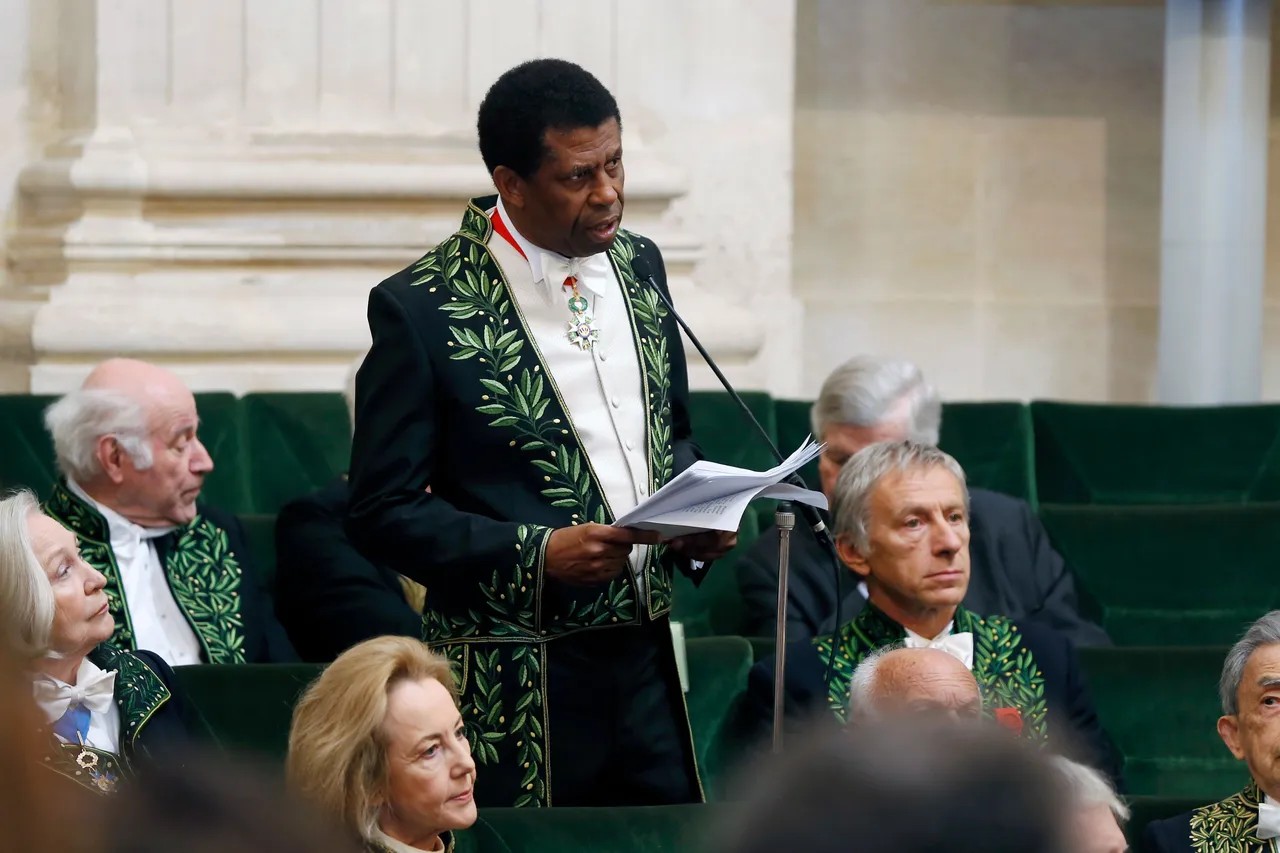
Through this tribute, Jarry Jacques celebrates the remarkable journey of Dany Laferrière, the first Haitian-Quebecer elected to the French Academy.
Through this tribute, Jarry Jacques celebrates the remarkable journey of Dany Laferrière, the first Haitian-Québécois elected to the French Academy. From exile to recognition, his work and commitment show the power of literature to cross borders, preserve memory, and shine a light on Haiti. More than just a writer, Laferrière comes across here as a messenger of hope, whose words continue to inspire current and future generations.From Exile to the French Academy: The Journey of a Universal Writer
Having become the first Haitian-Québécois to sit in the French Academy, your journey reminds us that every human being has an inner library, a homeland made up of readings and encounters. It is this quiet strength and this insistence on cultivating beauty that, every time, guide me during my hours of devoted reading. Your philosophy is thus about taking the time, observing the world with a child’s naivety and a writer’s cunning, offering a true model of personal and authentic development. In a world where everything moves too fast, where everything goes wrong, you teach us to savor the moment, just like your grandmother’s coffee ritual. Nothing is sweeter than being loved by your grandparents, nothing.As a cultural journalist in Haiti, you had to flee Port-au-Prince in 1976 after the assassination of your friend Gasner Raymond. Having taken refuge in Montreal, you went through a series of odd jobs and worked as a factory worker to survive. In 2009, you received the Médicis Prize for L’Énigme du retour. In December 2013, you were elected to the French Academy, taking seat number 2, previously held by Hector Bianciotti. During the solemn opening session of the five Academies in 2019, you, so to speak, helped get the word ‘Vertières’ into the French Academy dictionary. It now appears in the ninth edition as a symbol of a historic, literary, and artistic victory, referring to the memorable district of Cap-Haïtien, the site of the Battle of Vertières on November 18, 1803.Inspired by this bright freedom that comes from your literary work, I realized through your stories that writing is above all an act of poetic resistance and a way of inhabiting the world. Personal and creative development, as you practice it with seeming ease, lies in this ability to turn exile and constraints into a springboard toward the universal. That’s why I want to pay tribute to you, because your words, whether written or spoken, have strengthened my belief that building oneself doesn’t happen in a rush, but in the attention given to others and to the little things. Thanks to your writing style, living in a foreign land no longer feels like a tear, but like an infinite space of freedom and creation.Writing as a Refuge: Memory, Exile, and Creative Freedom
On the show Le Point on Radio Métropole, with Wendell Théodore, on Friday, July 17, 2026, you appeared wearing a yellow shirt and tie under a black jacket, with a hat on your head. During this interview, you emphasized that culture and art continue to stand strong to nourish the hope of the Haitian people, even in times of national tragedy. Your dedication is therefore an invitation to slow down, notice the details, and celebrate life, glass in hand.
Autobiographical novel, The Smell of Coffee makes this scent an ever-present motif representing a haven of peace. Your haven of peace. In this striking sentence, you say: ‘One day, I asked Da to explain paradise to me. She showed me her coffee maker. It’s Palms coffee that Da prefers, mostly because of its smell. The smell of Palms coffee. Da closes her eyes. For me, the smell makes me dizzy.’ This aroma not only evokes a sweet memory but also acts like a true madeleine de Proust. It grounds me even more in Haitian culture and embodies the physical and reassuring bond that connects a little boy to his nanny. All in all, this title is a powerful literary vehicle.To describe it, you mainly use figures of analogy, especially personification, which gives human traits to the smell of coffee: ‘The heady scent of coffee grabbed me as soon as I woke up,’ as well as comparison, which likens the aroma of this black liquid to a comforting or familiar element: ‘The smell of coffee spread through the kitchen like a warm hug,’ you write.From your difficult early days in Montreal to your academic attire, your journey informs all of your thinking. In The Enigma of Return, published in 2009, you highlight the harsh reality of the exile, unable to fully fit into the cold Montreal environment. The distance becomes a real “enigma,” to the point that physically returning to your home country does not end the uprooting. However, you show that exile is not just a wound, but also a driving force for writing. Faced with this pain, imagination becomes an essential coping strategy, allowing you to carry your homeland within yourself, no matter where you live.To ease the pain of being apart and the grief over your father, you turn to wordplay and poetic puns. Instead of using classic expressions, you create new words and word pairings that capture an entire human condition. ‘The exile of time is harsher than that of space. I miss my childhood more painfully than my country,’ you add in this work.
The return to Haiti: sharing hope through literature
Invited by the rectorate of the State University of Haiti (UEH), you made a memorable return to your country on July 11, 2026, as part of a literary tour. This visit led to passionate exchanges with students and young people, symbolizing resilience and cultural transmission. Beyond these university meetings, your voice carries a message of hope, inviting the public, even the whole world, to come ‘see’ and discover Haiti, with the support of the Ministry of Tourism. This approach highlights the importance of culture and tourism in showcasing the country.Ultimately, your return to Haiti in the summer of 2026, at the invitation of the State University of Haiti, feels like a triumph of memory over exile. This literary pilgrimage shows that your roots remain intact and sends a vibrant message of hope about passing things on and the eternal power of words against the hardships that plague Haitian land. This trip also proves that, despite the years spent in Montreal and Paris, your umbilical connection to your homeland remains unbreakable.The triumphant reception you received shows just how much culture and poetry transcend crises and act as a beacon for Haitian youth. Far from being a simple ceremonial visit, your series of lectures resonated deeply with the nation’s resilience. By engaging with students, you reminded everyone that writing remains the ultimate defense against forgetting and despair. This poetic journey of 2026 thus completes the circle of The Enigma of Return, showing that while exile is a wound, literary creation allows you to reconnect with your roots in order to reinvent yourself.