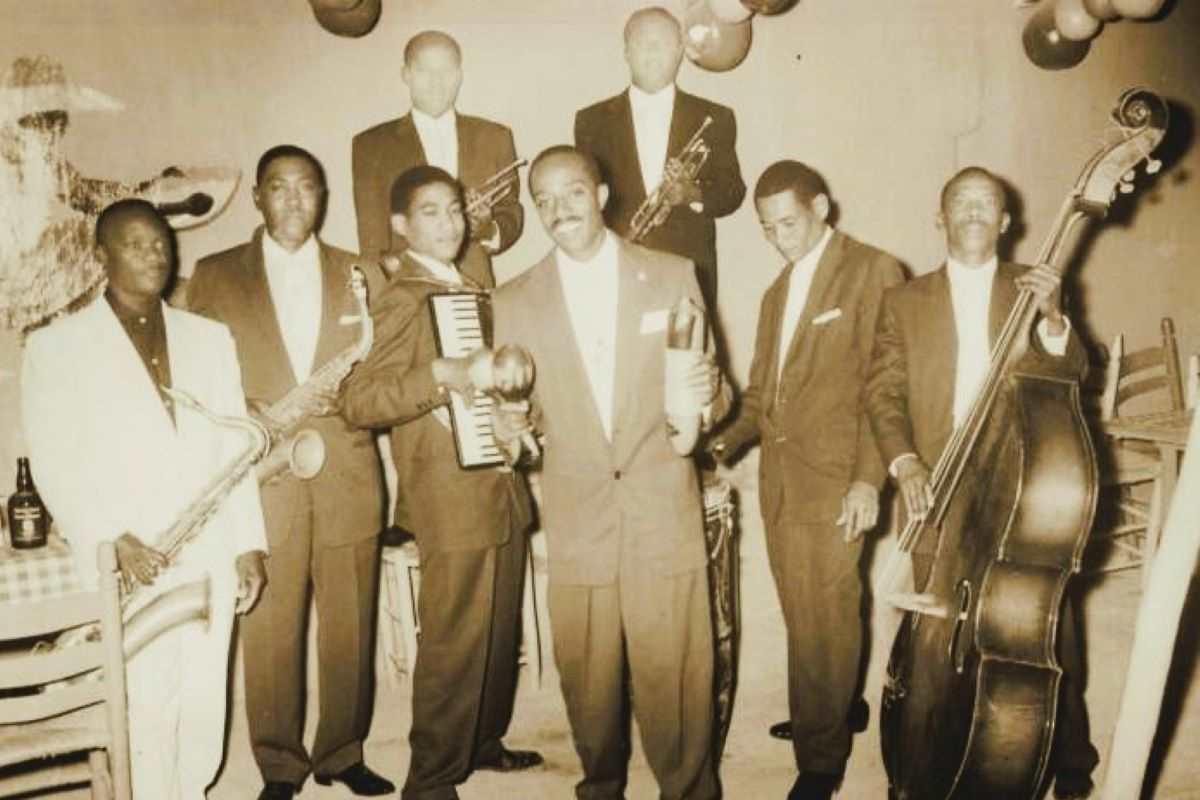
Seven musicians played on the night the Compas Direct was born. This first part features four of them: the two saxophones and the two voices from the founding group.
There were seven of them that night. On the night of July 25-26, 1955, at Place Sainte-Anne in Port-au-Prince, the newly formed Conjunto International brought together Nemours Jean-Baptiste and Wébert Sicot on saxophones, Julien Paul and Anilus Cadet on vocals, Monfort Jean-Baptiste on double bass, Mozart Duroseau on accordion, and Kreutzer Duroseau on drums. Collective memory has only remembered one name, that of the maestro. This series is dedicated to all of them: four musicians in the first part, three in the second, and those who joined the adventure later in the third.The setting was that of a music scene under influence. Since the 1949 Bicentennial International Exhibition, the airwaves and nightclubs of the capital had been playing Mexican, Cuban, and North American sounds. Musician Mario de Volcy, an endless repository of compas knowledge, talks about it as a cultural invasion. Haitian musicians were taking on these repertoires while trying to find a national style that could compete with them. During a trip to Saut-d’Eau, Nemours and Sicot agreed to form a band as soon as they got back to Port-au-Prince.On July 25, 1955, right in the middle of preparations for the Saint Anne festival, they got together at Léon Volcy’s place on Champ-de-Mars Street, along with several other musicians. The idea came up to take advantage of the lively streets to play outdoors. Nemours took Sicot in his Simca to get his saxophone. From his car, megaphone in hand, he shouted out the invitation: ‘I’m waiting for all of you at Place Saint-Anne.’
The square’s kiosk turned out to be too cramped. The orchestra set up at the south entrance, facing the church, in front of a place that would later become Maggy’s bakery, with power drawn from the nearest pylon on Carbone Street. The chronicler Robert Noël carefully recorded the layout, between the Toussaint Louverture high school on Saint-Honoré Street and the Dodo Dufresne funeral parlors.
The band named itself Conjunto International, echoing the Latino trend of the moment. The first piece they played isn’t certain: it may have been a composition by Anilus Cadet or a merengue called “Mercedes.” The night’s repertoire also included tunes like “Bannann pouyak,” “Grenn moudong,” and “Maskawon.”Nemours, the Mastermind
Nemours Jean-Baptiste, on tenor saxophone, led the orchestra. Born in Port-au-Prince on February 2, 1918, he grew up on Lakou Labissière dead-end street, Rue des Fronts Forts. After studying at Jean-Marie Guilloux, he worked as a guitarist, footballer at Racing Club Haïtien, tailor, barber, and shoemaker. His neighbor François Guignard introduced him to Anilus Cadet’s Trio, which performed on Radio HH2S, where he started on guitar before co-founding the Trio Anacaona. A stay in Les Cayes redirected his career: Destinoble Barrateau introduced him to the saxophone, and he permanently gave up the banjo. Around 1946-1947, he joined the Orchestre Atomique; after it dissolved in 1953, he performed regularly at Tana or at Titato in Bel-Air.The public’s reception, in the days following July 26, was mixed. In Le Nouvelliste, Roland Léonard noted that the rhythm was initially mocked by music lovers attached to the ibo, in Congo, to the classic and slow méringue, to the contredanse, and to the petro. The younger audience, however, embraced it. Promoter Jean Lumarque brought the orchestra into his club in Kenscoff, then into a second venue decorated with colorful calabashes, where the Ensemble aux Calebasses settled. The public quickly dubbed this music the ‘calabash rhythm,’ derived from the karé dance, which itself was inspired by the carabinier beloved by Dessalines.According to Ed Rainner Sainvil, in ‘Tambours frappés Haïtiens campés,’ this music, soon called Compas Direct, stood out for its slower tempo, pronounced syncopation, the introduction of the gong, a drum set acting as a metronome, a brass section with three trumpets and three saxophones, dynamic riffs, and the sharp drumming of Kreutzer Duroseau, the creator of the rhythmic break. Nemours added the electric guitar and bass, being the first to introduce them to Haitian dance halls, despite criticism from his rivals.In 1958, after breaking up with Jean Lumarque, the orchestra became the Nemours Jean-Baptiste Ensemble. Facing Wébert Sicot, the creator of the cadence rampas, he founded in 1963 the Super Ensemble Nemours Jean-Baptiste. Their rivalry peaked on April 8, 1964, at the Sylvio Cator stadium, during a football match refereed by Raoul Guillaume, which ended in a draw, one goal each. This emulation, among others, sparked the creativity of both leaders.
At the end of the 1960s, the rise of mini-jazz transformed the scene. Nemours went into exile in New York in December 1970 with his Super Ensemble, which dissolved after a few shows. Back in Haiti at the end of 1971, he returned to the stage with Top Compas, then created in 1973 the Super Combo Nemours Jean-Baptiste. His eyesight declined, and despite hope from surgery, he lost his vision completely. He passed away on May 18, 1985, the very day Ti Manno was buried in New York.Wébert Sicot, the alto who trained the maestro
Within the Conjunto International, Wébert Sicot, on alto, faced off against Nemours’ tenor. The two wind players formed the frontline of the orchestra, and the project was born from their agreement in Saut-d’Eau. His contribution even came before the group: after the training received in Les Cayes, he was the one who perfected Nemours’ mastery of the saxophone. The two men were already performing together in Tana or at the Titato in Bel-Air.Born in Port-au-Prince on April 14, 1930, he grew up in a family of six children. His mother, Dormélia Casimir, a shopkeeper and practitioner of Vodou, introduced them to music at an early age. At Collège Simon Bolivar, he won a contest that allowed him to learn the flute. Gérard Dupervil then taught him music theory, before his brother Raymond continued his training. According to Ed Rainner Sainvil, he refined his skills at the Maison Centrale des Arts et Métiers under Augustin Bruno and picked up the alto saxophone there. Later, he and his brother Raymond were recommended to Claudin Toussaint, who brought them into the Jazz Capois: this was their professional debut. They went on to play with Jazz des Jeunes and the Orchestre Issa Saieh, with which he recorded a record.
Disagreements with Nemours led him to join the Orchestra of the International Casino. In 1957, he stayed in Italy on tour with Joe Trouillot and Roro Baillerjou, known as Ti Roro, then went to Miami, where he honed his skills. Returning to Port-au-Prince in 1959, he led the Latino Orchestra, founded La Flèche d’Or with his brother, and in 1960 created the Wébert Sicot Ensemble, with which he launched the cadence rampas and its new rhythmic variations. A multi-instrumentalist, he played the flute, guitar, trumpet, drum, bass, trombone, and alto, tenor, and baritone saxophones.
From 1967, Compas Direct and cadence rampa lost ground to mini-jazz. Facing financial problems, Sicot quietly left Haiti for New York in 1968. There, he founded the Orchestra Le Jeune with Charles Delva and Duffont Mayala, played in cabarets in Brooklyn and Manhattan, recorded with Ibo Combo, and collaborated with the big CBS orchestra. Back in Haiti in 1972, he founded the Wébert Sicot Orchestra, worked with Zotobre by Serge Rosenthal, and joined the National Radio Orchestra led by Raoul Guillaume.
In 1977, during the carnival route, a tree branch threw him off his float at the corner of Monseigneur Guilloux and Oswald Durand streets. That didn’t stop him from recording the album “L’Union,” a sign of a belated reconciliation with Nemours, his former partner turned rival. His health was declining day by day. After an incident at the General Hospital, where he had accompanied his sick son, he was met with indifference from the staff.A anger that worsened his heart problems. Wébert Sicot passed away on February 4, 1985, right in the middle of carnival season.
Anilus Cadet and Julien Paul, the two voices of the core
Anilus Cadet was the only one in the group who joined already with a solid reputation. Probably born in 1915, he was one of the most notable twoubadou guitarists of the 1940s and 1950s. Initially self-taught, he later studied European classical guitar, a rare dual training in Haiti at that time. He led the Trio D’or, also called Trio Anilus Cadet, one of the flagship bands of Radio HH2S, one of the main stations in the capital. It was in this trio that the young Nemours took his first steps on the guitar. So the relationship was reversed: the elder had welcomed the younger.Cadet belonged to the generation that dominated the twoubadou scene well before the appearance of Compas Direct: the generation of acoustic trios that enlivened popular dances, local festivals, evening gatherings, and radio shows. In July 1955, he participated in the creation of Conjunto International, where he contributed his voice, his experience with traditional melodies and guitar accompaniment, as well as an already established reputation. His involvement was likely brief, as if he had mainly come to lend a hand to his friends before continuing his twoubadou career.
Julien Paul, on the other hand, wore many hats. Trained as a bassist and lead singer, he also wrote lyrics to the maestro’s melodies and stayed by his side for five years. Born on March 21, 1927, in Port-au-Prince, the son of Léonce Paul and Germaine Souffrant Paul, he left high school to work. He played at Jazz Scott for nearly three years, then moved to the North for a better-paying job in an industrial company.He returned after a year, then joined Jazz Cabral as a bassist and backup singer. It was at the Casino International that he met Kesner Hall, Djo Laveau, Robert Camille, and Nemours Jean-Baptiste.
He was also the one who wrote the lyrics to ‘Mariage Solennel.’ The chorus, which listed the lack of a house and a car as reasons to get married, almost cost him his engagement: Tico, his fiancée’s mother, saw it as mocking. Jean Lumarque and his wife Carmen stepped in to reassure her. Julien Paul got married in January 1958 at Saint-Charles Church in Carrefour. He left the band in 1961, moved to New York two years later, founded the Julien Paul Orchestra there, and worked for General Motors for fifteen years. In the summer of 2002, he recorded a tribute to Nemours Jean-Baptiste with Shleu Shleu. He died on December 29, 2005, and was the last surviving member of Conjunto International.Three other musicians were part of the founding core that night on Place Sainte-Anne: Monfort Jean-Baptiste on double bass, Mozart Duroseau on accordion, and Kreutzer Duroseau on drums. They were the section that kept the rhythm going, and whose names history of Compas Direct has barely remembered. The second part of this series will be dedicated to them.