
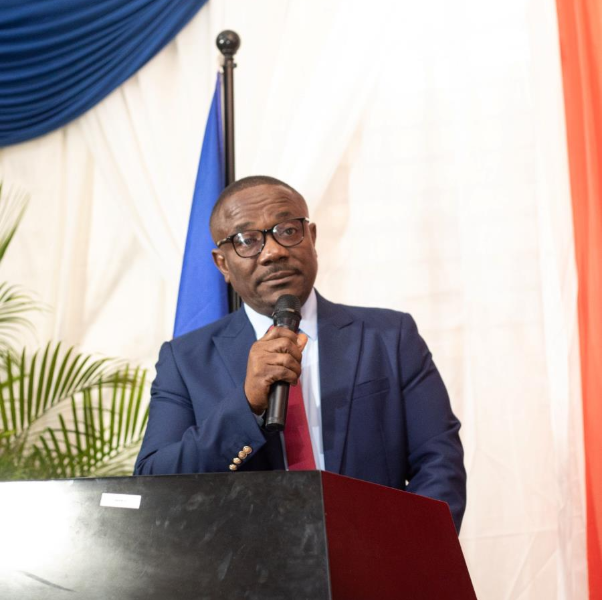
“Haiti, facing the next climate shocks: are we ready?” To this question asked during the BID’s Reflection Wednesdays this July, Minister Marcelin Aubourg, head of the Ministry of Agriculture, Natural Resources, and Rural Development (MARNDR), answered frankly.
“Haiti, facing upcoming climate shocks: are we ready?” In response to this question asked during the BID’s Reflection Wednesdays this July, Minister Marcelin Aubourg, head of the Ministry of Agriculture, Natural Resources and Rural Development (MARNDR), answered frankly. “Our country is still not sufficiently prepared. However, this answer should not lead us to discouragement or resignation,” said the top official of MARNDR, emphasizing that instead, it should prompt us to strengthen our capacity for anticipation, prevention, coordination, and action.In his presentation, Minister Marcelin Aubourg explained that climate change is not a distant threat. He mentioned some effects of climate change that are already showing up through seasonal irregularities: prolonged droughts, heavy rains, floods, cyclones, landslides, and the accelerated degradation of natural resources.
These phenomena, Mr. Aubourg noted, have a strong impact on the agricultural sector, causing considerable damage: crop losses, livestock deaths, soil degradation, reduced water availability, and destruction of irrigation infrastructure, farm roads, and productive equipment. Additionally, he added that these events weaken family farms, which often face a lack of resources to absorb the losses and quickly restart their activities.”When agricultural production decreases, the food supply shrinks, prices go up, and the country’s reliance on imports grows,” said Minister Marcelin Aubourg, pointing out that rural areas are never able to cope with the consequences of climate change-related events. Indeed, producers and traders in rural areas see their incomes drop. As for households, especially the most vulnerable, they are forced to spend a larger portion of their income on food.Other consequences caused by climate change phenomena have been pointed out by Minister Marcelin Aubourg. “Every climate shock becomes an economic and social shock that worsens food insecurity and increases the vulnerability of populations. Moreover, it heightens internal displacement and limits development opportunities in different areas,” said the MARNDR head, emphasizing that climate shocks put additional pressure on public finances.“After every disaster, the government has to quickly mobilize resources to help people, restore production means, repair infrastructure, and restart economic activities. With limited budget resources, repeating these emergency expenses reduces our ability to fund major investments in the country despite the needs,” said Mr. Aubourg, emphasizing that we need to gradually change this approach from one focused on damage repair to a policy centered on prevention, preparedness, adaptation, and resilience.
MARNDR’s Actions to Address Weather Events
According to Minister Marcelin Aubourg, this new direction is reflected in the MARNDR’s public investment program proposal for the current fiscal year. “MARNDR plans to allocate around 100 million gourdes to the pre- and post-storm emergency management project. This project aims to strengthen preparedness before weather events, as well as the pre-positioning of response resources to ensure quick action,” Marcelin Aubourg said, emphasizing that the funding for this proposal comes from the Public Treasury.A new national watershed management project has emerged from this proposal. To finance this project, an indicative budget of one million gourdes is planned. “Protecting watersheds is a first line of defense against erosion, floods, the silting of structures, loss of soil fertility, and reduction of water resources. These efforts are complemented by the proposal to dedicate 250 million gourdes to the rehabilitation and expansion of irrigated areas, and then 30 million gourdes to set up a national network for hydroclimatic parameters,” said Mr. Aubourg.According to the minister, these stations are essential for improving data availability, monitoring risks, and anticipating droughts, heavy rains, and floods. The program also includes 100 million gourdes for the development and rehabilitation of farm roads to maintain access to production areas, not to mention 400 million gourdes for the construction of storage silos to preserve agricultural products. ‘These infrastructures help reduce post-harvest losses, protect stocks, and secure food supply after disasters,’ the minister said.
An emergency support program for vulnerable households affected by food insecurity. For this program, there is a proposed funding of 120 million gourdes. There are also plans to strengthen the seed sector after a shock. The MARNDR has other projects that should help it deal with climate shocks.
However, the Minister of Agriculture acknowledges that national resources, which are limited, are not enough to meet the scale of the needs. In this regard, support from technical and financial partners remains essential. Mr. Aubourg also stated that the Ministry of Agriculture cannot build the country’s resilience on its own.