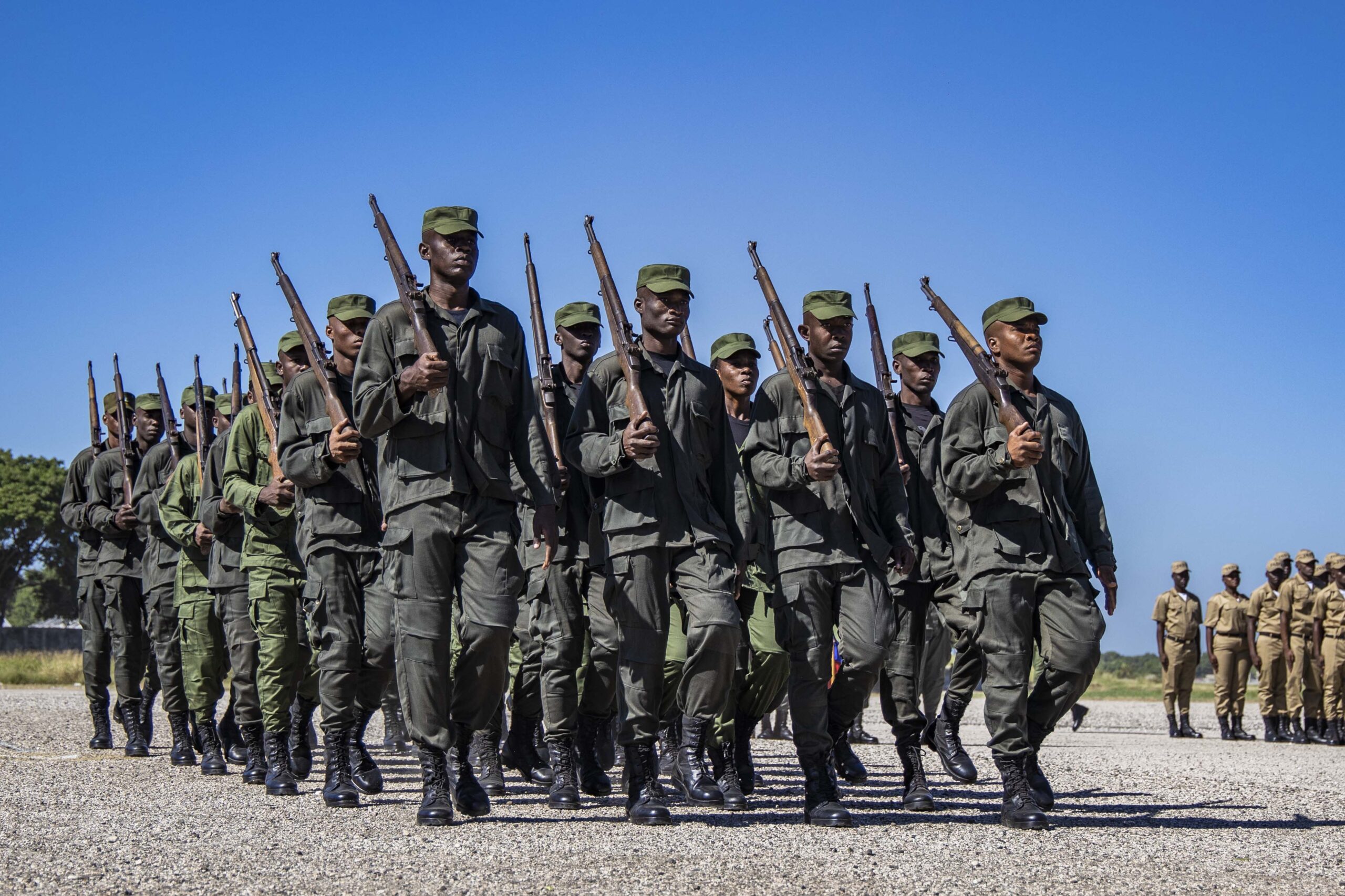
From the first steps toward the remobilization of the Armed Forces of Haiti (FAD’H) under President Michel Joseph Martelly to the actual remobilization of the military institution in May 2017 by President Jovenel Moïse, despite the opposing views of most of our international partners, there was a lot of controversy over the army issue, particularly about whether this remobilization was urgent during a crisis affecting every corner of society.
From the first steps toward remobilizing the Armed Forces of Haiti (FAD’H) under the presidency of Michel Joseph Martelly to the actual remobilization of the military institution in May 2017 by President Jovenel Moïse, despite the opposing views of most of our international partners, there has been a lot of controversy over the army, especially about the urgency of this remobilization during a crisis affecting every corner of society. Those against remobilizing the army haven’t missed pointing out the missteps and politicization of the military institution, while others have focused more on the role this institution played in building the Haitian nation-state and the crucial contribution it can make in efforts to reclaim national sovereignty and restore state authority.This debate about the army, which is now over, had the positive effect of allowing both supporters and opponents of the army to dive back into national history and to encourage them to learn more about this centuries-old institution, essential for any attempt to understand and trace the evolution of our people’s history.
Just as tumultuous as the history of all the country’s major institutions, the history of the Haitian army has had its share of troubles and crises, as well as moments of glory and achievements. Due to the length of my presentation, I won’t be discussing here the characteristics of the public force in the 19th century, rightly called the Century or Period of Bayonets. After the American Occupation (1915 – 1934), which created the Gendarmerie of Haiti, the military institution changed its name on three occasions: Garde d’Haïti (1928), Armée d’Haïti (1947), and Forces armées d’Haïti (1958). Radically transformed into a partisan army, loyal to the macoute regime, thus politicized and servile, it was never able to play a defense role and always stopped at being a police and repressive force (hence the expression ‘‘armed to crush bones’’).The Haitian army, the one that came out of the American Occupation, twisted by Colonel Paul Eugène Magloire and disastrously changed by the Duvalier regime, collapsed on Monday, September 19, 1994, like a sandcastle, after the coups led by General Henri Namphy, Prosper Avril, and the failed coup by the trio Biamby-Rébu-François.
The problems caused by the professionalization of the military institution throughout its history not only cannot justify questioning the usefulness of military force, since the importance of the army for a nation is no longer up for debate, but they were also an expression of the problem and not “The Haitian Problem.” The events that followed, since the dissolution of the army in 1995, have shown that the country is not doing any better without a military force. For more than three decades, the Republic of Haiti has been facing a serious socio-economic and institutional crisis, a crisis of sovereignty, in short, whose consequences
no less serious, affect the Haitian state in its core functions of regulating social and political relations, controlling the territory, and protecting the population. This chronic political instability has caused the breakdown of the social fabric, the collapse of the economy, environmental degradation, and the weakening of state authority. This terrible climate, which prevents the workings of development and change, makes it hard for our country to find public policies and leaders that can help it get out of these bottlenecks of disorder, chaos, and political instability.And this is precisely where the FAD’H (revised and corrected, if you will) become a key institution in creating the conditions needed for change and collective progress in the country. Although the general insecurity, the rise of armed gangs, and some recent events that shook the country have renewed a sense of nostalgia for the old FAD’H among a segment of the population, especially those over forty, there are still parts of the population that have very bad memories of this defunct army.
Modern theories of political development that aim to explain the birth of the nation-state see the establishment of a centralized and rational administration (in the sense of Max Weber), a permanent army under unified command, and an independent legal system as universal systemic problems. Reformulating these areas through systems theory should make it possible to take into account the specific context in which the three powers operate. The legal-police sub-system functions to reinforce established order by protecting society from any degradation, but it cannot solely hold the potential for stability or deterrent power over the society whose cohesion it is meant to maintain. To carry out this taskIt goes without saying that the military institution, in order to become a professional institution serving the nation-state (I prefer the concept of nation-state to the very uncertain concept of rule of law), will have to change course, have a new direction, and new responsibilities that will put all units of the military force at the service of the population.
Started in a timid way, quietly in the background, without a real schedule of activities, the overhaul of the military institution was at the heart of the remobilization of the Haitian Armed Forces, which must/should/will have to completely change their approach, both organizationally and geographically, with new regulations and standards. So, from then on, it wasn’t just about remobilizing the army as many demanded, it was about gradually modernizing it with a new vision, new responsibilities, and new leaders. Has that been the case so far?
As is thoroughly laid out in the Decree of October 26, 2015, on the organization and functioning of the Ministry of Defense, the ministry, tasked with implementing the strategic vision of the State’s National Security and Defense Policy, should play the main role in this remobilization of the army with a roadmap. Does it have the means? With which leaders?As soon as it was reinstated in 2011, the Ministry of Defense was given the heavy task of taking stock of the challenges, formulating, and implementing the strategic vision of Haiti’s National Security and Defense Policy. The decree of October 26, 2015, regarding the organization and functioning of the Ministry of Defense, makes this institution the central body responsible for coordinating the actions of all government agencies and institutions involved in the design, execution, supervision, monitoring, and evaluation of security, defense, and sovereignty policy throughout the territory of the Republic. In my opinion, mission and vision intertwine. Everything is said here! The vision corresponds to the doctrine or at least provides the doctrinal elements, the key objectives, while the mission would just be the implementation of said objectives or courses of action.It’s at the level of actions and monitoring public policies that there are previously some frustrations linked to inertia or to insufficient resources, both material and human!As clearly defined in the ‘Ministry of Defense Strategic Plan 2020 – 2023’, it is emphasized that the gradual reclaiming of national sovereignty involves rebuilding the armed forces to regain control of our borders, assist the population in case of natural disasters, and ensure the construction and monitoring of the country’s strategic infrastructure. This rebuilding primarily involves strengthening the institutional capacities of the FAD’H as well as the training of military personnel, which is an essential issue. Since this cannot be done outside the law, it will require updating the legal instruments governing the organization and operation of the FAD’H. This involves drafting and/or revising the following laws:
- The Decree of September 21, 1987, concerning the General Regulations of the Armed Forces of Haiti
- The Law of December 23, 1994, concerning the creation, organization, and functioning of the National Police of Haiti (PNH)
- The Military Justice Code, in accordance with the amended 1987 Constitution
- The establishment of the permanent National Defense Commission.
Reviewing the 1987 decree on the General Regulations of the Haitian Armed Forces is crucial for constitutional compliance reasons. This review should consider the return of most of the missions and responsibilities of the Armed Forces of Haiti that were transferred to other institutions, especially the Haitian National Police (HNP), through the law of December 23, 1994, which established, organized, and regulated the police institution. Alongside the functional specification of legal administration and prevention tasks, the concept of special services or intelligence services is emerging, which calls for intense discussion. This is an important issue that has sparked heated debates.The National Intelligence Agency (ANI) was created on November 26, 2020, by a decree from President Jovenel Moïse and was replaced in 2025 by the National Security Agency (NSA), which is under the administrative authority of the Prime Minister.
To effectively carry out its mission, the Ministry of Defense must get involved in strengthening institutional capacities to provide the FAD’H with the necessary structures and adequate equipment. With the effective rebuilding of the army, the country should have an army that serves the population across all its units, an army that protects, ensures public order, and works to safeguard national sovereignty while helping to restore the authority of the state over the 27,750 km² of our country.There are other sources of guidance not to be overlooked. I won’t mention here the report of the Security Working Group (submitted on August 9, 2009) chaired by Patrick Elie, which recommends creating a new force with a military status alongside the PNH, while also advocating for setting up a National Security Council. When referring to the “White Paper on Security and National Defense,” prepared in June 2015 with the determination of President Michel Joseph Martelly by a team of enlightened patriots, it outlines the formation of three major units: the Border Protection Unit, covering land, sea, and air; the Infrastructure and Communications Unit, which includes the Military Engineering Unit; and the Disaster Recovery Unit.In addition to these three major units, there are technical units, commanded by a senior officer or a general who takes the title of Technical Service Commander. These include the Corps of Engineers, the Communications Corps, the Health Service, the Legal Service, and the Agronomy Service. The general regulations of the Haitian Armed Forces also provide for Training Centers, each commanded by a senior officer or a general who takes the title of Training Center Commander. These are:
- The Haitian Military Academy;
- The Application Camp;
- The Non-Commissioned Officers School;
- The Military High Schools;
- The Higher Defense Institute;
- The Military Institute for Research, Human Rights, and International Humanitarian Law;
- The Cultural Service of the Haitian Armed Forces, which oversees the Historical Service of the HAF, the HAF Museum, military clubs, and recreational centers.Alongside this internal restructuring of the Haitian Armed Forces, a set of measures is planned both to repair the FAd’H facilities, acquire new spaces for the army services, ensure a presence at border posts, and improve working conditions for the Ministry of Defense staff in general and the FAd’H in particular. The main measures are:
- The physical repair of the FAd’H Grand Headquarters
- The repair of the Petite-Rivière de l’Artibonite base
- The repair of the Péligre barracks
- The restoration of the 4 border crossing points as well as the control of Lake Azuei
The setting up of giant banners at border posts
Identifying the former MINUSTAH bases whose land belongs to the Haitian state to put them to use for the Armed Forces
Installing (independent) solar energy in farms
Training officers
A reconsideration of the allowances given to members of the High General Staff, as well as the expenses and/or salaries for military personnel, staff, and contractors of the Ministry of Defense. And should we really leave the budget arena to the police and the big spenders who can’t see beyond their own noses?The rebuilding of the army cannot happen without the will to develop and carry out suitable (modern) training programs, fully linked to the process of democratization, economic and environmental challenges, and the threats of natural disasters. This new vision must therefore be integrated throughout the entire national territory. Indeed, since security issues are closely linked to drug trafficking, human trafficking, and other transnational crimes, combating all kinds of trafficking and transnational crime is part of the new responsibilities of the Haitian Armed Forces, but it’s not the only issue affecting the lives of Haitians. The fundamental problem, from which everything started, is certainly that of military depoliticization, but now there is much more.