
By hitting farms, markets, ports, and major shipping routes, conflicts are now spreading their effects far beyond the battlefields.
By hitting farms, markets, ports, and major shipping routes, conflicts are now spreading their effects far beyond the battlefields. From the Black Sea to the Strait of Hormuz, war is driving up the costs of energy, fertilizers, and food, while humanitarian aid is retreating in the countries most at risk.
One family, four children, and a hundred kilometers on foot. In Somalia, armed groups had demanded that this family pay to be allowed to continue farming their land. They chose to abandon their farm and head to a displaced persons camp. One of the children died on the way.
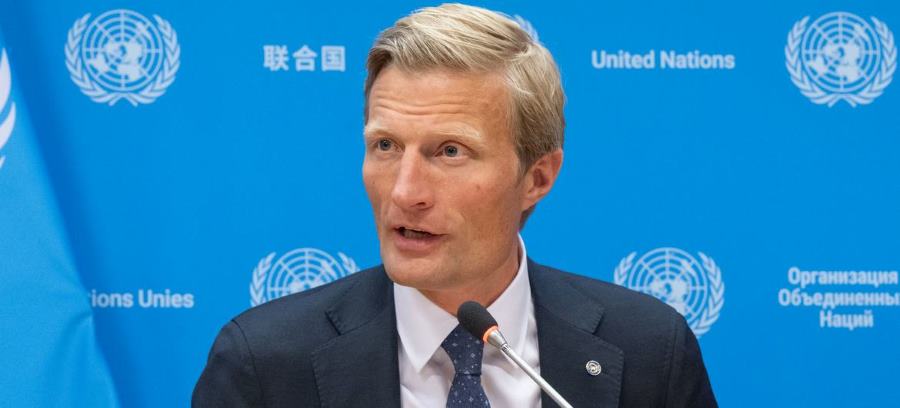
Carl Skau, Deputy Executive Director of the WFP, briefed journalists on his recent visit to Haiti.UN Photos / Eskinder Debebe Carl Skau, interim executive director of the United Nations World Food Programme (WFP) (archive).
Carl Skau, interim head of the World Food Programme (WFP), met with the family last week. On Tuesday, in front of the UN Security Council, he used their story to illustrate a cycle that repeats itself in war zones: the “vicious circle of conflict and hunger.” War destroys the means to feed people; hunger, in turn, increases populations’ vulnerability and creates conditions for new violence.
But this mechanism is scaling up today. In Somalia, farmers are being driven off their land. In Sudan, markets are being hit by drones and missiles. In Haiti, entire communities are cut off by gangs. From Gaza to Mali and Myanmar, humanitarian workers are being blocked from reaching certain populations.It is now the very infrastructure of the food system – farms, markets, warehouses, ports, and shipping lanes – that is being hit by conflicts whose economic fallout spreads far beyond the front lines.
“Essential food systems – along with the lives and livelihoods that depend on them – are under attack,” warned UN Secretary-General António Guterres at the start of the debate.
At least 266 million people experienced severe food insecurity last year, as the number of armed conflicts reached its highest level since World War II. For the first time since the start of the century, famine has been confirmed simultaneously in Sudan and Gaza. In 12 of the 13 food crisis hotspots considered most worrying by the UN, conflicts and violence are now the main drivers of hunger.Mona, a three-year-old child who is severely malnourished, is being fed through a syringe by a healthcare professional at an MSF-run hospital in Paris in Tawila, North Darfur, Sudan, in February 2026.
Local wars, a global shock
The geography of this crisis is also changing. A strike on a port or an attack on a merchant ship can now make food prices rise thousands of kilometers away from the fighting.
The Black Sea provides the most immediate example. Russia and Ukraine are among the world’s main grain exporters, and the escalation of attacks between the two countries disrupts a vital route for food trade. According to the WFP, the volume of grain passing through the Bosporus has dropped by 40% in a year.At the same time, attacks on merchant ships are disrupting traffic in the Red Sea, while disruptions in the Strait of Hormuz affect a route through which about a fifth of the world’s oil supply and a third of fertilizer trade pass.
Carl Skau thus describes a simultaneous crisis of three major maritime arteries: the Black Sea, the Red Sea, and the Strait of Hormuz. Energy, fertilizer, and food markets being closely intertwined, shocks ripple from one to another. For wealthy economies, this first means higher prices. For countries dependent on imports and already vulnerable, it can mean fewer meals.
In Sudan, the price of staple foods has risen nearly 40% since February. The fuel increase weighs on irrigation, transport, and grain processing, while disruptions in fertilizer exports threaten theEcuadorian female farmers sell and trade their organic products at the Pachamama Nos Alimenta community fair in Cotacachi, Ecuador.
When hunger prolongs war
The relationship also works the other way around. By destroying livelihoods and displacing populations, war makes impoverished communities more vulnerable to recruitment by armed groups and criminal networks.
In Somalia, six million people, or about a third of the population, suffer from acute hunger or are in an even worse situation. Nearly two million children are affected by acute or severe malnutrition. But currently, the WFP only provides assistance to about 600,000 people.Last week, fighting in Baidoa once again prevented aid organizations from bringing nutritional assistance to around 5,000 children. When families can no longer feed themselves, Carl Skau warned, their desperation makes it easier for armed groups and criminal networks to recruit the most vulnerable young people.
The Security Council had recognized this vicious cycle back in 2018, with the unanimous adoption of resolution 2417 on conflict and hunger. “The vicious circle continues,” António Guterres noted.The problem is no longer so much about predicting famines as it is about acting before they happen. The one that hit Somalia between 2010 and 2012 killed nearly 260,000 people, about half of them children. In 2017 and then in 2022, earlier mobilization helped avoid a similar toll. In Sudan, according to Carl Skau, the warning signs were known, yet they didn’t trigger an international response up to the task.
“We cannot wait for famine or catastrophic conditions to be officially confirmed,” the Secretary-General insisted. “I urge this Council to act when the warning lights go on.”
Meanwhile, humanitarian resources are shrinking even as conflicts multiply. The world is getting better at predicting where hunger might spiral into famine, yet has fewer and fewer means to prevent its own warnings from becoming reality.

