
The Haitian economy is expected to keep shrinking over the next two years, but at a gradually slower pace.
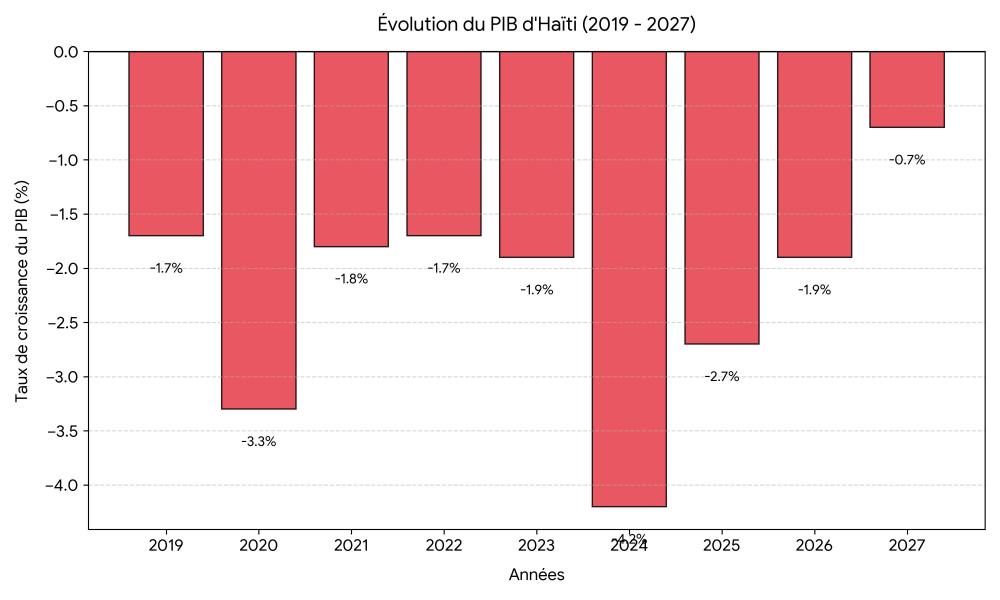
The Haitian economy is expected to keep contracting over the next two years, but at a gradually slower pace. In its report Estudio Económico de América Latina y el Caribe 2026, the Economic Commission for Latin America and the Caribbean (ECLAC) forecasts a decline in Haiti’s real gross domestic product of 1.9% in 2026 and 0.7% in 2027, after an estimated contraction of 2.7% in 2025.
The report was presented on Thursday, August 20, 2026, by ECLAC’s executive secretary, José Manuel Salazar-Xirinachs, during a hybrid press conference broadcast online from the institution’s headquarters in Santiago, Chile. This annual publication looks at the recent trends in the region’s economies and provides updated projections for 2026 and 2027. It also includes a special analysis of the links between growth, productivity, and informality.For Haiti, the projected trajectory points to a gradual easing of the recession, without actually indicating a return to growth. A contraction of 0.7%, even if less severe than the 1.9% expected in 2026, still means that the volume of economic activity is shrinking. So, ECLAC’s forecasts don’t suggest that Haiti would come out of the recession in 2027.
This trend would extend a particularly unfavorable economic streak. According to the World Bank, Haiti’s economy contracted in 2025 for the seventh year in a row, amid a rise in armed group violence. The 2.7% decline that year affected all economic sectors.The indicators from the Haitian Institute of Statistics and Informatics (IHSI) help to better understand this deterioration. In the first nine months of the 2024-2025 fiscal year, the overall economic activity indicator fell by 2.4%. The primary sector decreased by 5.7%, the secondary sector by 4.4%, and the tertiary sector by 1.1%. Agriculture, in particular, suffered from the abuses of armed groups in some production areas as well as from a poor rainy season, while construction, manufacturing activities, trade, and the hotel and restaurant industry also declined.
The security crisis does not only weigh on places directly affected by violence. It disrupts the movement of people, goods, and services, weakens supply chains, and reduces companies’ ability to operate normally. Added to these constraints are the fragility of the political transition and the displacements
The contrast is especially striking with the Dominican Republic. The other economy on the island of Hispaniola is expected to grow by 4% in 2026, then by 4.4% in 2027, after a 2.1% increase in 2025. The gap between the growth rates of the two countries would thus reach 5.9 percentage points in 2026 and 5.1 points in 2027.
These gaps don’t directly measure differences in income or living standards between the two populations. However, they do show completely opposite trends: on one side, activity would continue to decline in Haiti; on the other, growth would speed up in the Dominican Republic.The gap is also noticeable compared to sub-regional averages. Excluding Cuba and Haiti, Central America would see growth of 4% in 2026 and 4.2% in 2027. Including these two economies, the average increase would drop to 1.6% this year, before rising to 2.8% next year. The expected contractions in Haiti and Cuba therefore significantly weigh on the sub-region’s result.
The situation in Cuba would, however, be much more severe. After a 3.8% contraction in 2025, Cuba’s real GDP would fall by 10.3% in 2026, then by 5.1% in 2027. Jamaica, for its part, is expected to go from a 1.2% contraction in 2026 to positive growth of 2.5% in 2027. Unlike Haiti, it would therefore cross the threshold from contraction to economic expansion as early as next year.ECLAC predicts growth of 5.6% for the entire Caribbean in 2026 and 7.9% in 2027. However, these averages are heavily boosted by Guyana, driven by the expansion of its oil production. Without this country, Caribbean growth would be limited to 1.1% in 2026 and 2.2% in 2027, while still remaining positive and higher than the expected results for Haiti.
Across Latin America and the Caribbean, activity is expected to grow by 2.2% in 2026, after 2.4% in 2025, and then by 2.5% in 2027. ECLAC considers these levels insufficient to sustainably raise per capita income, reduce development gaps, and expand the room for maneuver of public authorities.The regional organization links this weak growth capacity to common structural constraints: low levels of investment, limited productivity growth, and high informality. The outlook is also exposed to geopolitical and trade tensions, the maintenance of relatively high international interest rates, as well as a possible rise in oil, fertilizer, and transportation costs.
For Haiti, the new forecasts thus describe a slower deterioration of activity, but not yet a turnaround. Even limited to 0.7% in 2027, the contraction would keep the country on a negative trajectory, going against the trend in the Dominican Republic and most neighboring economies. These estimates remain projections and could be revised depending on developments in security, political, economic, and international conditions.

