
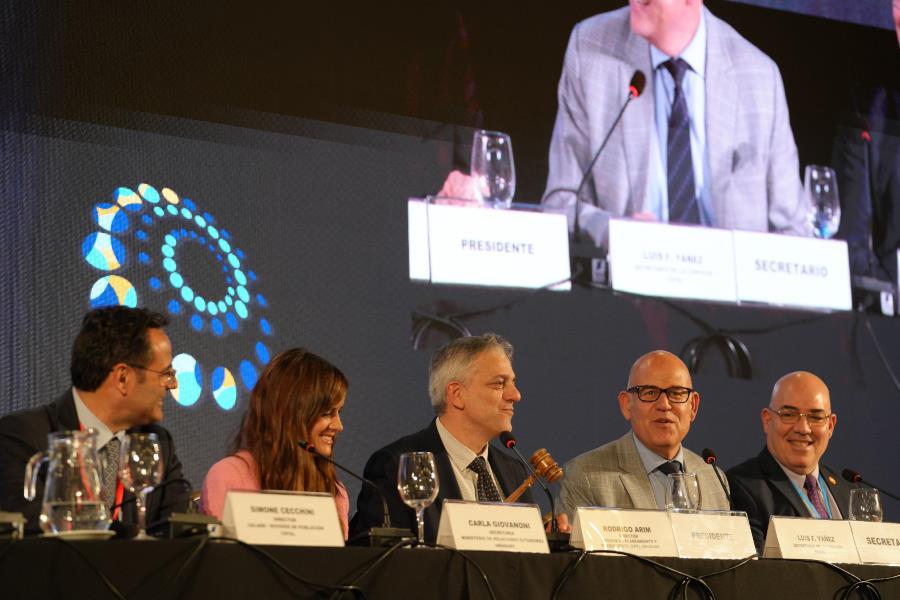
From left to right: Simone Cecchini, director of CELADE – the Population Division of ECLAC; Carla Giovanoni, facilitator of the negotiation process for the Uruguayan presidency; Rodrigo Arim, director of planning and budget for the Uruguayan presidency; Luis F.
From left to right: Simone Cecchini, director of CELADE – Population Division of ECLAC; Carla Giovanoni, facilitator of the negotiation process for the Uruguayan presidency; Rodrigo Arim, director of planning and budgeting of the Uruguayan presidency; Luis F. Yáñez, secretary of the ECLAC Commission; and Hugo González, deputy regional director for Latin America and the Caribbean at UNFPA.
The sixth session of the Regional Conference on Population and Development in Latin America and the Caribbean wrapped up in Montevideo. This session was organized by ECLAC in coordination with UNFPA.The member states of the Economic Commission for Latin America and the Caribbean (ECLAC), who took part in the sixth session of the Regional Conference on Population and Development in Latin America and the Caribbean, acknowledged on Thursday, August 20, that meeting the challenges of demographic change requires strengthening democracy, human rights, and multilateralism. They stressed the importance of promoting partnerships at all levels and innovative approaches that combine private initiative and multi-stakeholder cooperation.Among the Conference’s resolutions, the countries reaffirmed that the Montevideo Consensus on Population and Development is a comprehensive roadmap for national and regional action in this area and called for strengthening the respect of its priority measures through the implementation of specific actions, proper allocation of resources, and the creation and reinforcement of institutional mechanisms for its implementation and monitoring.
They also recognized that changes in demographic dynamics, in a context of persistent poverty and structural inequalities in the economic, social, and territorial spheres, will have impacts on all aspects of society, such as labor markets, health and social protection systems, care systems, education, and the fiscal sustainability of social policies.It is therefore necessary to take these changes into account when funding the design and implementation of public policies that promote the human rights of the population within a sustainable development framework.
The main intergovernmental forum for monitoring and reviewing population and development issues in the region brought together delegates from 29 member and associate states of ECLAC, as well as representatives from 12 United Nations system entities.
Participants from intergovernmental organizations, regional parliaments, academia, the private sector, and nearly 400 civil society members joined them. In total, almost 800 people participated.
The Conference was established in 2012 by ECLAC, which provides the secretariat, in coordination with the United Nations Population Fund (UNFPA).The closing session brought together Luis Fidel Yáñez, Secretary of the ECLAC Commission; Héctor Hugo González Coltrinari, Deputy Regional Director of the UNFPA Office for Latin America and the Caribbean; and Rodrigo Arim, Director of the Planning and Budget Office of Uruguay, the country holding the presidency of the Regional Conference on Population and Development in Latin America and the Caribbean.
“It’s clear that the demographic changes our region is experiencing today are not inevitable. The decline in fertility, the aging population, the care crisis, the transformation of households, human mobility – all of this is actually a historic opportunity. An opportunity to restructure our development models toward sustainability, inclusion, and gender equality. This Conference has allowed us to collectively reflect on this opportunity,” said the Secretary of the ECLAC Commission.For his part, the UNFPA deputy regional director emphasized that “our mission, when we return to our countries, is clear: to help turn consensus into concrete policies, strategies into allocated budgets, and commitments into real changes in the lives of people facing multiple and intersecting forms of discrimination.
This also means strengthening the population and development institutions in our region so that they can engage different sectors and translate demographic change into concrete and sustainable responses,” he said.Director Rodrigo Arim reminded that thirteen years ago in Montevideo, the foundations of a new regional agenda on population and development had been laid. “The Montevideo Consensus marked a turning point in the region by putting human rights, equality, dignity, autonomy, and the well-being of people at the heart of public policies and by turning these principles into concrete commitments for life. Thirteen years later, in the same place, we are renewing this commitment. We are not here to replace this agenda, but to reaffirm it and update it in order to stay true to these principles while also making them interact with a region that has changed profoundly,” he said.
In their final resolutions, the delegates reaffirmed their commitment to gender equality, as well as to fighting racism and inequalities affecting Afro-descendant, Indigenous, and migrant people, and highlighted the importance of continuing work to include the rights of people with disabilities.
They also recognized that homeless people are a particularly vulnerable population group, facing multiple forms of discrimination and interconnected barriers.
The Regional Conference on Population and Development will be chaired by Uruguay, with Bolivia (Plurinational State), Costa Rica, Cuba, Guatemala, Guyana, Jamaica, and Mexico serving as vice-chairs for the next two years.

