
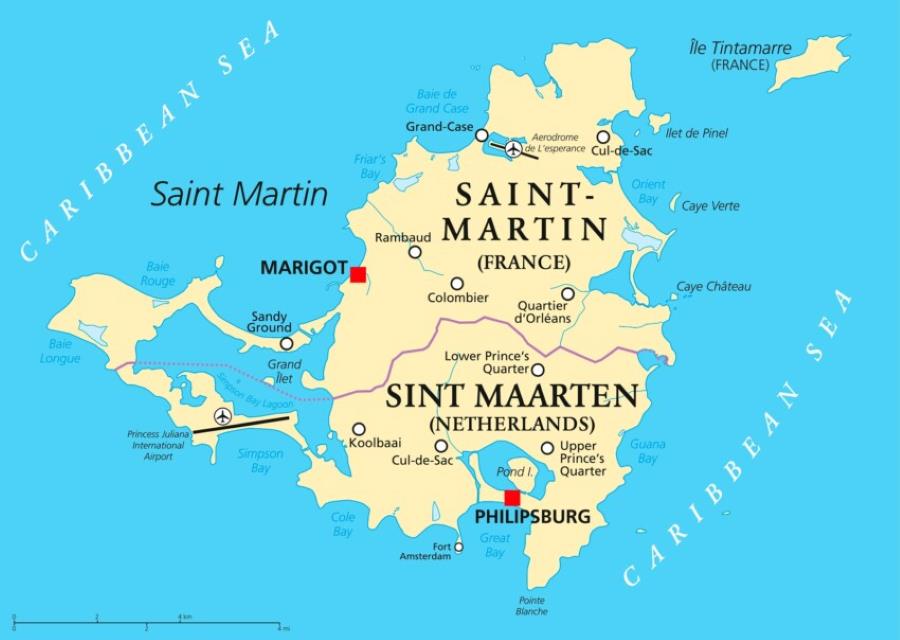
Northeast of the Caribbean Sea lies a unique territory: the same island, but two administrations, two institutional systems, and two political affiliations.
Northeast of the Caribbean Sea, there is a unique territory: the same island, but with two administrations, two institutional systems, and two political affiliations. The French part makes up the Collectivity of Saint Martin, while the southern part, Sint Maarten, is an autonomous country within the Kingdom of the Netherlands. Together, they form an island covering 95.8 square kilometers with around 75,000 inhabitants. Haiti is about 290 times the size of the island of Saint Martin. For comparison, Gonâve Island, which is the largest island next to Haiti, covers around 700 square kilometers, more than seven times the size of Saint Martin.Despite this administrative border, the two territories form a single economic, tourist, and social space. The island of Saint Martin is therefore a particularly interesting case when thinking about the development of small island economies. Its experience shows both the opportunities offered by tourism, infrastructure, and international openness, but also the limits of a model heavily dependent on imports, foreign visitors, and weather conditions.Tourism at the heart of the economic model
The first notable feature of Saint Martin’s development is the central role tourism plays. Hotels, restaurants, transportation, commerce, real estate, and leisure activities make up a large part of the local economy. On the Dutch side, hotels, restaurants, and related services account for about 45% of GDP, while tourism brings in nearly 73% of foreign currency earnings. Almost a third of the workforce is directly employed in the tourism sector.In 2021, the Issuing Institute for the Overseas Departments (IEDOM) reported a gross domestic product (GDP) of 2.3 billion euros in a report on Saint Martin and a GDP per capita of 31,035 euros. Meanwhile, the Haitian GDP per capita was around 1,000 euros during the same period. For its part, the National Institute of Statistics and Economic Studies (Insee) estimated in 2019 that the GDP of Sint Maarten was twice that of Saint Martin over the 2016-2021 period. Sint Maarten’s GDP per capita, which is among the highest in the Caribbean, is on average 70% higher than that of Saint Martin over that period.However, this dependence isn’t necessarily a weakness in itself. It becomes a problem when an economy fails to turn tourism revenue into infrastructure, human capital, local businesses, and a variety of economic activities. Saint Martin seems to have understood this need. Reconstruction after successive crises has gradually been accompanied by investments in tourist infrastructure, transportation, and services.
In 2024, the economy of the Dutch side grew by 3.3%, fueled by strong tourism and construction. The Reconstruction, Recovery, and Resilience Fund set up after Hurricane Irma (which devastated the island on September 6, 2017) also played a key role in modernizing infrastructure. A disaster of that scale could have trapped Saint Martin in a permanent rebuilding cycle. Instead, the island tried to use the crisis to boost its resilience. The rebuilding of Princess Juliana International Airport is one of the most significant examples. This infrastructure is crucial not just for Sint Maarten, but for the island’s entire tourism economy. Normally, over two million passengers use its terminal each year, and the airport is directly or indirectly linked to thousands of jobs.So the reconstruction didn’t just involve putting the airport back the way it was. The goal was also to build infrastructure that can better withstand the next natural disasters. That’s one of the main lessons from Saint Martin: after a disaster, rebuilding the same way doesn’t necessarily count as a development effort. Rebuilding better, stronger, and with a long-term vision can turn a crisis into opportunities and investments.Two parts, two models, one economic space
The coexistence of the French and Dutch sides is a unique feature of Saint Martin. The Dutch side has a major international airport and a deep-water port that handle significant tourist traffic. The French side, on the other hand, offers more in terms of villas, small hotels, gastronomy, and a more intimate tourism experience. So, the two small economies compete in some markets but are also complementary. Visitors can easily move between the two parts of the island, and the infrastructure on one side often benefits businesses and residents on the other.However, the 2024 economic report from IEDOM points out that the Dutch side still has a significant competitive edge thanks to its modern airport and port infrastructure and higher tourist accommodation capacity. This situation highlights the crucial role of infrastructure in an island economy. A beautiful tourist destination alone isn’t enough. You need to be able to get there easily, get around, stay, eat, and access quality services.The real challenge is moving from tourism to sustainable development. Tourism can create jobs and bring in foreign exchange, but on its own, it doesn’t make a complete development strategy. So, Saint Martin faces a classic challenge of small island economies: how to use tourism revenue to build a more productive and less vulnerable economy? The answer involves education, vocational training, digital technology, infrastructure, local entrepreneurship, and improving productivity. The World Bank specifically points to education, training, and on-the-job learning as important areas to address Sint Maarten’s labor market constraints. It also highlights the need to continue public investment in infrastructure and digitalization.
This issue is fundamental. A tourism-based economy can’t sustainably grow if it has to import a large part of its skilled workers, goods, and services.
The environmental issue is also unavoidable. The development of Saint-Martin faces a physical constraint: the island is small and its resources are limited. Agriculture is not very developed there, and a large part of the food has to be imported, which could have been a good partnership opportunity for Haiti. Energy and many manufactured goods are also imported.On top of that, there are risks from hurricanes, floods, rising sea levels, and urbanization. Water and wastewater management is therefore becoming a key part of development. The World Bank is working with the authorities in Sint Maarten on a strategy to improve sanitation networks, wastewater management, and the protection of marine ecosystems. The goal is to simultaneously safeguard public health, the environment, and the tourism economy. In other words, protecting the environment is no longer just an ecological issue. It has become a matter of economic survival.Lessons to be learned
The experience of Saint Martin offers some interesting insights for the whole Caribbean. First lesson: tourism development requires modern infrastructure. Airports, ports, roads, telecommunications, water, energy, and sanitation are the invisible foundations of the tourism industry. Second lesson: resilience must be built into development policy. In a region prone to hurricanes, building less vulnerable infrastructure is not a luxury—it’s an economic investment. Third lesson: human capital is just as important as physical capital. Hotels, ports, and airports can’t operate efficiently without trained workers.Fourth lesson: tourism should create links with the rest of the economy. Agriculture, fishing, crafts, restaurants, digital services, transport, culture, and creative industries can help a larger part of the population benefit from the income generated by visitors. Fifth lesson: on a small island, development can’t be separated from environmental protection.Saint Martin isn’t a perfect model. The disparities between the two parts of the island, labor market constraints, dependence on imports, real estate pressure, climate risks, and heavy reliance on tourism remain major challenges. But its experience is particularly instructive. In less than a decade, the island had to face a devastating hurricane, a global pandemic, and several economic shocks. Yet, its economy has gotten back on a growth path, and essential infrastructure has been rebuilt or modernized. Saint Martin’s future will depend, however, on its ability to take the next step: moving from reconstruction to sustainable development, from tourism growth to economic diversification, and from climate vulnerability to resilience.
The real success of Saint-Martin will therefore not simply be to attract more visitors. It will be making sure that every dollar spent by these visitors contributes more to education, employment, local businesses, infrastructure, and the quality of life for the population. A small island can hardly control the big forces of the global economy. However, it can decide how it prepares for them. Maybe that’s the main lesson of Saint-Martin. Haiti has a lot to learn from it!
Thomas Lalime
thomaslalime@yahoo.fr

