
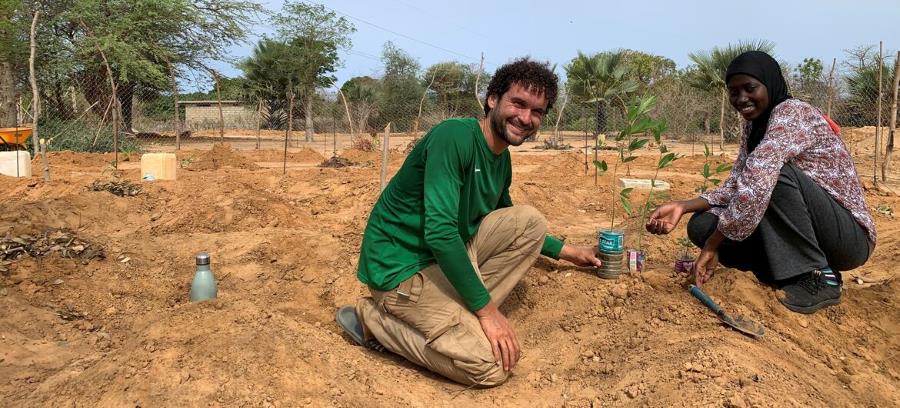
Féro Daniel Halman, from the company Féro, is planting a young tree in Senegal.
Féro Daniel Halman, from the company Féro, is planting a young tree in Senegal. In Kholpa, the company is working with a cooperative of 50 women farmers on a project that combines 15 greenhouses with a hectare of agroforestry to support incomes while restoring degraded land.
And what if restoring land could also create jobs and generate income? From Ecuador to Bangladesh, a new generation of entrepreneurs is trying to show just that, turning environmental challenges into economic opportunities.Turning agricultural waste into value, high-yield greenhouses, precision farming, or even AI-powered sensors: these young entrepreneurs are developing models that aim to balance soil restoration, agricultural productivity, and income creation, with the support of a United Nations-backed initiative.
In Senegal, Daniel Halman is betting on a simple idea: produce more on a smaller area to free up some farmland for restoration.His company, Féro, combines high-yield greenhouses with agroforestry systems. Greenhouse crops generate short-term income, while fruit trees and native species are planted elsewhere on the farms.
“Of course, you could choose to act within an NGO, but I deliberately chose to pursue this approach as a business,” he said at an event in Ulaanbaatar, Mongolia, during the 17th Conference of the Parties to the United Nations Convention to Combat Desertification.The main challenge was time: trees can take years to start making profits, while a business needs to generate revenue much more quickly. Féro therefore focuses on greenhouse crops whose harvests can be sold quickly.
“In Senegal, people love onions; so we saw a great opportunity there,” explains Mr. Halman.

