
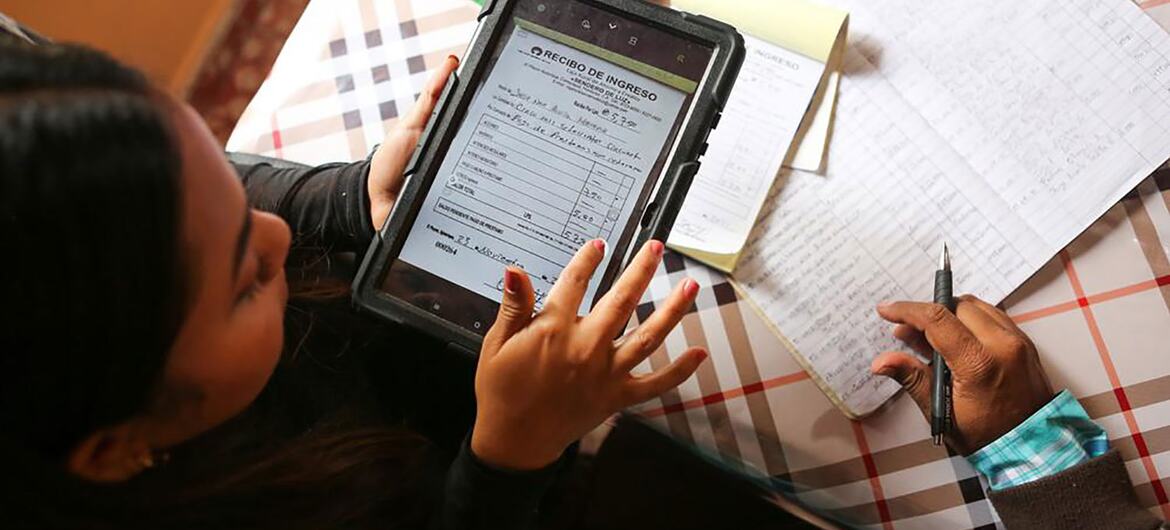
Money transfers reduce poverty and increase opportunities. In 2025, migrants sent $728.6 billion to their families in low- and middle-income countries, nearly double the amount recorded ten years earlier, according to a new report from the UN’s International Fund for Agricultural Development (IFAD).
Money transfers reduce poverty and increase opportunities
In 2025, migrants sent $728.6 billion to their families in low- and middle-income countries, nearly double the amount recorded ten years earlier, according to a new report from the UN’s International Fund for Agricultural Development (IFAD).
These transfers, which serve as a lifeline for hundreds of millions of people, have grown by 94% between 2016 and 2025, much faster than the number of migrants from these countries, which only increased by 28%.”This report is about financial flows of an extraordinary scale. But more importantly, it concerns families,” said Pedro de Vasconcellos, head of IFAD’s Remittances Financing Mechanism, on Monday during a press briefing at the UN headquarters.
Behind these hundreds of billions of dollars are usually transfers of $300 to $400, made nine or ten times a year. About 220 million migrants and diaspora members support some 1.1 billion relatives this way.
A lifeline
Remittances now represent more than four times global official development assistance and also surpass foreign direct investment to low- or middle-income countries.For families, around three-quarters of this money goes towards covering basic needs like food, housing, and essential services. The rest is used for things like health, education, savings, housing, or economic activities.
Nearly $233 billion reached rural economies in 2025, while beneficiary households invest about $22 billion a year in rural food systems.
This money also plays an important role in dealing with climate shocks, helping families make up for lost income or rebuild after a disaster.A dependence that exposes
This growing importance, however, makes families vulnerable to changes in the situation of migrants in host countries.
The phenomenon is particularly noticeable in Latin America and the Caribbean, where the United States is the main source of remittances. In 2025, these transfers accounted for 30% of Honduras’s GDP, 28% of El Salvador’s, and 27% of Nicaragua’s.
Expulsions, restrictions on access to employment, or a drop in labor demand could reduce migrants’ ability to support their loved ones.But for now, no widespread decrease is observed. “At the moment, the numbers do not show a reduction in remittances,” said Mr. de Vasconcellos, highlighting these flows’ ability to withstand crises, especially due to families’ ongoing needs.
Latin America and the Caribbean saw the highest growth over the decade, with an increase of 132%, reaching $168.6 billion. The Asia-Pacific region remains the largest recipient, with $384.9 billion, or 53% of the global total. Africa received $124.2 billion, up 86% since 2016.
Four men are in a cramped living space lit by a single light bulb. One is smoking, another is using a laptop, and the other two are sitting on mattresses. It seems to be a shared or temporary living arrangement.
IOM/Elyor Nematov In Russia, migrants from Central Asia, whose families rely on remittances.The Challenge of Transfer Costs
Digital transformation is making these transactions easier and easier, but costs remain high. Only 35% of the services studied in 2025 allowed a fully digital transfer from sender to recipient.
Digital transfers cost an average of 4.6% of the amount sent, compared to 7.3% for non-digital services.
IFAD therefore calls for lowering costs and improving the transparency of transfers, while expanding access to financial services.
“Technology can really help. But that’s not enough,” emphasized Mr. de Vasconcellos, noting that remittances remain private and family resources that “cannot replace” public investment, social protection, humanitarian aid, or financing the fight against climate change.

