
By Célia LEBUR with Clément MELKI in Rome When Brian Green first walked through the doors of Anthropic in Silicon Valley, one December day in 2025, accompanied by a priest in a black shirt and Roman collar, he had no idea what was coming next.
By Célia LEBUR with Clément MELKI in Rome
When Brian Green first walked through the door of Anthropic in Silicon Valley, one December day in 2025, accompanied by a priest in a black shirt and Roman collar, he had no idea what was about to happen.
Alongside the priest, this artificial intelligence (AI) ethics expert from Santa Clara University in California was taking part in an “exploratory meeting” at the request of the American company.
The idea: to assess whether a dialogue with the Church was possible – the two men are members of a research group on AI linked to the Vatican – in order to “positively influence” technological developments, he recalls.Seven months later, on May 25, just three seats away from the pope in the Synod hall at the Vatican, surrounded by cardinals and to everyone’s astonishment, sat a non-believer: Christopher Olah, the co-founder of Anthropic himself. Pope Leo XIV presented the first-ever encyclical dedicated to AI – in which he called to ‘disarm’ AI to ‘prevent it from dominating humans.’
He also criticized the concentration of technological power in the hands of a few private companies, including Anthropic… before letting its boss speak.”Some might think that AI issues are the domain of computer scientists like me. They’re wrong,” says the thirty-something with a youthful face to the assembly gathered within the walls of the city-state.
“We need more players around the world — religious communities, civil society, researchers, governments — to do what His Holiness has done here: take this seriously, look closely, and steer events in a better direction,” he preaches further.
This has caused some discomfort within the Church, where some have pointed out the risk of a kind of ‘pope washing,’ moral legitimization or approval on the eve of Anthropic’s IPO, which could reach a valuation of $2 trillion.But in a context where worries about the future of AI – and its potential to take over the world – are growing, even among those who develop it, the Vatican believes it has a role to play.
On the “front lines”
The Catholic Church’s interest in AI-related issues isn’t new. As early as the 2010s, encouraged by Pope Francis, discussions with academics and Silicon Valley leaders began to multiply.The first major step came in February 2020 with the launch of the “Rome Call for AI Ethics,” a text signed by the Vatican, Microsoft, and IBM, among others. Innovative for its time, it promotes an “algo-ethics” based on transparency and privacy protection.
Four years later, Francis became the first pope to attend a G7 summit. The Argentine pontiff described AI as a “cognitive-industrial revolution” and called for the most sensitive decisions to remain under human control, especially in the military field.
“The Vatican played a pioneering role by recognizing very early a trend that would become structural,” Eric Salobir, advisor to the Holy See and president of the Human Technology Foundation—which counts Google, Palantir, and Qualcomm among its members—told AFP.But things really pick up with the arrival of Leon XIV in the spring of 2025, “a pope deeply rooted in modernity” – the first to wear a smartwatch – who “understands these issues thanks to his scientific training” as a mathematician, adds this Dominican priest.
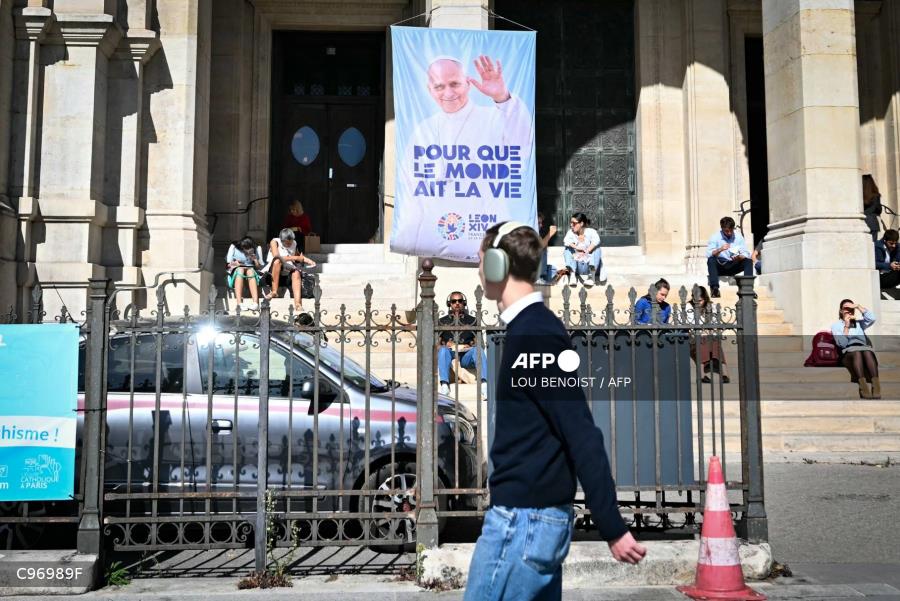
The American pontiff, expected in France on Friday, where he is likely to touch on the subject during his visit to UNESCO, keeps warning against the growing dependence on algorithms.
His encyclical “Magnifica Humanitas” (Magnificent Humanity) is often compared to that of Leo XIII in 1891 on workers’ rights, which redefined the social doctrine of the Catholic Church during the industrial revolution.This major document is the result of a “Vatican strategy that combines religious diplomacy, academic expertise—particularly through its vast network of Catholic and pontifical universities—and dialogue with the tech world,” explains François Mabille, director of the Geopolitical Observatory of Religion.
Blackmail
After the December 2025 meeting in Silicon Valley, Brian Green and the priest are invited again by Anthropic in January, and several times in the following months. The latter is no ordinary person: Father Brendan McGuire, who leads Saint-Simon Parish in Los Altos, California, studied cryptosystems before becoming a tech executive and then entering the priesthood.This time, the two men are joined by an official representative of the Vatican: Msgr. Paul Tighe, the number 2 of the Dicastery (ministry) for Culture and Education, with whom they have already been working for several years.
The exchanges—which sometimes also involve Jewish, Muslim, and Buddhist authorities—go both ways. Anthropic, which did not respond to AFP’s requests, has publicly stated that it relied on their contributions for drafting the ethical charter of its AI model Claude, published at the end of January.
Specifically, there are “sorts of +personality+ archetypes within the AI, good or bad, because the texts and data used to train all these large language models also reflect a dark side of humanity,” Brian Green explains to AFP. “The AI reproduces human behaviors it observes on the internet, what people say on forums, how characters in books act, etc.”During internal simulations in 2025, Claude, who was playing the role of a business assistant, for example discovered by email that he was going to be replaced by another system and tried to blackmail an engineer over a fictitious extramarital affair.
“The developers are trying to prevent these behaviors, which involve harming or exploiting humans for its own benefit, from resurfacing,” adds the theologian.
There are also links with other AI giants like Google DeepMind and OpenAI, according to Brian Green and Eric Salobir, but none have gone as far in dialogue as Anthropic, which now advocates for “strong regulation” of AI.During a legal dispute between Anthropic and the U.S. government in March, a group of 14 Catholic ethicists and theologians, including Brian Green, filed a brief in court to support its complaint against the Pentagon.
The company had been excluded from key national security systems after refusing to let the military use Claude for fully autonomous lethal weapons or mass surveillance of Americans.Diplomatic Networks
While Washington rejects global regulation of AI, as President Donald Trump reiterated on Tuesday at the UN podium, the Vatican is also active on the diplomatic front.
In mid-September, it sent its prominent AI advisor to the European Parliament in Strasbourg. The theologian Paolo Benanti did not fail to highlight the shared views between the Vatican and the 27 member states, encouraging MEPs to legislate on this topic so that AI players are not left as the sole decision-makers.
Behind the scenes in Rome, other meetings took place, including one in April at the French embassy to the Holy See, bringing together representatives from Meta, Google, Amazon, and the Vatican on child protection in the AI era, as one participant told AFP.”Everyone has their role – companies are there to produce technology, and states are there to define the limits of what they consider socially and politically acceptable (…) Just talking doesn’t mean there’s an agreement, but it’s better to know what others think before taking a stance,” emphasizes a Western diplomatic source.
Gilles Gressani, editor of the geopolitical magazine Le Grand Continent, goes even further. More than governments and their regulations, he believes the Church is the “real competitor” of the AI giants. “What’s at stake with AI, and it’s dizzying, is the definition of what it means to be human, but also what is divine. And the Vatican knows it.”

