
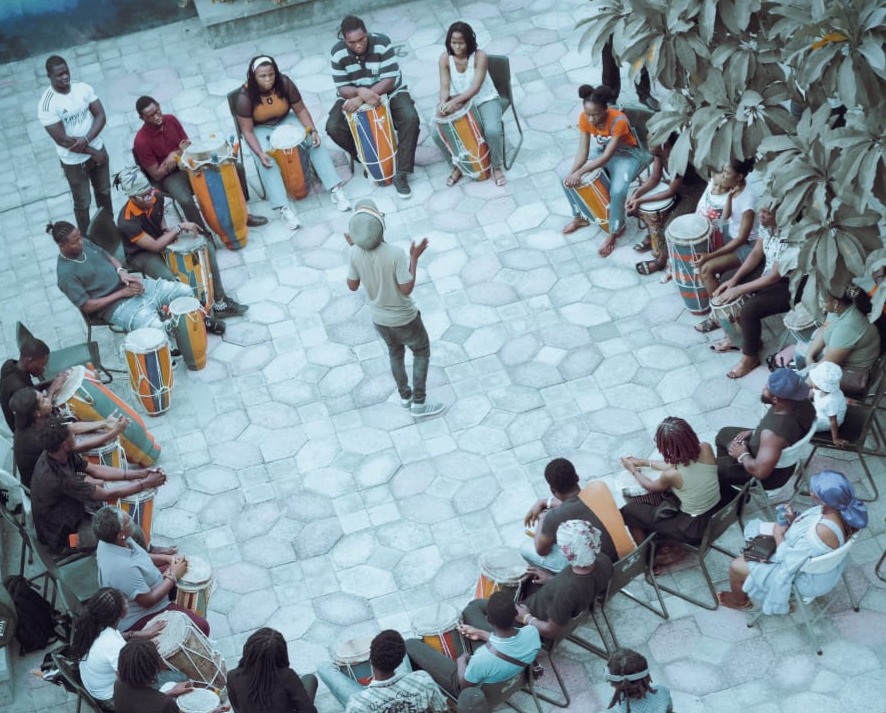
The Emmanuel Charlemagne Cultural Center, located at 16 Côte-Plage in Carrefour, hosted the second edition of the drum workshop, organized by Atelye Tambou Loray Kale (ATLK), on September 17 and 18, 2026.
The Emmanuel Charlemagne Cultural Center, located at 16 Côte-Plage in Carrefour, hosted on September 17 and 18, 2026, the second edition of the drum workshop organized by Atelye Tambou Loray Kale (ATLK). Led by the excellent drummer Joseph René, also known as Batala, this workshop aimed to introduce young people from the Carrefour community and surrounding areas to drumming.
About thirty young people, mostly boys but with a notable female presence, took part in these two days of training, during which participants were invited to discover or deepen their connection with an instrument deeply rooted in Haiti’s musical and cultural history: the drum.When we arrived on Thursday, September 17, the atmosphere was perfect for learning. About thirty young people, drums between their legs, were listening intently to the presentation given by the facilitator, Batala. He was talking about this percussion instrument, its shapes, various sizes, and different functions, especially in Vodou.
“The drum isn’t an ordinary instrument. Deeply rooted in our popular culture, it comes in many shapes, sizes, and has specific functions,” the percussionist pointed out right from the start.After the theoretical explanations, it’s time for practice. To play the drum well, a whole set of techniques is involved. It’s not enough just to hit it: you need to know the right striking technique, maintain a relaxed posture, and aim for the right spot on the drumhead. The method varies slightly depending on whether you’re playing with your hands or with sticks.Excited, the participants hit and played the drum. The instructor interrupted their movements to give them a few pointers: playing with your hands requires mastering different strokes to vary the sounds. You can hit the edge of the drum with your fingers together and straight to get a medium sound. The future drummers resumed their exercises. Batala reminded them that you can also hit with the palm of your hand, which stops on the wooden rim while the fingers bounce on the skin, to get a low sound, or hit the center of the drum with the whole palm flat to get a high sound.
A great experience at the Emmanuel Charlemagne Cultural Center in Carrefour. The workshop continued the next day. According to the organizers, the initiative goes beyond just instrumental technique: it aims to pass on a heritage, to reveal its functions and sounds, and to respond to the growing interest of young people in traditional instruments.Passing It On to Preserve It
Emmanuel René, head of the Atelye Tambou Loray Kale, places the event in the logic of generational relay. “Every person who comes to learn is someone we train to then go train others,” he sums up. The ambition goes beyond these two days: the organizers also want to open the door of drumming to regular schools, regardless of whether the students belong to the vodou community. “Knowledge has no borders,” stresses Emmanuel René, for whom knowing a rhythm doesn’t mean practicing a religion.Overcoming Prejudices
In some parts of Haitian society, the drum is still spontaneously associated with Vodou or certain ceremonies, a perception that tends to distance some people from it. Samuel Kensley Pierre, a professor of sociocultural education and visual artist, says he long saw the instrument as “mysterious,” though this mystery wasn’t tied to anything mystical. Participating in the workshop, he explains, allowed him to form a different relationship with the drum and understand its symbolic, cultural, and musical dimensions. He advocates for more activities like this, which he sees as the only way to move beyond the stereotypes that still surround the instrument.
From Technical Basics to Traditional Rhythms
The first day allowed beginners to discover the history of the drum, the basic sounds, the different shapes of instruments, as well as a rhythm called Afò. More advanced participants, on the other hand, reviewed the components of the drum ensemble: kata, mother drum, bass, and second drum. Practical exercises took up a large part of the day, with everyone invited to create their own sounds before combining them collectively — a method that, according to the instructors, shows that the approach to drumming can be both intuitive and gradual.A training open to everyone
The workshop isn’t just for those who are already familiar with the drum or come from the Vodou community. The organizers emphasize that it’s open to everyone, a vision shared by several young participants, for whom learning the instrument is also a way to reconnect with their roots. One of the participants points out that the drum is an integral part of Haitian heritage and that it’s important for young people to know their origins. Several of them already plan to continue their learning beyond these two days.A structure built to last
Atelye Tambou Loray Kale (ATLK) doesn’t see itself as a temporary organization. According to Emmanuel René, it operates on an ongoing basis, regularly welcoming new young people, and also puts on shows and artistic activities in different parts of the country, in collaboration with schools. Economic constraints, however, still limit its growth; the organizers say they rely on friends as well as financial and logistical support to keep their activities going.At the end of this training, one message stands out: the drum can be seen both as a musical instrument, a subject of knowledge, and a part of Haitian cultural heritage. The second edition of the workshop aims, through practice and sharing, to bring a new generation closer to this instrument and the richness of Haiti’s musical traditions.

