
We all, over time, develop a deceptive sense of intimacy.
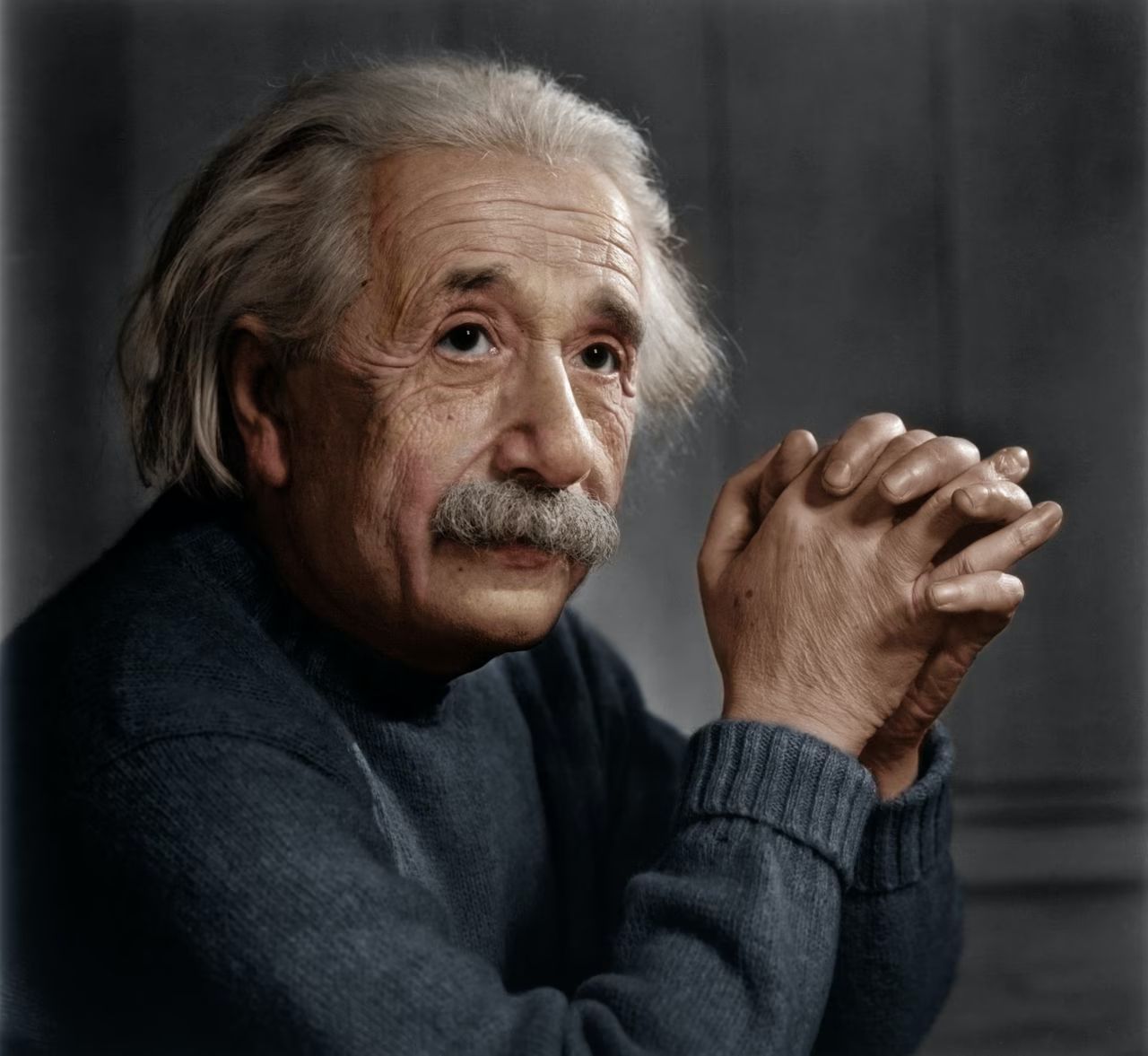
Over time, we all develop a deceptive intimacy with time. We all think we know what it is because it carries us, ages us, and seems to flow with the regularity of a universal metronome. Sir Isaac Newton formalized this intuition by postulating the existence of absolute time, true and mathematical, flowing uniformly without relation to anything external. It was very comfortable; the universe had its fundamental clock, and the term ‘now’ held exactly the same value for a human in Port-au-Prince, a hypothetical creature on Mars, or an observer at the edge of the Andromeda galaxy. And then, in 1905, in the dim, hushed office of the patent office in Bern, Switzerland, a twenty-six-year-old young man, still unknown to academic circles, committed an act of unprecedented boldness when he decided, with the help of his genius, to challenge the very structure of the stage on which the grand comedy of the world is played.Albert Einstein was neither a lab experimenter with sophisticated instruments nor a know-it-all full of certainties. He was someone who thought by watching shadows and lights, fascinated from childhood by an apparently naïve question: what would a ray of light look like if you could ride alongside it? By answering this question, Einstein didn’t just solve a theoretical puzzle that had been troubling 19th-century physics about the obvious clash between Isaac Newton’s mechanics and James Clerk Maxwell’s electromagnetism. He reshaped our grammar of reality, leaving humanity a vision of the world whose effects, both conceptual and technological, continue to shape our most intimate daily lives.
We still need to remember the dead end that physics had reached at the end of the 19th century. In 1864, James Clerk Maxwell brilliantly showed that light is an electromagnetic wave propagating at a constant speed, called c, of about 300,000 kilometers per second in his paper “A Dynamical Theory of the Electromagnetic Field.” Now, classical mechanics clearly tells us that any speed is relative. If you walk down the aisle of a moving bus, your speed relative to the ground is the sum of your walking speed and the bus’s speed. So, relative to which frame of reference was the speed of light fixed? The answer at the time was to invent an invisible substance, the luminiferous ether (Aristotle had something to do with it), which would fill all of space. All experimental attempts to detect the slightest “ether wind,” notably the famous Michelson and Morley experiment, systematically failed.This is precisely where Einstein’s conceptual boldness comes in: instead of patching up ad hoc hypotheses to save the ether, he decided to take Maxwell’s equations seriously. He elevated the speed of light to the status of an absolute invariant, independent of the motion of both the source and the observer. This postulate, deceptively simple, nevertheless required sacrificing a dogma that had lasted for millennia.If the speed of light is the same for everyone, no matter the state of motion of the person measuring it, then space and time are no longer fundamental—it’s the constant c itself that is. Since speed is, by definition, a distance divided by a duration, keeping the speed constant means you have to adjust distances and times. Consequently, they stop being absolute quantities and become relative ones that depend on the observer’s motion. The first casualty of this conceptual reshuffle is simultaneity. Two events that appear simultaneous to someone at rest won’t be simultaneous for someone on the move. As a result, the idea of ‘now’ collapses as a universal concept, because there’s no giant clock hanging over the cosmos ticking away seconds for the whole world.
Time becomes individualized because each physical system has its own time, its own measure of existence dictated by its trajectory.
The physical consequences of this upheaval are as spectacular as they are counter-intuitive. They involve the concept of time dilation and length contraction. A moving clock ticks more slowly than a stationary clock. Similarly, an object in motion shortens in the direction of its movement. These aren’t optical illusions or just measurement quirks, but structural properties of physical reality. As the mathematician and physicist Hermann Minkowski summed up in a speech on September 21, 1908, during his lecture titled (Space and Time) delivered to the 80th Assembly of Scientists and Doctors in Cologne: ‘Space by itself and time by itself are doomed to fade away like mere shadows; only a union of the two, which we now call spacetime'”preserves an independent reality.” Since then, we’ve moved from a universe where space served as a passive stage for the unfolding of time to a four-dimensional variety where space and time are inextricably intertwined.Going back to Einstein, some time after his groundbreaking paper, he published a short note containing the most famous equation in the history of science, the famous E=mc². Behind this algebraic conciseness and mathematical beauty lies an astonishing equivalence between mass and energy. Mass is no longer that inert, heavy, and indestructible stuff imagined by Newtonian physics. It is actually a form of extremely concentrated energy. Just one gram of matter, no matter its kind, holds within it as much energy as the burning of several thousand tons of fuel. The speed of light squared, on the other hand, acts as a prodigious conversion factor, uniting these two principles that were previously thought to be separate: the conservation of mass and the conservation of energy.
But what does humanity actually owe to these abstractions about space-time and the constant c? To start with, our entire understanding of modern astrophysics and nuclear physics. It’s special relativity that explains why the Sun has been shining for over four billion years and makes life possible on Earth. Without special relativity, the longevity of stars would have remained an unsolvable mystery that left scientists baffled. It’s what lets us understand the process of nuclear fusion reactions in the cores of stars, where hydrogen turns into helium and releases an enormous amount of energy, radiated as light and heat. That’s why they shine. Here on Earth, the same relationship governs nuclear energy physics as well as nuclear medicine, particularly positron emission tomography imaging, which allows highly precise detection of cancerous conditions.Special relativity plays a crucial role in particle physics, especially with tech giants like CERN’s Large Hadron Collider (LHC). When protons are accelerated to speeds reaching 99.9999991% of the speed of light, Newtonian physics becomes completely blind. At such velocities, the effective mass of the particles increases dramatically, requiring massive magnetic fields to keep them on track. Einstein’s kinematics also gives us a vivid demonstration of time dilation through the observation of cosmic muons. These unstable particles, created high in the atmosphere by cosmic rays, have a proper lifespan of only 2.2 microseconds (2.2 millionths of a second).If they followed classical (Newtonian) physics, they would only have time to travel a few hundred meters before disintegrating and would never reach the ground. But since they move at a speed very close to c, time passes much more slowly in their frame of reference as seen from Earth. Their apparent lifetime is thus extended enough to allow them to cross the entire atmosphere and be detected at the surface.
Even more subtle, we owe to this theory our deep understanding of magnetism itself. In reality, magnetism isn’t an independent force, but a relativistic effect of the electric field. When an electric current flows through a wire, the electrons move. From the point of view of a stationary charge outside the wire, length contraction applies to these moving electrons, creating a slight change in charge density. This imbalance generates an apparent force that we recognize as the magnetic force. Every time you use an electric motor, a transformer, or a speaker, you’re actually exploiting a pure relativistic effect without even realizing it. Similarly, satellite positioning systems like GPS use Einstein’s equations every day so that we don’t get lost when using Google Maps or Apple Maps, for example.The atomic clocks on board satellites (which work by trilateration) move through space at about 14,000 km/h relative to the ground; if we didn’t correct the daily delay (7 microseconds per day) caused by this relative speed, the location errors would add up by several kilometers each day, making the technology useless.Beyond its practical applications, Einstein’s legacy extends to all of theoretical physics, having paved the way for the emergence of relativistic quantum mechanics. In the late 1920s, the British physicist Paul Dirac set out to unify quantum mechanics and special relativity. From this synthesis came a legendary equation that describes the behavior of the electron. Not only does this formula explain a fundamental quantum property that had been mysterious until then, spin, but it also theoretically predicts the existence of a symmetrical form of matter, which, for lack of a better term, was called antimatter. The later discovery of the positron confirmed this prediction based on relativistic consistency. Without special relativity, the quantum field theory that now describes all of matter’s fundamental interactions could never have come about.
But humanity’s true debt to special relativity isn’t measured just by technological innovations or theoretical progress. It’s primarily philosophical and epistemological. Einstein taught us to be wary of our first intuitions, shaped by our evolutionary adaptation to a world of slow speeds. Common sense is all too often just the name we give to the collection of prejudices our minds have accumulated over time. By daring to question such deeply ingrained certainties as the stillness of space or the absolute nature of time, Einstein showed that reality isn’t the same as our immediate perception. He basically left us a lesson of universal significance. To understand the world, we have to be willing to think against our senses and let the rigor of principles outweigh the comfort of our usual ways of thinking.By freeing us from the shackles of universal time and rigid space, Albert Einstein’s special relativity offered us a poetic vertigo as much as a scientific certainty. It reminds us that the universe is vaster, stranger, and more subtly connected than the surface of our ordinary perceptions suggests. Every time a digital map guides us, a power plant generates electricity, or we gaze at the night sky knowing that the starlight tells a story millions of years old, we celebrate the richness of that summer of 1905. Humanity owes Einstein far more than just a set of formulas. We owe him a transformation of our perspective, a constant invitation to wonder, and proof that a pure idea, pursued with absolute rigor, can reveal the most intimate workings of nature.

