
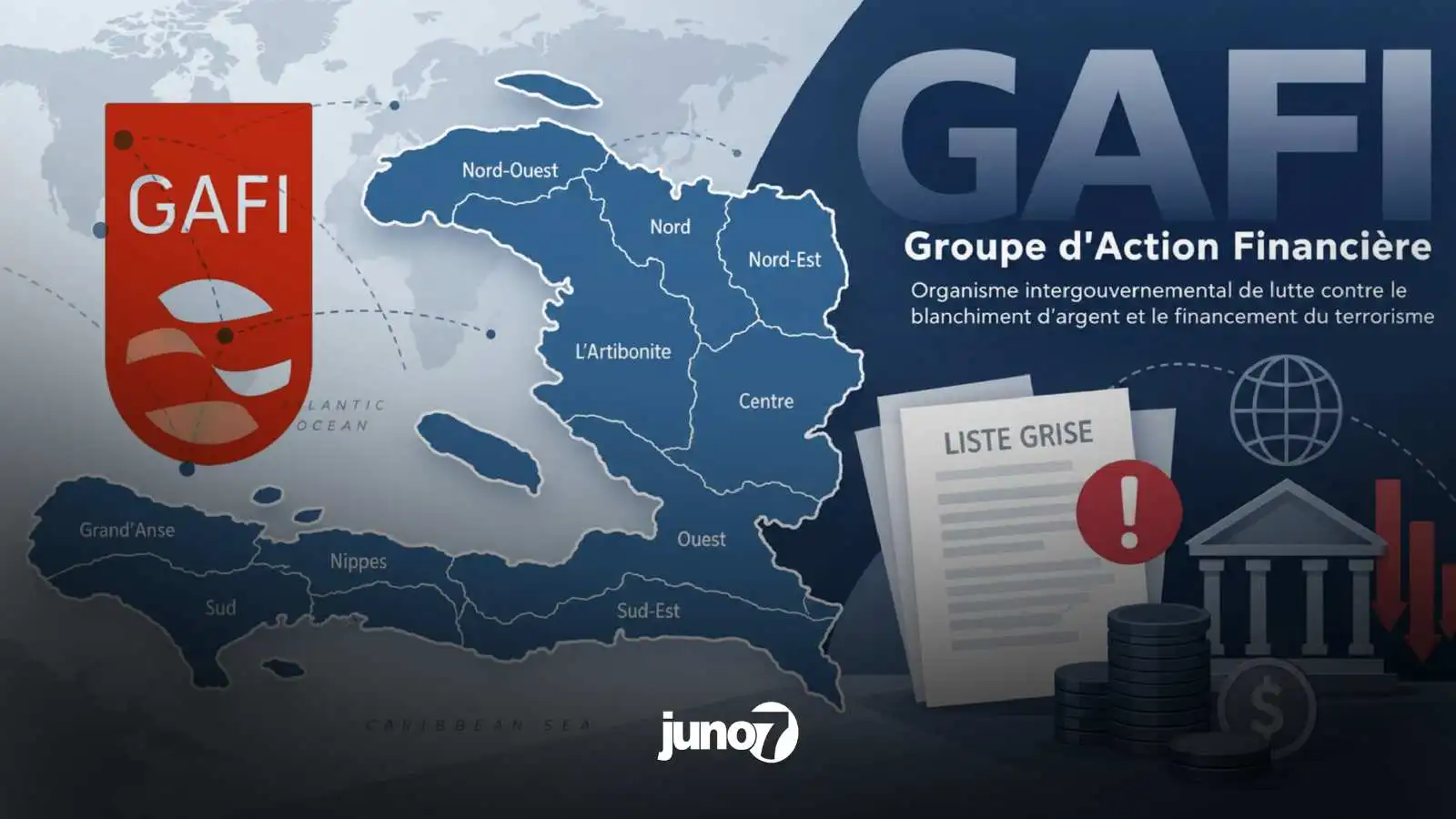
For more than five years, Haiti has been on the grey list of the Financial Action Task Force (FATF), the international body that sets global standards for combating money laundering, terrorist financing, and proliferation financing. Behind this classification, which might seem technical and far removed from everyday life, there’s actually a much more concrete issue at play: the ability of Haitian banks, businesses, and, indirectly, families to stay fully connected to the international financial system.
In Port-au-Prince, a business owner has to pay a supplier abroad. In Miami, Montreal, or Paris, a member of the diaspora is sending money to their family. A Haitian company needs to settle an international invoice in dollars.
At first glance, these are just ordinary banking operations.
But behind an international transfer is a much more complex infrastructure. A Haitian bank doesn’t necessarily have direct access to all the financial systems of the countries it wants to send money to. For some transactions, it has to rely on foreign correspondent banks that act as intermediaries to carry out international payments.
And to keep these relationships going, trust is key.This is exactly where Haiti’s prolonged presence on the FATF grey list becomes a national issue.
On June 19, 2026, the FATF kept Haiti among the jurisdictions under “enhanced monitoring,” commonly called the grey list.
The country has been on it since June 2021, when it committed to working with the FATF and the Caribbean Financial Action Task Force (CFATF) to fix strategic weaknesses in its system to combat money laundering and terrorist financing.
The grey list is not the black list.
In June 2026, the high-risk jurisdictions that the FATF called to take action included North Korea, Iran, and Myanmar. Haiti is not one of them.Being on the grey list basically means that a country has strategic weaknesses in its system to fight illicit financial flows, but it has committed to fixing them under international supervision.
The FATF actually specifies that it does not ask financial institutions to automatically cut off their relationships with countries on this list. It even discourages widespread ‘de-risking,’ meaning the systematic exclusion of entire categories of clients or countries solely because of their presumed risk level.
The nuance is important: Haiti is not excluded from the international financial system.
The problem lies elsewhere.
For an international bank, maintaining a relationship with a foreign institution comes with responsibility. It has to know the institution it’s working with, understand its compliance system, assess money laundering risks, monitor certain transactions, and comply with applicable sanctions regimes.
The more a relationship is perceived as risky, the more controls can become significant, complex, and costly.
This is where a country’s regulatory reputation really matters.The International Monetary Fund points out that a country being on the grey list can lead to pressures on banking correspondent relationships, increase the cost of international payments, affect remittances, limit access to certain markets, and impact cross-border trade as well as capital flows.
This doesn’t mean that every problem faced by a Haitian bank or business is caused by being on the grey list. That would be going too far. The decisions of foreign banks are based on many factors and their own risk assessments.
But being under international scrutiny for a prolonged period adds an element that foreign financial institutions may take into account when deciding whether to maintain, strengthen, or reduce a relationship with a Haitian institution.For an economy heavily dependent on financial exchanges with abroad, maintaining these relationships is therefore strategic.
The latest FATF report, however, contains signs of progress.
The organization acknowledges that Haiti has continued to move forward with its action plan despite a particularly difficult social, economic, and security situation.In June 2026, the FATF notably welcomed Haiti’s completion of its national risk assessment on money laundering and terrorist financing, as well as the publication of its findings.
A year earlier, the organization had also noted the implementation of risk-based supervision for financial institutions and the improvement of the financial intelligence unit’s ability to produce and share analyses with the relevant authorities.
But one sentence from the statement released in June 2026 now sums up the urgency: all deadlines in Haiti’s action plan have passed, and there’s still work to be done.
After more than five years on the grey list, the issue is no longer just about showing that Haiti is adopting reforms. The country has to prove that its system actually works.Six major projects are still identified by the FATF.
Haiti needs to strengthen risk-based supervision of certain professions and non-financial businesses considered more vulnerable to money laundering or terrorist financing.

