
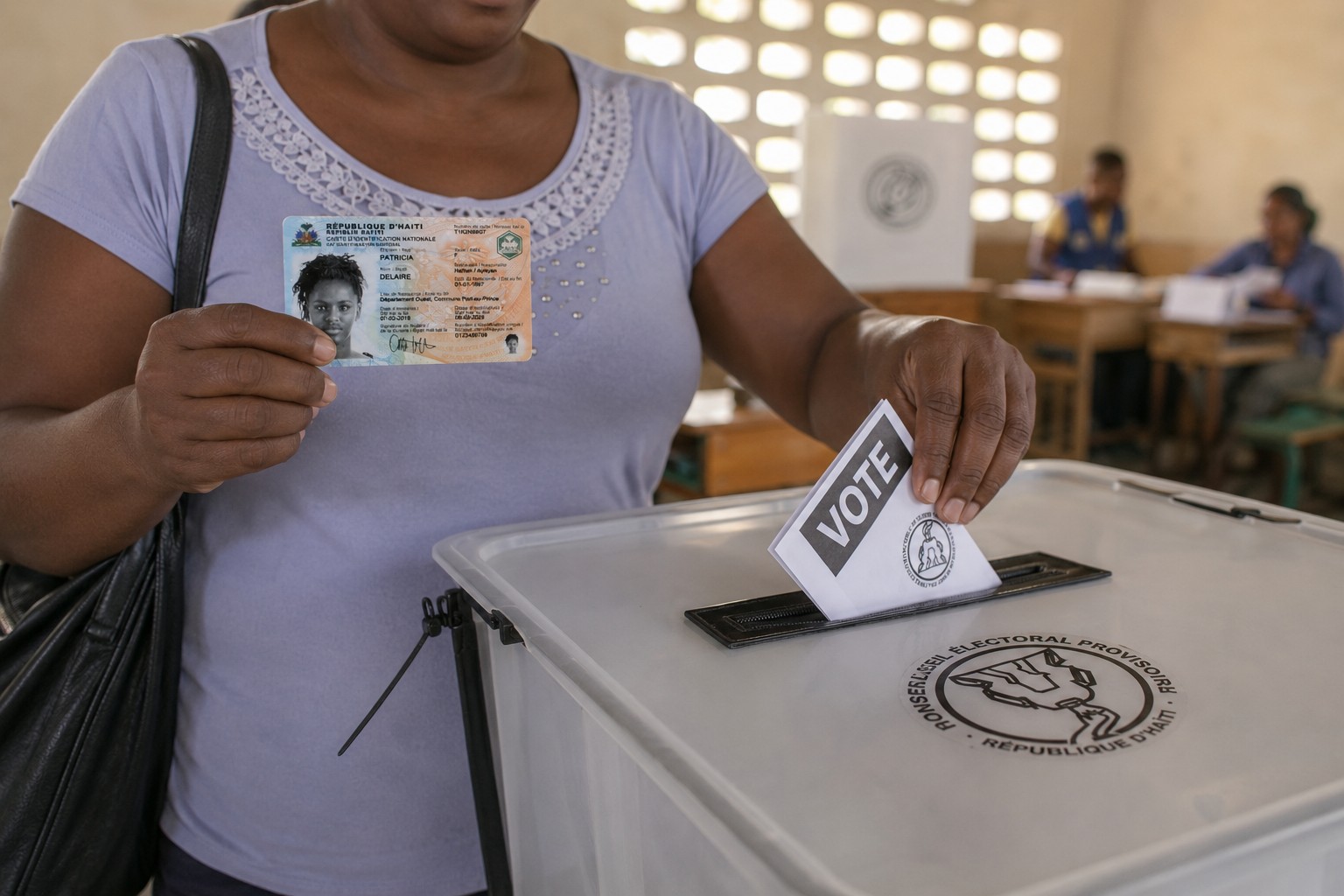
“The question of the ballot box” refers to the main issue that determines how voters cast their vote in an election.
The ‘question of the ballot box’ refers to the main issue that determines how voters decide in an election. It’s the fundamental question voters are trying to answer when they choose their candidate. It represents the issue that, in the voters’ minds, outweighs other considerations when making their choice. This question can be about the economy in general, inflation, unemployment, security, corruption, or even the quality of public services.
As the next elections in Haiti approach, beyond the names of the candidates, political alliances, and campaign promises, it’s important to ask what will really be at stake in the ballot box. In other words, what issue will weigh the most in voters’ minds when they cast their votes? The answer could be especially decisive in a country simultaneously facing insecurity, fragile institutions, a lack of political leadership, and a deep economic crisis.Will voters first vote for the candidate they believe is capable of restoring security, reestablishing state authority, boosting the economy, or rebuilding institutions? Or will their priorities be more related to their daily situation, their purchasing power, access to essential services, and their future prospects? So, the vote should really be a true judgment on the ability of future leaders to get the country out of this downward spiral.
Under these conditions, the stakes of the upcoming electoral battles might not just be about choosing between candidates or platforms. It could mainly be about deciding which national urgency voters should put at the top of their concerns. The next elections shouldn’t just be about picking a man or a woman. They should also be a moment when Haitian society expresses its frustrations, expectations, and hopes.Safety First
For a large part of the population, the first question might be extremely simple: who can restore safety? It’s hard to imagine a real economic recovery or sustainable institutional rebuilding without reestablishing order and security. A business can’t invest normally in an environment where its employees, goods, or facilities are constantly at risk of kidnappers. A farmer can’t produce peacefully if access to their market is compromised. A student can’t pursue their studies calmly when getting around becomes uncertain. And a citizen can’t fully exercise their political rights if going to a polling station poses a threat to their life.Security thus becomes not only an election issue but also a prerequisite for carrying out many other political commitments. The main question remains: is promising to restore order enough? Will voters want to know the concrete measures that will be used, the cost of these policies, and especially how they will be sustained over time?Behind the security issue lies a much deeper question: what kind of state do Haitians want to build? For several decades, political debate has often focused on the people called to lead the country. Yet the Haitian crisis goes far beyond the question of individuals. It’s about the ability of institutions to fulfill their responsibilities, deliver justice, ensure the safety of lives and property, collect and use public revenue effectively, provide essential services, and uphold the law.
The next president shouldn’t just be judged on their ability to win an election. They should instead be evaluated on their ability to build institutions that can function effectively beyond their term to create wealth sustainably. That’s where one of the real questions at the ballot box lies: will voters simply choose a new leader, or will they seek to open a new institutional chapter that could promote the country’s economic and social development?And for the economic recovery
The second big concern will be economic. After eight years of contraction, the Haitian economy needs more than just a public spending program or a few one-off projects. The country needs to regain production capacity, attract investment, create jobs, and restore household purchasing power. The question for the candidates should therefore be precise: what model of economic recovery or development do they propose for the country? Agriculture, industry, tourism, infrastructure, energy, digital technologies, and services could all play a part in this recovery strategy. But first, it’s necessary to create the conditions that allow progressive private sector and innovative entrepreneurs to take risks and invest.The diaspora could also play an important role in this equation. Their remittances are already a key source of resources for many families. But the debate could shift toward a more ambitious question: how can part of these resources be turned into productive investments, instead of being mainly limited to their parents’ consumption?
However, it would be simplistic to consider the election only as a referendum on security or the economy. Voters will also need to weigh in, directly or indirectly, on the quality of governance. How much emphasis should be placed on fighting corruption? How can the justice system be reformed and strengthened? How can trust between citizens and institutions be restored?After so many years of crisis, the real challenge might be convincing a disillusioned population that voting can still bring about real change. That’s why candidates will need to do more than just throw out slogans. They’ll have to explain how their promises will be funded, which institutions will implement them, when we can expect tangible results, and what oversight mechanisms will be in place.Who? For what purpose?
Traditionally, Haitian election campaigns are built around personalities. We should rather ask: Who will be president? For what purpose? And especially: What priority problem will the next president need to solve first? If voters’ answer is security, candidates will need to present a credible strategy to restore the authority of the state. If it’s the economy, they will have to explain how to create wealth and jobs within a reasonable time. If it’s governance, they will need to show how they plan to rebuild trust in institutions. Obviously, it’s about all these issues, to be considered in a sequential way.Obviously, an election won’t automatically solve all these problems. It won’t create security on its own, instantly revive the economy, or transform institutions overnight. But it can provide something the country deeply needs: political legitimacy from the popular vote to start reforms and lay the foundations.
The real question in the ballot box might ultimately be this: do Haitians just want to change leaders, or do they want to change the path of governance and development? That’s the question candidates will have to address during the campaign. And it’s especially the question voters will have to answer in the voting booth. Asking the question of the ballot box means breaking away from the logic of a vote that is traded for one or a few 1,000-gourde bills and putting the electoral choice back on the issues and the country’s future.

