
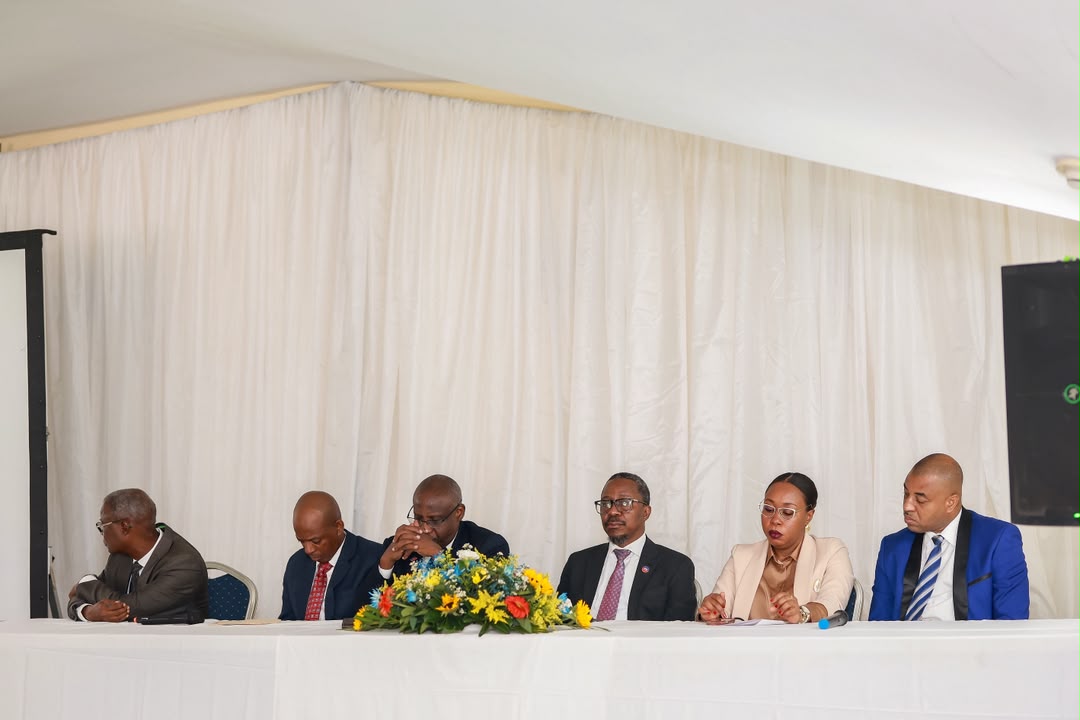
The OCPAH, with the support of the World Bank and other partners, wants to provide Haiti with a national external audit quality assurance system.
The OCPAH, with support from the World Bank and other partners, wants to provide Haiti with a national external audit quality assurance system. Presented on September 28, 2026, at the El Rancho Hotel, the assessment carried out in this context highlights the weaknesses of a still fragmented system and proposes a roadmap based on a hybrid model.
The accounting and auditing sector in Haiti is looking to take the next step. Gathered around the Order of Certified Professional Accountants of Haiti (OCPAH), representatives from the government, audit firms, regulatory institutions, and technical and financial partners went over the assessment of the national external audit quality assurance system.According to Jacques Nerettes, chairman of the OCPAH board, the goal is to strengthen the quality of audits, improve the reliability of financial information, and create a national framework that allows for more consistent checking of the application of professional standards. The report particularly points out the absence of a structured national quality review mechanism, partial implementation of international standards, and varying technical capacities among firms. ‘The standards exist, but their application remains uneven and national supervision is still insufficiently structured,’ emphasizes Jacques Nerettes.
For Jean-Michel Silin, Director General of the Budget at the Ministry of Economy and Finance, this initiative is part of efforts to modernize the country’s economic governance. ‘Trust can’t be decreed. It is built quite slowly through the quality of institutions and the reliability of the information they provide.’The Budget Director General placed the approach within the process of modernizing public finance management, recalling the role of institutions like the Supreme Court of Accounts and Administrative Litigation, the General Inspectorate of Finance, the General Tax Directorate, and the Bank of the Republic of Haiti. For the ministry, the reform needs to be built with the different stakeholders. It requires “a clearer framework, stronger institutions, better-equipped offices, and improved coordination among all actors in the financial trust chain.”A diagnosis that reveals structural weaknesses
The report is based on questionnaires sent to audit firms, public regulatory institutions, and OCPAH, as well as on interviews and a document review. It reveals a system that is still in its early stages and fragmented. Nearly 100% of respondents confirmed the absence of a structured national quality assurance mechanism. Over 80% reported partial application of international auditing standards, while around 70% of the firms surveyed stated a limited implementation of international quality management standards.
These results don’t mean that audits conducted in Haiti are systematically flawed. They mainly show that the country still lacks a national mechanism to regularly and uniformly measure the quality of work done. The diagnosis published by OCPAH in September 2026 thus places the national quality assurance system at aIn his speech, Franck Russo, representing the World Bank, pointed out that the issue goes beyond the accounting profession. “The quality of audits is not just a technical or professional requirement,” he emphasized. It’s also “a key factor in transparency, accountability in resource management, and trust in institutions.”
The assessment comes from a process of analysis, consultation, and dialogue with key stakeholders. It should now serve as the basis for a reform that fits the country’s realities and priorities. The initiative was led by OCPAH, with support from the World Bank and the participation of partners such as the Inter-American Development Bank, the International Federation of Accountants, and the Pan-African Federation of Accountants.For Franck Russo, the challenge now is to turn the recommendations into concrete measures: ‘The real value of this assessment will depend on our collective ability to transform the recommendations into concrete, realistic, and sustainable actions.’
A preferred hybrid model
The assessment looked at several scenarios for organizing the future national quality assurance system. Strengthened self-regulation by the profession offers some proximity to the firms and limited institutional cost, but can raise questions about independence. A fully independent public authority would ensure greater institutional separation, but would require a solid legal basis, permanent resources, and significant administrative capacities.The chosen model is hybrid. It aims to keep an important technical role for OCPAH while introducing governance that is independent and pluralistic enough. This approach matches the guidelines published by OCPAH, which presents the hybrid model as a mix between a structuring role of the Order and an independent supervisory mechanism.
Project leaders stress that the reform will be gradual. The first phase is expected to focus more on technical support and training rather than a strictly punitive approach. “The roadmap provides for a formal period of adjustment based on a teaching and non-punitive approach, targeted technical support, and gradual evaluation,” the consultants explained.Capacity building will involve training, providing methodological tools, and supporting firms in applying standards. ‘Strengthening audit firms shouldn’t be seen just as an accounting profession issue. It’s also a matter of governance.’SNAQAE as a tool for transformation
The future National System for External Audit Quality Assurance (SNAQAE) is meant to be one of the main instruments of the reform. Its goal is to improve transparency and the quality of financial governance, strengthen investor and partner confidence, increase the credibility of financial information, and promote competition more based on skills. The system should also allow for a gradual alignment of national practices with international standards, while taking local market constraints into account. The OCPAH’s strategic plan had already envisioned designing an external quality assurance system in line with international requirements, as well as setting up monitoring tools and procedures.
The speakers emphasized the expected effects of the reform on economic governance. Reliable financial information makes the work of regulators, investors, partners, and public decision-makers easier, while also allowing for a better understanding of the financial situation of companies and institutions. This approach comes at a time when the OCPAH is also continuing its initiatives on institutional transparency. In March 2026, the Order had published the audit report of its own financial statements for the 2024-2025 fiscal year, presenting this approach as a part of transparency and good governance.The ceremony ended with a call to continue the process. For OCPAH and its partners, presenting the assessment is not the end of the reform. “What we are opening today is not a conclusion. It’s a starting point,” said the chairman of the board. The next step will be to turn the recommendations into concrete actions, with clear responsibilities, deadlines, and resources. OCPAH is thus calling for a new phase based on “action, accountability, and consistency,” aiming to establish a national quality assurance system that can sustainably strengthen transparency, credibility, and trust in financial information in Haiti.

