
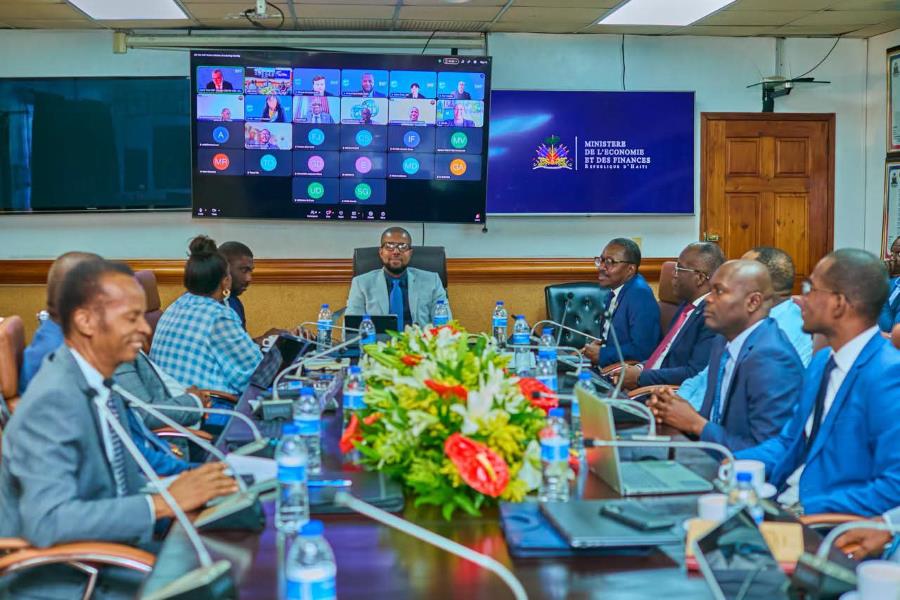
A team from the International Monetary Fund (IMF) services led by Mr.
A team from the International Monetary Fund (IMF), led by Mr. Camilo E. Tovar, carried out a remote mission from September 14 to 25, 2026 to assess the progress made under the 4th review of the support program for Haiti. During this mission, the IMF team was able to look into the advances and delays recorded regarding the quantitative and indicative targets, as well as the security constraints that not only weigh on economic activity and the provision of basic services but also weaken the political transition, etc.At the end of this assessment, the head of the IMF mission, Camilo E. Tovar, in an IMF statement dated September 28, gave a summary of his observations on the economic and financial situation in a statement worded as follows:Haiti is facing an exceptionally tough macroeconomic situation, marked by persistent insecurity, precarious humanitarian and social conditions, and multiple adverse shocks. Rising oil prices are straining the budget and external balances and driving up the cost of living, while the end of Temporary Protected Status for Haitian nationals in the U.S. could lead to a drop in untied private transfers and worsen economic and humanitarian vulnerabilities. These challenges come amid a fragile political transition and preparations for elections. Despite these constraints, the authorities have continued to implement their economic program and maintain macroeconomic stability.
During the 2026 fiscal year, economic activity is expected to shrink for the eighth consecutive year. Ongoing insecurity, rising oil prices, and weak export prospects for the textile and clothing sectors have continued to weigh on activity. Inflation, particularly due to the stability of the exchange rate, is expected to be around 16% year-on-year during the 2026 fiscal year, well below the peak of over 32% recorded in October 2025. Financial intermediation remains sluggish in a context of low activity and increased uncertainty, which hampers private investment. The external position continues to benefit from strong private transfers without reciprocation and a sufficient level of international reserves. The current account balance is expected to remain in surplus despite the weakness of the trade balance, while gross international reserves stay at an adequate level, equivalent to about seven months of projected imports. However, a prolonged increase in fuel import costs remains a source of vulnerability for the external sector.
The external position continues to benefit from strong private transfers without reciprocation and a sufficient level of international reserves. The current account balance is expected to remain in surplus despite the weakness of the trade balance, while gross international reserves stay at an adequate level, equivalent to about seven months of projected imports. However, a prolonged increase in fuel import costs remains a source of vulnerability for the external sector.Budget policy is facing increasing pressure due to exceptionally low revenues, rising oil prices, and urgent and critical needs in security, humanitarian aid, and development. To free up budget space for these priorities while maintaining macroeconomic stability, it will be necessary to boost revenue collection, continue efforts to strengthen the tax and customs administrations, adopt realistic planning and prioritization of spending, and ensure careful financing without resorting to non-concessional loans. Strengthening budget execution, cash management, and payroll integrity could improve the quality of spending and control over the wage bill, which would create room for priority expenditures.The risks to the outlook are rather mixed. New setbacks in terms of security, rising oil prices, and the delayed impact of fuel price and minimum wage increases could weigh on growth and keep inflation high. A weakening of private remittances following the end of VAT and a possible El Niño-related drought are other downside risks. On the upside, falling oil prices, more noticeable progress on security, and a smooth election process that reduces uncertainty and boosts confidence could support a stronger recovery.
particularly difficult. By the end of June 2026, all quantitative and indicative targets were met, except for the ongoing target related to the non-accumulation of external arrears. These arrears temporarily accumulated due to administrative and capacity constraints but were quickly cleared. Net international reserves reached about 1.9 billion US dollars by the end of June 2026, which is well above the program floor.
The ceiling on financing of the non-financial public sector by the central bank was also respected by the end of June 2026. The implementation of the reform program is progressing, despite some delays due to capacity constraints and a very challenging operational environment. The authorities also reported progress in areas covered by the upcoming structural benchmarks and reaffirmed their determination to continue implementing the reform program.The reference program will continue to focus on the following priorities:
“Strengthening governance and financial integrity to boost trust in public institutions and the rule of law. It will be crucial to make the recently established judicial chambers operational to tackle complex financial crimes and mass crimes, in order to reinforce the fight against corruption, money laundering, and organized crime. Implementing the action plan from the National Risk Assessment and applying reforms linked to the Financial Action Task Force should remain priorities, especially through a Financial Intelligence Unit (UCREF) equipped with the necessary resources, greater transparency of beneficial ownership, enhanced cooperation between agencies, and better tracking, identification, and recovery of assets.”Strengthening revenue collection to meet the needs of priority spending. The implementation of the new tax code on October 1, 2026, will be an important milestone in Haiti’s tax reform program, by consolidating and modernizing the tax framework. Effectively putting the new tax code into practice, continuing the modernization of the tax and customs administrations, improving interoperability between them, and maintaining a transparent, rules-based fuel pricing system will be essential to improve compliance, reduce losses, and support domestic revenue mobilization.“Ensure a more effective use of public resources. Strengthening cash management, public investment management, and commitment control, as well as continuing the consolidation of the Treasury single account, remain essential to improving budget execution and reducing budget risks. Continuing efforts to strengthen payroll integrity and wage bill management could free up room for priority spending. Improving the traceability of expenditures, as well as identifying and targeting beneficiaries, would help ensure that social assistance reaches the intended populations. Effective use of the remaining resources from the IMF’s 2023 grant for the food shock response financing window.”Following up on the findings of ongoing control and audit reports will be important for supporting vulnerable households, improving the delivery of social aid, and enhancing accountability and transparency. Maintaining prudent debt management practices and mobilizing enough resources to ensure timely debt service remain essential for keeping the budget sustainable and reducing financing risks.« Preserving confidence in the monetary policy and exchange rate framework. The Bank of the Republic of Haiti (BRH) remains committed to maintaining price and exchange rate stability, which underpins the credibility of policies within the reference program. It is essential to maintain an adequate level of reserves to support confidence and strengthen resilience against external shocks.
Additionally, continuing the implementation of the reserve management strategy, with stronger internal controls, clearer risk management practices, improved governance of investment decisions, and ongoing progress in IT security and operational continuity, will help strengthen BRH’s institutional framework, risk management, and operational resilience.“Strengthen supervision of the financial sector to maintain financial stability. Progress is being made in implementing risk-based supervision, particularly through the assessment of risk analysis grids and rating matrices, as well as completing work on the new accounting plan for financial institutions. These reforms will help increase the effectiveness of supervision, improve the quality of financial information, and promote prudent risk management within the sector.
“Improve the quality of data and its timely production. The BRH has completed the publication of the financial statements for fiscal year 2024 and the independent auditors’ report, and work has begun to address audit reservations and recommendations from fiscal year 2023. Timely publication of the financial statements and audit reports for fiscal years 2025 and 2026 will help maintain regular\
Continuing to strengthen economic and financial statistics, especially those for the external sector—thanks to the transition to BPM6 and better information on reserves—as well as budget tracking, will promote transparency and policy making. IMF technical assistance, particularly through the Caribbean Regional Technical Assistance Center (CARTAC), will keep supporting efforts in these areas and many others.« Mobilizing support from development partners to advance reforms and manage budget risks. Timely external aid in the form of grants and concessional financing, aimed at maintaining debt sustainability, along with continued capacity building, will help meet urgent humanitarian, security, and development needs, strengthen policy implementation, and support institutional reforms. This support, accompanied by strict evaluation and transparency requirements for donor-funded operations, can help safeguard the public sector’s balance sheet, consolidate progress under the program, and promote a sustainable recovery that could improve the living conditions of the Haitian people.Following the IMF Strategy for fragile or conflict-affected states, IMF staff will continue their close collaboration with Haiti’s main development partners in the areas of governance and capacity building. This cooperation is notably carried out through the “Mutual Accountability Framework for Haiti’s Stability and Recovery,” recently developed by the Government of Haiti in partnership with the World Bank and other international partners.
The IMF team met with Mr. Serge Gabriel Collin, Minister of Economy and Finance, and Mr. Ronald Gabriel, Governor of the Bank of the Republic of Haiti, as well as other senior officials. The mission expresses its gratitude to the Haitian authorities for their close cooperation and the open and constructive discussions throughout all its work.

