
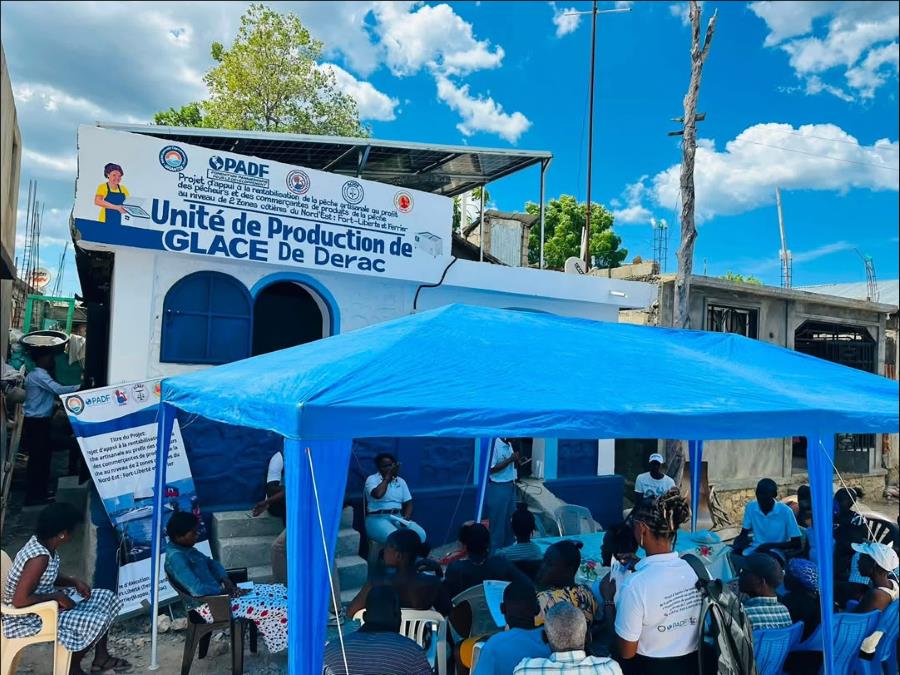
The GFRD-ACDDF-TKFW consortium, with funding from the “Ocean Community Empowerment and Nature” program and support from UK International as part of the Blue Economy project, officially inaugurated three ice production units in the Northeast Department on Tuesday, September 29, 2026.
The GFRD-ACDDF-TKFW consortium, with funding from the “Ocean Community Empowerment and Nature” program and support from UK International as part of the Blue Economy project, officially inaugurated three ice production units in the Nord-Est department on Tuesday, September 29, 2026. The facilities are located in Garde-Saline and Dérac, in the Fort-Liberté municipality, as well as in Meillac/Mapoux, in the Ferrier municipality. The ceremony took place with the presence of the coordinator of the Revolutionary Feminist Group of Haiti (GFRD), engineer Fania Finfin, the representative of the Pan-American Development Foundation (PADF), Frednel Isma, local authorities, and representatives of the beneficiary communities.A response to preservation challenges
These ice production units are designed to address one of the main problems faced by fishermen and fish product traders in these coastal areas: keeping the products fresh after they are caught. Through the project ‘Support for the profitability of artisanal fishing for the benefit of fishermen and fish product traders in two coastal areas of the Northeast (Fort-Liberté and Ferrier),’ GFRD aims to help reduce losses and improve the quality of products intended for consumption.
To enable the operation of the three units, equipment was given to the management committees. The Garde-Saline unit notably has nine 500-watt solar panels, a 5 kW lithium battery, a hybrid inverter, an ice machine, four insulated coolers, and two 5.5-foot freezers. The Dérac and Meillac/Mapoux units each have six 730-watt panels, a 5 kW lithium battery, a hybrid inverter, an ice machine, four insulated coolers, and two 5.5-foot freezers, along with lightning protection accessories.“Access to ice is a major need for fishermen and vendors,” said GFRD coordinator, engineer Fania Finfin. She believes that local ice production will help improve the preservation of fishery products, reduce losses after fish are caught, and maintain their quality. She also emphasized the importance of support and strengthening the economic capacities of the beneficiaries, urging them to see this equipment as “a real development tool for their communities.”
Committees tasked with protecting the equipment
The management of the three facilities will be handled by committees set up within the beneficiary communities. A memorandum of understanding was signed between the GFRD and the members of these committees to define the responsibilities related to managing the units and to prevent, in particular, sabotage or personal use of the equipment.
Meanwhile, Frednel Isma, the PADF representative, praised the completion of the project and congratulated the GFRD for its work. He also called on the beneficiary communities to link the development of fishing with the protection of natural resources. “We need to protect mangroves and coral reefs,” he emphasized, highlighting their role in preserving marine ecosystems and supporting fish reproduction. He encouraged local stakeholders to also work on increasing production.The beneficiaries from Garde-Saline, Dérac, and Meillac/Mapoux, for their part, expressed their satisfaction during the inauguration. They explained that the lack of ice used to be a major problem for preserving fish products. They committed to using the equipment provided properly and to helping strengthen the fishing sector in the Northeast.
Valéry Félix
fvalery751@gmail.com
X: @Valeryfelix7

