
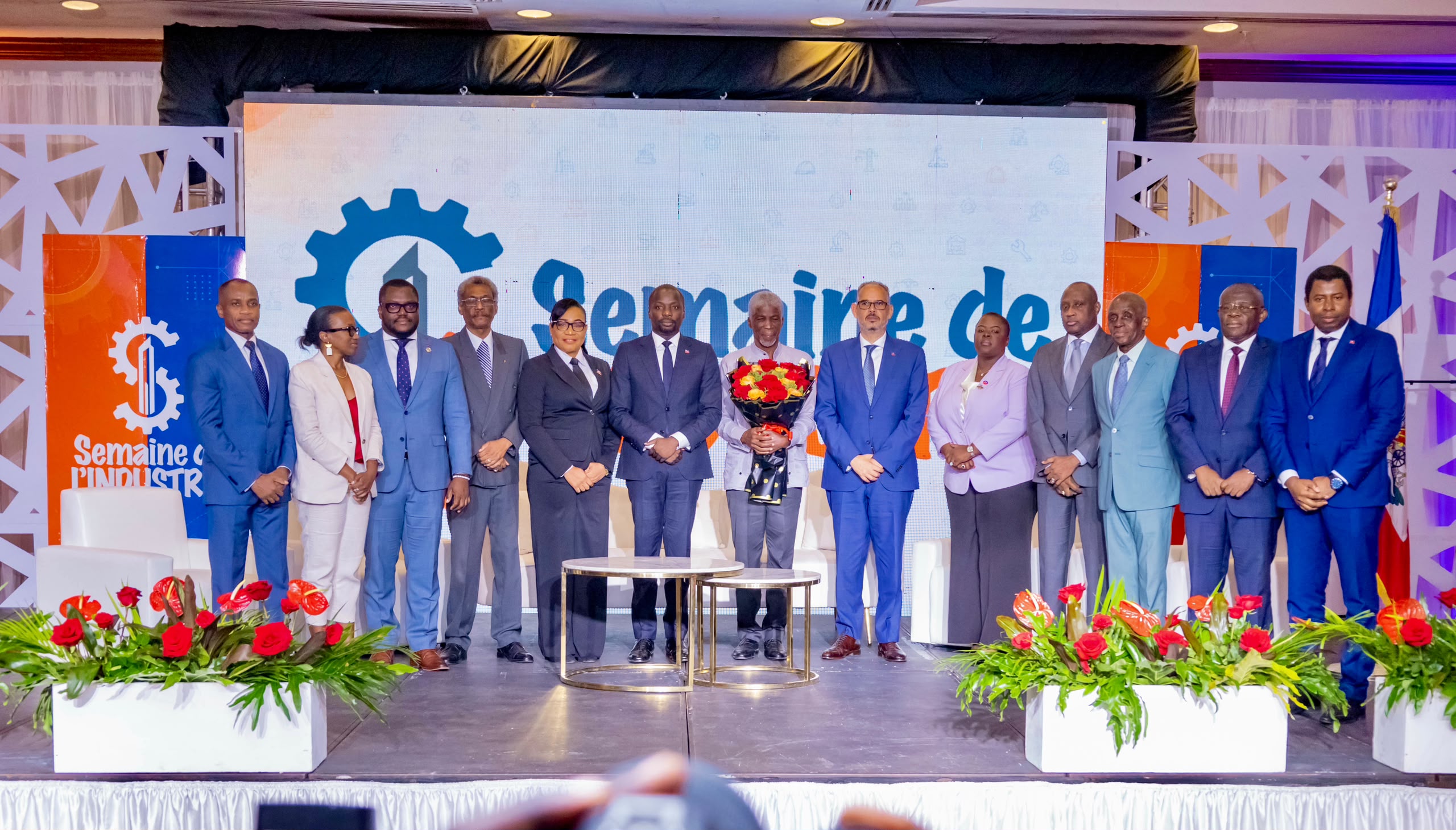
It was at the Karibe Hotel that the Ministry of Commerce and Industry, along with its partners, kicked off the first edition of Industry Week, around the theme ‘Towards the Revitalization of the Haitian Industrial Sector’.
It was at the Karibe Hotel that the Ministry of Trade and Industry, along with its partners, kicked off the first edition of Industry Week, under the theme ‘Towards the Revitalization of the Haitian Industrial Sector.’ Scheduled from October 1 to 3, 2026, the event aims to bring together private and public investors, entrepreneurs, academics, experts, and industrialists to discuss the need for a more dynamic sector, as well as to analyze the challenges it faces and potential solutions.From this perspective, Roberto Augustin, assistant director of the Directorate of Industrial Control and Regulation (DCRI), reminds us that industry isn’t just about machines and equipment. “Beyond machines, industry is a country’s ability to turn its resources, skills, and values into jobs and opportunities,” he says. He acknowledges that processing raw materials creates more value. Producing, yes, but producing better to win new markets and boost exports. According to him, this week helps set the tone and bring out a new industrial vision for Haiti.This need to produce more and create more value aligns with the concerns of the private sector. For his part, David Coles, president of the Haiti Industries Association (ADIH), argues that behind companies, there are women, children, families, and investments. Companies generate income and opportunities. However, he believes that they cannot go it alone in the ecosystem. “Industries need the necessary resources to operate,” he points out. Producing in Haiti shouldn’t become a real struggle.In this spirit, Mr. Coles particularly emphasizes the fight against smuggling, while also urging businesses to invest and innovate. The goal, he says, is to develop industries, better meet demand, and give young people the chance to build their own businesses in Haiti. He also stresses the need to create a favorable environment for investments. ‘What we consume depends on what we create,’ he reminds us.But to develop an industry capable of producing, innovating, and conquering new markets, the question of skills remains essential. It’s with this in mind that the rector of the State University of Haiti, Dieuseul Prédélus, emphasizes the role of training and research. A country without its executives and technicians can’t innovate. At that stage, it’s forced to import. “No country can get out of poverty without producing, without diversifying its productions,” he adds.
According to the rector, a country that imports most of what it consumes and depends on external markets is vulnerable to supply disruptions, price fluctuations, and the international climate. Stability, investment, and skills are needed to develop capacities. A modern industry relies on skills. Believing that the university has a role in energizing the industry through research and analysis, he thus invites the MCI and its partners to see the university as a partner, not just a beneficiary.Beyond production and skills, industrial recovery also raises the question of economic sovereignty. The Minister of External Cooperation, Sandra Paulémon, stressed that a country that doesn’t produce, imports its jobs, becomes vulnerable, and jeopardizes its sovereignty. For her, recovery isn’t something that happens by chance, but with a vision and coordination between the government, the private sector, and partners. She specifically advocates for ‘territorializing industry,’ bringing industry closer to production and family jobs, as well as turning diaspora engagement into investments.Turning resilience into growth capacity
This need to bring different players together around a shared vision is actually one of the reasons behind the launch of this first Industry Week, explains the Minister of Commerce and Industry, James Monazard. A country that doesn’t produce what it consumes ends up being dependent and vulnerable. Believing that the country has fallen far enough behind in the industrial revolution, the minister thinks this gap can’t be fixed by the government alone and is calling for everyone to get involved.”Gather, talk, and decide”: it is this quest for synergy that led to the launch of this first edition at the start of the fiscal year. However, the sector continues to face the harmful effects of the crisis. According to the minister, the economy shrank by 2.7% in 2025. As for manufacturing industries, they declined by 4.3% over the past three to four years. Behind these numbers are the realities that entrepreneurs have to deal with: falling production, blocked roads, and other difficulties. Praising their resilience and courage, the head of the MCI believes that this survival capability now needs to be turned into growth potential.
In the same vein, the minister believes that Industry Week should also help break down the perception that Haitian industry is only about the textile sector, even though more than 90% of industrial exports come from this sector. Industry accounts for nearly 22% of GDP. He also points out that Haiti provides half of the vetiver essential oil needed for perfume production on the international market.This desire to diversify and strengthen national production also aligns with the government’s vision. ‘Revitalizing our industry means reducing our dependence on imports by making the most of our local resources, creating wealth and stable jobs for our youth, and strengthening our economy in an increasingly competitive world,’ said Prime Minister Alix Didier Fils-Aimé. The head of government also announced, under the guidance of the Ministry of Commerce and Industry, the implementation of the Industrial Policy Strategic Plan, aimed in particular at structuring industries, modernizing infrastructure, and improving the operating conditions of the sector.The launch ceremony also highlighted and celebrated people who contributed to the development of the sector. Guest of honor, Harry Nicolas, known as “Mèt Fèy Vet,” an entrepreneur and head of agri-food companies, along with about fifteen companies, were honored for their work and contribution in the sector. Among the honored companies were the Société du Rhum Barbancourt, the National Brewery (BRANA), Brasserie La Couronne, San Miguel Haiti S.A., the Pharmatrix lab, Caribex S.A., the Comme Il Faut Tobacco Company, the National Paint Factory, Haïti Cereal S.A., and Séjourné.During these three days, an industrial fair and an industrial expo will give participants the chance to meet industry professionals, chat with them, explore opportunities to work or collaborate with them, and even showcase their projects. Taking stock of the situation and looking at the prospects, while highlighting the sectors that should be prioritized and encouraged: that’s the work the MCI and its partners are doing during this first edition of Industry Week.

