
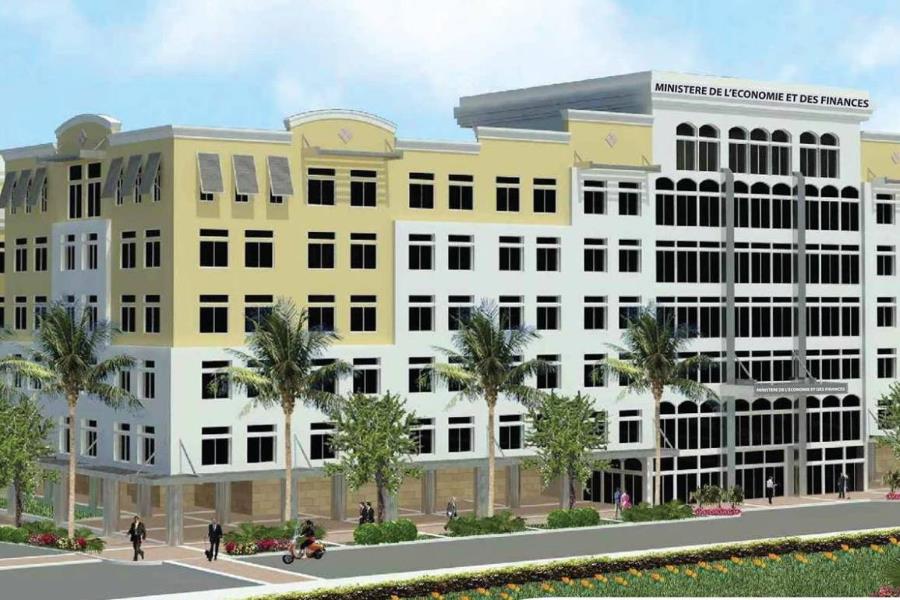
At a Cabinet meeting held on September 30, 2026, the government approved the 2026-2027 budget totaling 401.2 billion gourdes, according to a statement from the Ministry of Economy and Finance (MEF).
During a Cabinet meeting held on September 30, 2026, the government adopted the 2026-2027 budget totaling 401.2 billion gourdes, according to a statement from the Ministry of Economy and Finance (MEF). This represents an increase of 40.9 billion gourdes compared to the 2025-2026 revised budget, which was estimated at 360.3 billion gourdes.
Coming at a challenging time nationally, this budget needs to simultaneously address the need to gradually restore public security, speed up the electoral process, provide essential services to the population, maintain macroeconomic balance, and support an economic recovery that is still fragile.Through this new budget of 401.2 billion gourdes, the Haitian government has set three main priorities: public security and national defense, organizing elections and restoring institutions, and then economic recovery linked to social protection and regional development.Public safety and national defense remain the central priority of the 2026-2027 budget, according to the MEF statement. The government plans to strengthen the operational capacities of the Haitian National Police (PNH) and the Haitian Armed Forces (FAd’H), secure the main highways, step up the fight against criminal armed groups, and create the minimum conditions for the resumption of economic activity.
The Ministry of Justice and the Ministry of Defense are set to receive a budget of 73 billion gourdes, or 18% of the total budget, according to the statement. This amount covers payroll and related costs for the staff of the PNH and the FAd’H, as well as the essential operational goods and services for the police forces, including food, fuel, equipment, maintenance, logistics, communication, and operational support.“These funds will allow the continuation of the P-4000 program, which aims to recruit and provide intensive training for 4,000 new police officers, to honor contractual installments related to the acquisition of equipment for the PNH, to support the gradual scaling up of the FAd’H with the government goal of 15,000 soldiers over three years in mind, and to finance the construction of a prison, essential for strengthening the criminal justice chain and fighting impunity.”The second priority of the 2026-2027 budget is about continuing the electoral process and gradually returning to regular functioning of democratic institutions. The budget includes the necessary needs for carrying out the electoral process, securing operations, logistics, institutional communication, and support for the structures involved in organizing elections. To this end, a sum of 8.6 billion gourdes is allocated for exceptional expenses related to electoral activities and support for political parties, compared to 5.9 billion gourdes in the 2025-2026 revised budget, which is an increase of 2.7 billion gourdes.The new budget also includes additional budgetary allocations to ensure the regular functioning of state institutions, notably the Parliament, which includes the Chamber of Deputies and the Senate, as well as the Presidency, due to the renewal of political staff following the elections. According to the statement, this planning aims to prevent the restoration of democratic institutions from resulting in unforeseen expenses not covered by the budget.
The third priority is to support a gradual economic recovery, focused on projects that can deliver results.
The 2026-2027 budget proposal is built around a delicate balance between the effort to raise revenue, security and election imperatives, social protection, investment needs, and macroeconomic discipline.”The budget for the 2026-2027 fiscal year reflects the Government’s commitment to addressing national emergencies while maintaining the conditions for sustainable stabilization. It is based on careful trade-offs in a context of limited resources and aims to balance the immediate needs of the population with the requirements of fiscal discipline, transparency, and accountability. It is also a tool for ensuring continuity of the State, strengthening institutions, and preparing for a gradual return to stronger growth,” concludes the MEF statement on the adoption of the 2026-2027 Budget.

