
ProEco Haiti, a private consulting and research firm established in 2019, just released its economic report for the 2025-2026 fiscal year.
ProEco Haiti, a private consulting and research firm established in 2019, has just released its economic report for the 2025-2026 fiscal year. This analysis of Haitian economic activity, focused on 10 key findings, highlights an overall mediocre economy, but with some positive developments in terms of inflation trends, exchange rates, and the profitability of commercial banks, according to the summary of this publication from the firm led by economist Enomy Germain.
At the end of its review of the fiscal year, ProEco Haiti projects for 2026-2027, suggesting that the main challenge for the next year will be to consolidate the favorable developments observed, while creating the conditions for a recovery of the real economy and an improvement in the living conditions of the population.”From this perspective, the implementation of effective fiscal and monetary policies will need to be accompanied by a real and lasting improvement in the country’s security situation, which remains an essential condition for the recovery of economic activity,” continues the summary highlighting the 10 main findings that come from the analysis of the 2025-2026 fiscal year’s performance.1- Eight Years in the Red
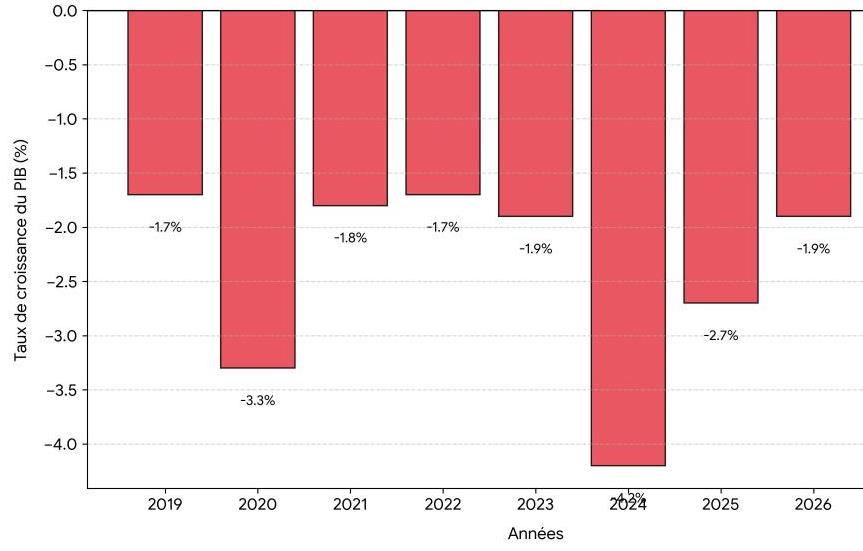
The Haitian economy is set to record its eighth consecutive year of contraction in 2026, following real GDP growth rates of -1.7% in 2019, -3.3% in 2020, -1.8% in 2021, -1.7% in 2022, -1.9% in 2023, -4.2% in 2024, and -2.7% in 2025. This uninterrupted string of underperformance marks one of the longest periods of economic decline in the country’s recent history.
For the 2025-2026 fiscal year, the Economic Commission for Latin America and the Caribbean (ECLAC) expects Haiti’s economy to shrink by 1.4%, while the regional economy as a whole is projected to grow by 2.2%. Following its fourth review of the Reference Program in September 2026, the International Monetary Fund (IMF) confirmed this eighth consecutive contraction.The expected performance in 2026 confirms the persistence of a downward trend in the Haitian economy. Eight consecutive years of contraction are no longer just a temporary slowdown: they reflect a prolonged weakening of productive activity and the economy’s ability to create wealth.
- A widespread contraction of the national productive apparatus
The contraction of the Haitian economy remains largely widespread in 2025-2026. In the first quarter, the overall Economic Activity Survey Indicator (ICAE) fell by 1.1%, due to a simultaneous drop in the three major sectors: -4.0% for the primary sector, -2.3% for the secondary sector, and -0.3% for the tertiary sector. Several important industries saw significant underperformance, including agriculture (-4.0%), construction (-4.1%), electricity and water (-5.0%), trade (-2.5%), and hotels and restaurants (-2.3%).In the second quarter, the contraction continued, although at a less pronounced pace, with a 0.6% drop in overall ICAE. The primary sector contracted by 3.5% and the secondary by 1.8%, while the tertiary sector slightly increased by 0.4%. However, this slight growth in the tertiary sector masks declines in several of its branches, notably trade (-1.1%), hotels and restaurants (-2.1%), and other market services (-4.5%).
IHSI data thus show that the recession affects a large part of Haiti’s productive sectors, even though some pockets of growth persist, particularly in financial institutions, transport and communications, and non-market services.Inflation slows down, but life remains expensive
The 2025-2026 fiscal year saw a clear slowdown in inflation. After hitting 31.9% in September 2025, the year-on-year inflation rate peaked at 32.2% in October, before gradually dropping to 17.0% in August 2026, a decline of over 15 percentage points from the peak recorded at the beginning of the fiscal year.
However, this disinflation does not mean that the cost of living has gone down. Prices are still rising, just at a slower pace. In fact, in August 2026, food prices were still up 17.6% on the year, while transport costs increased by 26.6%.Several everyday consumer products are still being heavily affected, notably rice (+20.5%), meats (+24.6%), and peas (+20.5%). So, the slowdown in inflation is a positive development, but the high price levels continue to weigh heavily on household purchasing power.
Despite this deceleration, the Bank of the Republic of Haiti (BRH), in its latest Monetary Policy Note, remains cautious. It rightly points out that the international environment still carries significant risks, particularly due to geopolitical tensions that could drive up international energy and other imported product prices, which would in turn impact domestic inflation and the balance of payments.The gourde held up thanks to the diaspora, not the economy
The exchange rate of the gourde against the US dollar showed remarkable stability during the 2025-2026 fiscal year. The BRH reference rate went from 130.7145 gourdes per dollar on October 1, 2025, to 130.6026 on September 30, 2026. The gourde therefore even appreciated slightly over the course of the year, despite the difficult security situation and the contraction of economic activity.
This stability was largely supported by the abundance of foreign currency, mainly fueled by private transfers from the diaspora, which reached 3.82 billion dollars between October 2025 and June 2026, up 15.55%. Added to this were the BRH’s interventions in the foreign exchange market, with net purchases of 98.98 million dollars in the third quarter, in a context where international reserves covered more than seven months of imports.The stability of the exchange rate has also helped keep inflationary pressures in check. As mentioned, this stability still heavily depends on foreign currency inflows and, in particular, remittances from the diaspora.
- Public finances: rising resources, but investment is lagging
Public finances saw an improvement in resource mobilization during the 2025-2026 fiscal year. As of July 31, 2026, mobilized revenues reached 178.8 billion gourdes, up 11% from the previous year, or about 73.4% of the initial annual target of 243.5 billion gourdes. This trend reflects a growth in the resources collected.On the spending side, 184.3 billion gourdes had been committed by July 31, marking a 28% increase over the previous year. However, the structure is still largely dominated by current expenditure, which accounts for 84% of the total. Public investment funded from domestic resources has indeed seen strong growth, reaching 29.6 billion gourdes, compared to 10.5 billion in the same period of the previous year, a rise of 181%. Despite this increase, investment remains low compared to the budget ambitions for the year, with initial forecasts for programs and projects amounting to 125.34 billion gourdes. With just two months left in the fiscal year, the level of execution thus represented only about 23.6% of the initial forecasts.This delay in investment is all the more significant since the guidance letter had made economic recovery, infrastructure, and social services, alongside security and elections, priorities for the year.
All in all, the challenge is not just to mobilize more resources, but also to strengthen the state’s ability to turn them into actual investments and tangible results for the population.Profitable banks… but barely funding the economy
Despite a tough economic and security environment, the Haitian banking system continues to show generally positive indicators. According to the BRH’s Monetary Policy Note, as of June 30, 2026, the banking system’s assets reached 762.9 billion gourdes, up 2.56% compared to March, while deposits increased by 3.13% to reach 630.6 billion gourdes. Profitability is also improving: the return on assets (ROA) went from 1.39% to 1.47%, and the return on equity (ROE) from 16.24% to 17.44%.The quality of the credit portfolio has also improved. The ratio of non-performing loans dropped from 8.44% to 7.99%, while their provisioning ratio reached 110.17%. However, banking intermediation remains low: the gross loans-to-deposits ratio fell from 20.12% to 19.45%. In other words, for every 100 gourdes in deposits, banks only have about 19 in the form of gross loans, which shows the limited role of credit in the use of banking system resources.
The banking system thus appears profitable and relatively resilient to the crisis, but its contribution to financing the economy remains limited. This low intermediation should, however, be viewed in a context where prolonged recession, insecurity, and economic uncertainties increase the risks associated with lending and can also reduce the demand for financing new investments.So the challenge is twofold: improving access to credit while creating the economic and security conditions that allow banks to finance more productive activity without compromising the quality of their portfolios.
- Bank credit: locked, concentrated, and very unevenly distributed
The profitability of the banking system contrasts with the persistent weakness of credit to the economy. In the third quarter of 2026, the banking system’s claims on the private sector fell by another 0.09% according to the BRH, after a 1.56% contraction the previous quarter. In an economy in prolonged recession, the credit channel remains largely clogged.Beyond its low activity, credit seems highly concentrated. Out of the 77,787 loans recorded in the third quarter, 96.15% were granted to individuals and only 3.85% to businesses, according to data collected by the Credit Information Bureau (BIC) of the Central Bank. In terms of value, however, the situation is reversed: companies hold 66.74% of the 238.99 billion gourdes in the recorded portfolio, compared to 33.26% for individuals.
Significant gaps also appear by gender: among loans granted to individuals, men receive 61.5% of the value of loans in gourdes and 72.94% of those in dollars, versus 38.5% and 27.06% for women, respectively.The disparities are even more pronounced territorially. The West department alone accounts for 76.29% of the credits granted, far ahead of the North (6.44%), Artibonite (4.51%), and the South (3.36%), while the Northwest represents only 0.67%.
- Foreign trade: the deficit widens, remittances act as a counterbalance
The trade imbalance worsened over the 2025-2026 period. In the third quarter, exports of goods and services amounted to 118.8 million US dollars, down 10.9% year-on-year, while imports rose to 1.31 billion dollars, up 15.2%. The trade deficit thus widened by 7.9%, reaching 1.19 billion dollars in the third quarter alone.Faced with this imbalance, remittances from the diaspora play a crucial role in the external accounts. They reached $1.31 billion in the third quarter and $3.82 billion between October 2025 and June 2026. While they don’t reduce the trade deficit itself, these currency inflows help soften its impact on the balance of payments and the foreign exchange market. Their growth has notably boosted the supply of foreign currency and, along with BRH interventions, contributed to exchange rate stability.
This situation highlights a structural vulnerability of the Haitian economy: its weak export capacity and high import needs are partly offset, in the external accounts, by the scale of diaspora remittances. So, the country’s external stability still heavily depends on currency flows that don’t come from its productive and export capabilities.Haiti is still hungry
Food insecurity remains alarming in Haiti. According to the IPC analysis update published in April 2026 by the National Food Security Coordination (CNSA), 5.83 million people, or 52% of the population analyzed, were in a situation of acute food insecurity (Phase 3 or higher) between March and June 2026. Among them, 1.83 million people, or 16%, were in an Emergency situation (Phase 4). Ten of the 30 areas analyzed remain in an Emergency situation, while the rest of the country is classified as being in Crisis.According to the institution, the persistence of armed violence, low incomes, still-high prices, disruptions in supply chains, and climate shocks continue to affect households’ access to food. The CPI also points out that, despite relatively favorable weather conditions, agricultural production remains insufficient to meet the population’s needs.
So, beyond disinflation and some more favorable macroeconomic indicators, more than one in two people in the analyzed population still face acute food insecurity. Hunger therefore remains one of the most worrying manifestations of the country’s economic and social crisis.Outlook 2026-2027: Recovery Will Be Slow
After the 2025-2026 period marked by poor economic performance, which is expected to mark an eighth consecutive year of contraction, the outlook for 2026-2027 points at most to a timid return to growth.
Indeed, the Budget Framework Letter for 2026-2027 forecasts real growth of 0.2%, while the IMF’s baseline scenario assumes 0.5%. These prospects mainly depend on how the security situation evolves. The framework letter emphasizes that recovery will particularly rely on improvements in security, movement of people and goods, revival of productive sectors, and better execution of public investments. Security thus remains one of the major conditions for economic recovery.But even if internal conditions improve, the economy still faces a significant external risk: changes in diaspora remittances. According to a study by the BRH published in September 2026, Haitian migrants living in the United States account for about 80% of the remittances received by Haiti. So, uncertainties surrounding the Temporary Protected Status (TPS) could affect these flows and, in turn, consumption, the supply of foreign currency, the exchange rate, international reserves, and public finances.
Ultimately, between a recovery still largely dependent on security and a persistent reliance on diaspora remittances, now exposed to new risks, the 2026-2027 fiscal year could be more of a stabilization year than a true turnaround.
1) ECLAC, Press Release, April 2026: https://www.cepal.org/en/pressreleases/latinamerica-and-caribbean-will-grow-22-2026-international-context-marked
2) IMF, Press Release, September 2026: https://www.imf.org/fr/news/articles/2026/09/28/pr306-imf-and-haiti-conclude-virtual-missionon-the-fourth-review
3) BRH, Note on Monetary Policy, published in September 2026: https://www.brh.ht/publications/publications-regulieres/note-sur-la-politique-monetaire/4) Ibid.
5) MEF, Summary note on the public finance situation as of July 31, 2026; General Budget 2025-2026.
6) Prime Minister’s Office, Budget framework letter for the 2026-2027 fiscal year, August 10, 2026; IMF, Haiti: Third Review Under the Staff-Monitored Program and Request for Extension, May 2026.
7) Prime Minister’s Office, Budget framework letter for the 2026-2027 fiscal year, August 10, 2026; BRH, Department of Economic and Financial Research, study on transfer shocks and VAT, September 2026.
Bibliographic References
Bank of the Republic of Haiti (BRH). (2026). Note on monetary policy, third quarter of the 2025-2026 fiscal year. Port-au-Prince: BRH.Bank of the Republic of Haiti (BRH), Research Department in Economics and Finance. (2026). Study on transfer shocks and Temporary Protected Status (TPS). Port-au-Prince: BRH.
Economic Commission for Latin America and the Caribbean (ECLAC). (2026, April). Latin America and the Caribbean will grow 2.2% in 2026 in an international context marked by uncertainty. Santiago: ECLAC.
National Food Security Coordination (CNSA). (2026, April). IPC Analysis of Acute Food Insecurity in Haiti. Port-au-Prince: CNSA.
International Monetary Fund (IMF). (2026, May). Haiti: Third Review Under the Staff-Monitored Program and Request for Extension. Washington, DC: International Monetary Fund.International Monetary Fund (IMF). (2026, September 28). IMF and Haiti Conclude Virtual Mission on the Fourth Review Under the Staff-Monitored Program. Washington, DC: International Monetary Fund.
Haitian Institute of Statistics and Informatics (IHSI). (2026). Economic Activity Conjunctural Indicator (ICAE) – First Quarter of Fiscal Year 2025-2026. Port-au-Prince: IHSI.
Haitian Institute of Statistics and Informatics (IHSI). (2026). Economic Activity Conjunctural Indicator (ICAE) – Second Quarter of Fiscal Year 2025-2026. Port-au-Prince: IHSI.
Haitian Institute of Statistics and Informatics (IHSI). (2026). Consumer Price Index (CPI) – August 2026. Port-au-Prince: IHSI.
Ministry of Economy and Finance (MEF). (2025). General Budget of the Republic of Haiti – Fiscal Year 2025-2026. Port-au-Prince: MEF.Ministry of Economy and Finance (MEF). (2026). Summary note on the public finance situation as of July 31, 2026. Port-au-Prince: MEF.
Prime Minister’s Office of the Republic of Haiti. (2026, August 10). Budget project framework letter for the 2026-2027 fiscal year. Port-au-Prince: Prime Minister’s Office.

